Menu
Call
Contact
Blog

5 Steps to Take After a Car Accident in California

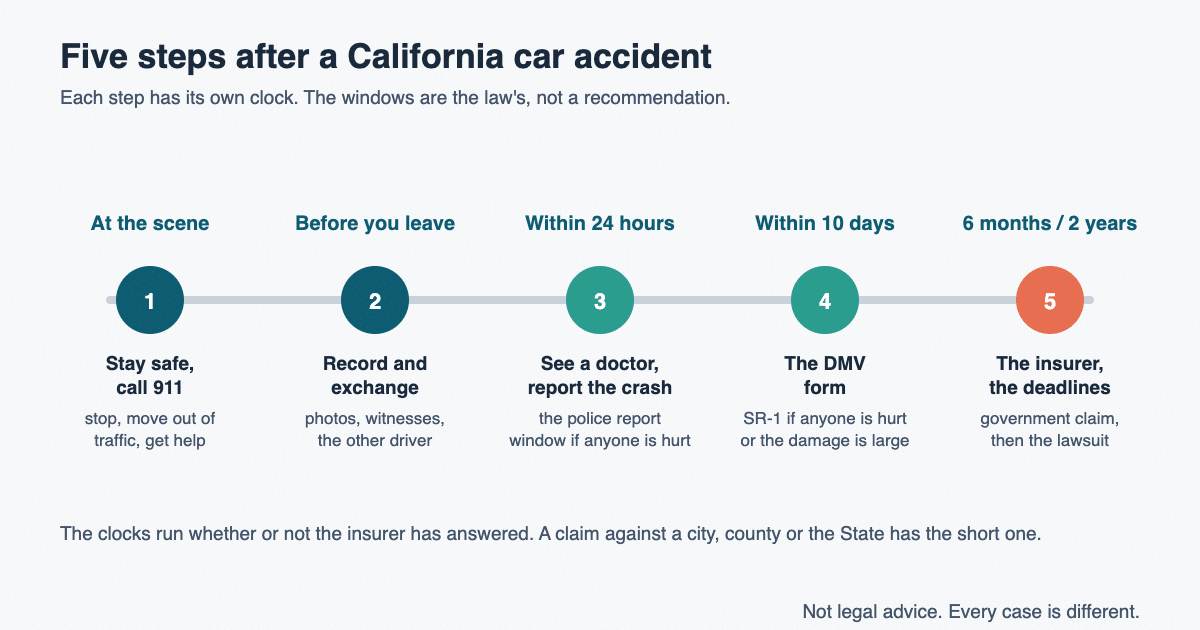
Timeline of the five steps after a California car accident: safety and 911 at the scene, the record and the exchange of information at the scene, the doctor within 24 hours, the DMV SR-1 within 10 days, the government claim within 6 months, and the lawsuit within 2 years

Reviewed by David Gammill, California trial attorney · Last reviewed: October 20, 2026

After a car accident in California, take these five steps in this order: get to safety and call 911 if anyone may be hurt; record the scene while it still exists; exchange the information the law requires and nothing more; see a doctor the same day, even if you feel fine; and report the crash to your own insurer and the DMV on time while saying as little as possible to the other driver’s insurer. Each step protects something the later steps depend on, and the mistakes that cost people the most are made in the first hour and the first week. This guide explains what each step requires, which of them are legal duties, and what the deadlines are.

The Bottom Line

  • Three legal duties at the scene: stop, exchange identification and insurance information, and, if anyone was hurt or killed, make a written report to the police or CHP within 24 hours; an SR-1 goes to the DMV within 10 days when anyone is hurt or damage exceeds $1,000.
  • The record is yours to make: photographs, the other driver’s documents, witness contacts, and your own written account that night are the evidence an insurer cannot rewrite.
  • The doctor visit is the claim: the medical record is the record of your injury, and a gap at the start becomes the insurer’s argument that you were not hurt.
  • Say nothing to the other insurer: you owe the other driver’s insurer no statement, no authorization, and no signature.
  • Two clocks matter later: two years to file a lawsuit, and six months to present a written claim if a city, county, or state vehicle was involved.

If you are reading this from the side of the road, do the first step and the fourth; the rest can wait. If the crash was days ago and something has already gone wrong, call 310-750-4149. The consultation is free.

Timeline of the five steps after a California car accident: safety and 911 at the scene, the record and the exchange of information at the scene, the doctor within 24 hours, the DMV SR-1 within 10 days, the government claim within 6 months, and the lawsuit within 2 years

Step 1: Get to Safety and Call 911

Stop, turn on the hazard lights, and decide whether the cars can be moved. If the vehicles are drivable and nobody is seriously hurt, moving them to the shoulder or a parking lot prevents a second crash, and California law expects drivers to clear a lane when they safely can. If a car cannot be moved, or someone in it should not be moved, stay belted in with the hazards on and wait for help. Do not stand in a traffic lane to take photographs.

Call 911 when anyone is hurt or might be, when a vehicle is blocking traffic, when the other driver seems impaired, when the other driver leaves, or when the damage is more than cosmetic. A police response produces a report with the officer’s diagram, the parties’ statements as given at the scene, and any citation issued, and that report is the single most useful document in the claim that follows. If the police decline to come, which happens on minor crashes, the 911 call itself is a time-stamped record that the crash occurred when you say it did.

Two duties attach at this point. Leaving the scene of a crash that hurt anyone, or that damaged someone else’s property, without stopping and identifying yourself is a crime in California, explained in our guide to Vehicle Code § 20001 and hit-and-run. And a crash that injured or killed anyone must be reported in writing to the police or the CHP within 24 hours, and an SR-1 report goes to the DMV within 10 days when anyone is hurt or property damage exceeds $1,000 (Vehicle Code § 16000). The police report does not satisfy the DMV filing; the SR-1 is a separate form you file yourself, and the DMV can suspend a license for skipping it.

Step 2: Record Everything Before It Disappears

Your phone is the only investigator at the scene, and the scene lasts about twenty minutes. Once the cars are moved and the glass is swept, the physical evidence is gone. Photograph:

  • Every vehicle from several distances: close enough to show the damage, far enough to show where the cars came to rest.
  • License plates, the other driver’s license and insurance card, and the registration if offered.
  • The intersection or roadway: signals, signs, lane markings, skid marks, debris, anything in the road, the weather and the light.
  • The inside of your car: deployed airbags, the seat belt, broken glass.
  • Any visible injury, that day and as it develops.

Then find the witnesses. A bystander who saw the light change is worth more than either driver’s account, and bystanders leave. Get a name, a phone number, and where they were standing. Nearby businesses and homes may have cameras, and that footage is usually overwritten within days; note the locations so a preservation letter can go out.

That night, write down what happened in your own words: the time, the route, the speed, what the other car did, what was said, and how you feel. A voice memo is fine. Memory of a crash degrades fast and in the direction of what people later tell you, and the account you make before anyone has told you anything is the one a lawyer wants.

Step 3: Exchange Information (and Nothing Else)

The law tells you exactly what to give the other driver, and that list is also the limit. Under Vehicle Code § 16025, every driver in a crash must exchange name and current address, driver’s license number, vehicle identification number, the registered owner’s address, and evidence of insurance, meaning the insurer’s name and address and the policy number. Failing to exchange that information is an infraction. Photograph the other driver’s documents rather than copying them by hand.

What you do not owe anyone at the scene is an explanation. State facts to the officer. Do not discuss fault with the other driver, do not apologize as a reflex, do not describe your injuries beyond “I am going to get checked,” and do not sign anything the other driver or a tow operator hands you. An apology at the scene becomes, in the adjuster’s file, an admission, and California reduces your recovery by whatever percentage of fault the insurer can attach to you.

If the other driver refuses to give information, or leaves, do not follow. Note the plate, the make and color, the direction of travel, and the time, call 911, and treat it as a hit-and-run from that moment; our hit-and-run accident page explains the uninsured motorist route and the 24-hour police report it depends on.

Step 4: See a Doctor the Same Day

Go even if you feel fine, because adrenaline is a painkiller and the record starts when you walk in. Neck and back strain from a low-speed collision commonly shows up hours or a day later. A concussion can present as a headache, poor sleep, or trouble concentrating for a week before anyone connects it to the crash. Internal injuries can be silent at first. An emergency room, urgent care, or your own doctor the same day does two things: it catches what you cannot feel, and it creates the first entry in the medical record that will later be the proof of your injury.

From then on, follow the plan. Keep every appointment, fill every prescription, and tell each provider that you were in a crash and when, so the chart says so. Keep the bills, the discharge papers, the imaging reports, and the receipts. A gap in treatment, or a missed referral, becomes the insurer’s argument that you recovered, or that the injury came from somewhere else. Pay for care through your health insurance while the claim is pending; the claim will reimburse the costs later, and waiting to treat until the claim pays is the single most damaging thing an injured person can do.

Step 5: Deal With the Insurers and the Deadlines

Two insurers will contact you, and you owe them very different things.

Your own insurer

Report the crash promptly; your policy requires it, and your own coverage may matter more than you expect. If the other driver had no insurance or not enough, your uninsured and underinsured motorist coverage is the claim. If the other driver fled, that coverage depends on a police report within 24 hours. Give your insurer the facts of the crash, the other driver’s information, and the claim number from the police report. You still do not have to narrate your injuries beyond saying you are being treated.

The other driver’s insurer

Its adjuster will call within a day or two, and the call will be friendly. You owe that insurer nothing: no recorded statement, no medical authorization, no estimate of how you feel, and no signature on a release. Each of those is a tool for reducing the claim. Take the adjuster’s name and number, say you will be in touch, and end the call. The insurer’s clocks run anyway: California’s claims regulations give it 15 calendar days to acknowledge a claim, 40 calendar days after receiving proof of the claim to accept or deny it, and 30 calendar days after acceptance to pay. Those clocks run on the other driver’s liability insurer as well as your own.

Fault, and the rear-end rule

California is a comparative-fault state: your recovery is reduced by your percentage of fault, not barred by it, and that percentage is what the adjuster’s questions are designed to build. If you were struck from behind, the regulations start on your side: a driver whose vehicle was hit in the rear, and who was not convicted of a moving violation in connection with the crash, is presumed not to be principally at fault, and an insurer may not find otherwise unless your conduct was at least 51 percent of the legal cause and it has investigated first. The presumption can be rebutted, which is why the record from Step 2 matters. Our rear-end accident page explains how those claims are built.

The deadlines

Three dates govern the claim after the scene. The SR-1 is due to the DMV within 10 days. If a city, county, or state vehicle or employee was involved, or a road defect contributed, a written claim must be presented to that entity within six months, explained in our guide to the six-month government claim deadline. And a lawsuit for your injuries must be filed within two years of the crash, explained in our guide to Code of Civil Procedure § 335.1. Settlement negotiations do not pause any of them.

What Should I Know About Coverage?

The other driver may have less insurance than your injury is worth. California requires bodily injury coverage of only $30,000 per person and $60,000 per accident, with $15,000 for property damage, for policies issued or renewed on or after January 1, 2025 (Vehicle Code § 16451), and many drivers carry exactly that. When the injury is larger than the policy, the recovery depends on your own underinsured motorist coverage, a second at-fault driver, or an employer or company behind the driver. Finding every policy that applies is a large part of what a lawyer does on a car case, and it is the reason to report the crash to your own insurer even when the crash was not your fault.

When Do I Need a Lawyer?

When anyone was hurt, when fault is disputed, when the other driver is uninsured or fled, when a commercial or government vehicle was involved, or when an offer is on the table and you cannot tell whether it is fair. A no-injury crash with admitted fault and an offer that covers the repair does not need one, and a firm that works on contingency will tell you so. Our guide to whether a minor car accident needs a lawyer works through the line, our guide to choosing a California personal injury lawyer covers the questions to ask, and our guide to no-win, no-fee representation explains what it costs, which is nothing unless the case recovers money.

Frequently Asked Questions

Do I have to call the police after a minor accident in California?

The law requires a written report to the police or CHP within 24 hours only when someone was injured or killed. But calling from the scene is almost always the right move even on a minor crash: the report fixes the facts while the other driver is still agreeable, and if the police decline to respond, the 911 call still records that the crash happened. Our guide to what to do immediately after a car accident in Torrance covers the local reporting routes.

What if the other driver asks to handle it without insurance?

Decline, politely. The offer is usually made by a driver who is uninsured, who has a reason not to involve the police, or who has not yet discovered the damage behind the bumper. Exchange the information the law requires, photograph everything, and report the crash. You can always choose later not to pursue a claim; you cannot recreate the record.

What should I say to the other driver’s insurance adjuster?

Your name, that you were in the crash, that you are being treated, and that you will be in touch. Nothing about fault, nothing about how you feel, and no recorded statement. Our guide to what to do after a car accident that was not your fault goes through the adjuster’s playbook in detail.

How long will the claim take, and what is it worth?

Both depend on the injury, the fault picture, and the coverage. Our guides to how long a California car accident settlement takes and how a California car accident settlement is calculated explain the stages and the arithmetic.

Should I post about the crash online?

No. A photograph of you at a barbecue two weeks after a back injury will be read by the adjuster out of context, and a post saying you are “fine” will be quoted. Stay off the subject until the claim is resolved.

Whatever path your claim takes, download our free guide, Crash Course: A California Car Accident Guide (2026), to keep every deadline and first step in one place.

Related Pages

Our Torrance car accident attorney page explains how the firm handles a crash case from the first call through trial, including the coverage search and the deadlines, for Torrance and the South Bay.

About Gammill Law

David Gammill is a former Los Angeles County Deputy District Attorney who has tried over 100 cases to verdict, first as a prosecutor and then as a trial lawyer for injured people. Every case is different, and past results do not guarantee a similar outcome. Gammill Law Accident & Injury Lawyers represents people in personal injury, wrongful death, and civil rights cases across California, and its attorneys bring more than 40 years of combined legal experience to every case they take. The firm has recovered more than $100 million for California clients across verdicts and settlements. Its results include a $21.1 million wrongful death verdict, a $16 million school sexual abuse verdict, and a $12 million whistleblower retaliation verdict; every case is different, and prior results do not guarantee a similar outcome. You can read more on our case results page. Consultations are free, there is no fee unless the firm recovers, and the firm takes calls in English and Spanish. Call 310-750-4149 or request a free case evaluation.

If you have already taken the first four steps and the fifth is going badly, call 310-750-4149. We will tell you where the claim stands and what to do next.

This page is attorney advertising and general information, not legal advice for any specific situation. Deadlines and outcomes are fact-specific; consult a licensed California attorney about your own circumstances. Prior results do not guarantee a similar outcome.

My name is David Gammill. I am a California trial lawyer and the founder of Gammill Law Accident & Injury Lawyers. Our firm has recovered more than $100 million for California clients. Our results include a $21.1 million wrongful death verdict, a $16 million school sexual abuse verdict, and a $12 million whistleblower retaliation verdict. I learned to try cases in front of juries early in my career as a Deputy District Attorney, and trying cases remains the backbone of my practice.

Ask Gammill AI Calculator