Menu
Call
Contact
Blog

How to Choose the Right Personal Injury Lawyer in California

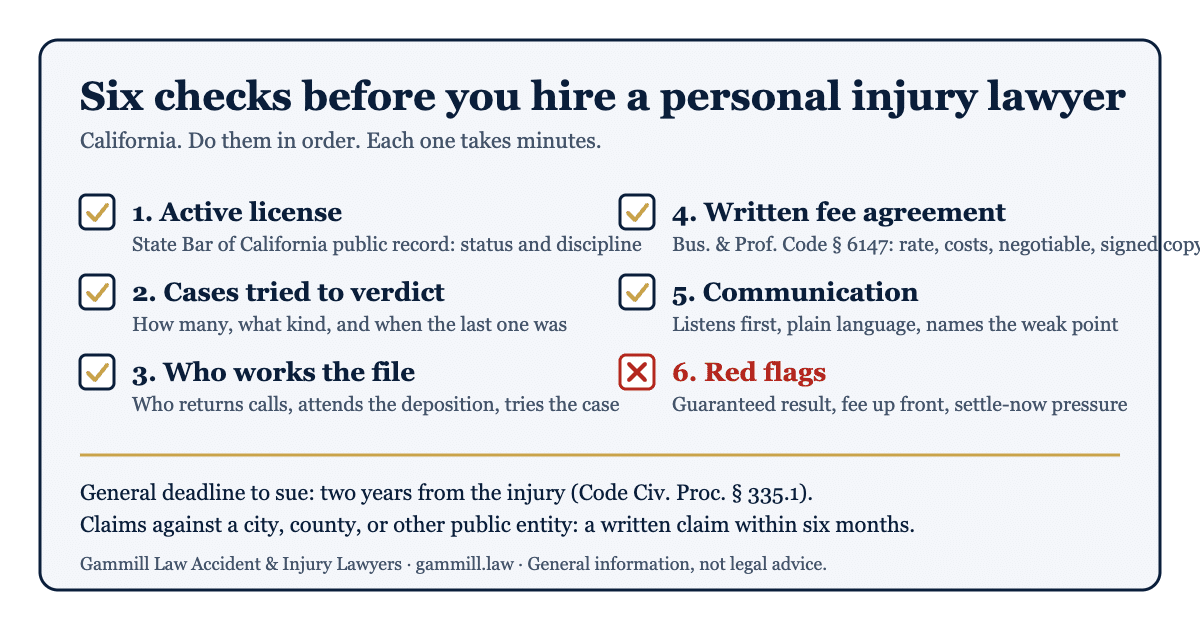
Six checks before you hire a California personal injury lawyer: license, trial record, who works the file, written fee agreement, communication, and red flags

Reviewed by David Gammill, California trial attorney · Last reviewed: October 11, 2026

Choose a personal injury lawyer the way you would choose a surgeon: by what they have actually done in cases like yours, not by the size of the billboard. In California, that means checking the lawyer’s public State Bar record, asking how many cases like yours they have taken to trial and who will work your file day to day, and reading the written contingency fee agreement that state law requires before you sign it. The free consultation exists so you can do all of that before you commit. This guide walks through each step, the questions to ask, and the warning signs that should send you to the next name on your list.

The Bottom Line

  • Check the license first: every California lawyer has a public record with the State Bar of California that shows whether the license is active and whether the lawyer has been disciplined. It takes two minutes.
  • Trial record over slogans: insurance companies pay fair value when they believe a jury will hear the case. Ask how many cases like yours the lawyer has tried to verdict, not how many they have “handled.”
  • Know who works your file: at some firms the lawyer in the ad never touches your case. Ask who will return your calls and who will try the case if it does not settle.
  • The fee agreement is the law, not a formality: Business and Professions Code § 6147 requires a signed written contract that states the rate, explains how costs come out, and tells you the fee is negotiable. Read it before you sign.
  • Red flags end the conversation: a guaranteed result, a fee due up front, pressure to settle before you have finished treating, or a suggestion to exaggerate your injuries.

If you were hurt in California and want a second opinion on a lawyer you are considering, or on an offer you have already received, call 310-750-4149. The conversation is free and confidential.

Six checks before you hire a California personal injury lawyer: license, trial record, who works the file, written fee agreement, communication, and red flags

What Does a Personal Injury Lawyer Actually Do for You?

A personal injury lawyer builds the evidence, deals with the insurance company so you do not have to, and takes the case to trial if the offer is not fair. In practice that means preserving video and records before they disappear, getting your medical treatment documented in a way an adjuster cannot talk around, identifying every policy and every defendant, meeting the deadlines that end a case if they are missed, negotiating from a position the other side takes seriously, and filing suit and trying the case when negotiation stalls. The parts you see are the phone calls and the settlement check. The parts that decide the number are the ones you do not see, which is why the questions below focus on how the lawyer actually works a case rather than how the lawyer describes it.

What Should I Look For in a Personal Injury Lawyer?

Four things, in this order: trial experience, the right kind of case, the person who will actually work your file, and how the lawyer communicates.

Trial experience. Most injury cases settle, and that is exactly why trial experience matters. An insurance company sets its offer by the risk it faces, and the risk is a jury. A lawyer who has not tried cases to verdict has no credible threat to carry into the negotiation, and the adjuster usually knows it. Ask how many cases the lawyer has personally tried to a verdict, in what kinds of cases, and when the last one was. “Handled” and “resolved” are not the same as “tried.”

The right kind of case. A car crash, a fall on commercial property, a dog bite, a wrongful death, and a claim against a city or county each have their own rules, deadlines, and defendants. A claim against a public entity, for example, has a six-month claim requirement that an ordinary car case does not. Ask whether the lawyer has taken your type of case, against your type of defendant, through to the end.

Who works the file. At high-volume firms the attorney in the advertisement signs you up and a case manager handles everything after. That is not always bad, but you should know it before you sign. Ask who will return your calls, who will attend your deposition, and who will stand up in court if the case is tried. Ask to meet that person.

Communication. You will live with this relationship for a year or more. Notice how the first call goes: whether the lawyer listens before talking, explains the process in plain language, answers the fee question directly, and tells you something you did not want to hear. A lawyer who is slow to respond before you are a client will not speed up afterward.

How Do I Check a Lawyer’s License and Discipline History?

Look up the lawyer’s public record on the State Bar of California’s website. Every lawyer licensed in California has a profile there that shows the license status, the year of admission, and any public discipline. The lookup is free and takes a minute, and it answers two questions no advertisement will: whether this person is actually licensed to practice in California right now, and whether the State Bar has ever disciplined them. If the lawyer’s name does not come up, or the record shows anything other than an active license, stop there. Note that the lookup does not tell you anything about trial results or how the lawyer treats clients, so it is the first check, not the only one.

What Questions Should I Ask at the Free Consultation?

Bring these, and write down the answers so you can compare lawyers side by side.

  1. How many cases like mine have you personally tried to a verdict, and when was the last one?
  2. Who will handle my case day to day, and who will try it if it does not settle?
  3. What is your contingency fee rate, and does it change if the case goes to litigation or trial?
  4. How are case costs handled, and do they come out of my share before or after the fee is calculated?
  5. If we lose, do I owe you anything?
  6. What are the deadlines in my case, and has any of them already started running?
  7. What is the weakest part of my case, as you see it right now?
  8. How often will I hear from you, and how do I reach you when I need to?
  9. Have you taken a case against this insurance company or this defendant before?
  10. Can I have a copy of the fee agreement to read at home before I sign it?

The seventh question is the one that separates lawyers. A good one will tell you the weak point without being asked twice, because they are already thinking about how the defense will use it.

How Do Contingency Fees Work, and What Must the Agreement Say?

In a contingency fee arrangement the lawyer is paid a percentage of what is recovered and nothing if nothing is recovered, and California law requires the terms to be in a signed written contract. Business and Professions Code § 6147 requires that a contingency fee contract be in writing and that it state the fee rate you agreed to, explain how costs and disbursements will affect the fee and your recovery, explain whether you could owe the lawyer anything for related matters outside the contract, and tell you that the fee is not set by law and is negotiable between you and the lawyer. The lawyer must give you a copy signed by both of you at the time the contract is made. If the contract leaves any of that out, the law makes it voidable at your option, and the lawyer is then limited to a reasonable fee. Our guide to how no-win, no-fee agreements work in California walks through the statute and a real settlement calculation.

Rates are set by the market, not by statute. Most California personal injury lawyers charge in the range of 33 to 40 percent of the recovery, often with a lower rate if the case settles before a lawsuit is filed and a higher one if it goes to trial. The percentage matters less than two other terms: whether costs are deducted before or after the fee is calculated, which changes your net by real money on a large case, and whether you owe costs if the case is lost. Our page on what a personal injury lawyer costs shows the arithmetic both ways. Read the agreement at home, and if a lawyer will not let you take a copy home before signing, that is your answer.

What Are the Warning Signs?

Six things that should end the conversation.

  • A guaranteed result or a promised number. No lawyer can know what a case is worth at the first meeting, and California’s rules for lawyer advertising bar statements that create unjustified expectations about results. A lawyer who promises a figure is either guessing or selling.
  • A fee due up front. Injury cases are taken on contingency. A retainer or a consultation fee for an ordinary injury claim is a sign the lawyer does not expect to win it.
  • Pressure to settle fast. A settlement before your medical treatment is finished locks in a number before anyone knows what the injury is. Volume firms sometimes push early settlements because the fee is the same for less work.
  • Nobody will say who works the file. If the question “who will try my case” gets a vague answer, assume the answer is nobody.
  • Any suggestion to exaggerate or invent. A lawyer who hints that you should overstate your injuries, see a particular doctor for the paperwork, or leave something out of your account is risking your case and your credibility. Leave.
  • No trial record, or an unwillingness to describe it. A lawyer who has never tried a case can still get you a settlement, but it will be the settlement the insurance company wants to pay.

Can I Switch Lawyers if I Chose Wrong?

Yes. You can discharge your lawyer at any time, and in a contingency case the usual practice is that the two lawyers divide one fee out of the recovery rather than charging you twice. The first lawyer is generally entitled to be paid for the work done, and that payment normally comes out of the fee the new lawyer collects at the end, not out of your pocket in the meantime. Before you switch, ask the new lawyer to confirm in writing how the fee will be split, because the terms depend on your agreements. Switching costs time and is not something to do over a slow week, but staying with a lawyer who is not working the case is more expensive than changing.

Why Does the Timing of This Decision Matter?

Because evidence has a short shelf life and the law has a clock. Store video is overwritten in days or weeks, witnesses move, and vehicles are repaired or scrapped. California’s general deadline to file an injury lawsuit is two years from the injury under Code of Civil Procedure § 335.1, and a claim against a city, county, or other public entity must be presented in writing within six months. Take the time to choose well, but take it in days, not months. A lawyer who is hired early can preserve what a lawyer hired late can only ask about.

Frequently Asked Questions About Choosing a Personal Injury Lawyer

Is a bigger firm a safer choice?

Not by itself. Size tells you about the advertising budget, not about who will work your file. A large firm may have more staff to move paperwork and a small firm may give you the trial lawyer’s direct number. The question is the same at any firm: who, by name, is handling the case, and what have they tried.

Does the lawyer need to be in my city?

No, but the lawyer should know the courthouse where your case will be filed and the defendants and insurers who operate there. A lawyer across the county who tries cases in your courthouse is a better choice than a lawyer down the street who does not. Ask where the case would be filed and whether the lawyer has tried cases there.

The insurance company already offered me money. Do I still need a lawyer?

An early offer is the insurer’s estimate of the least you will accept, made before your treatment is finished and before anyone has valued the claim. Have a lawyer look at it before you sign anything. A signed release ends the claim for good, including for injuries that have not shown up yet.

What does it cost to talk to a lawyer about my case?

At most injury firms, nothing. The consultation is free, and if the firm takes the case it is paid a percentage of the recovery under the written agreement described above. If a firm wants money to evaluate an injury claim, keep looking.

Related Pages

Our Torrance personal injury attorney page explains how the firm handles an injury case from the first call through trial, and which kinds of cases it takes.

About Gammill Law

David Gammill is a former Los Angeles County Deputy District Attorney who has tried over 100 cases to verdict, first as a prosecutor and then as a trial lawyer for injured people. Every case is different, and past results do not guarantee a similar outcome. Gammill Law Accident & Injury Lawyers represents people in personal injury, wrongful death, and civil rights cases across California, and its attorneys bring more than 40 years of combined legal experience to every case they take. The firm has recovered more than $100 million for California clients across verdicts and settlements. Its results include a $21.1 million wrongful death verdict, a $16 million school sexual abuse verdict, and a $12 million whistleblower retaliation verdict; every case is different, and prior results do not guarantee a similar outcome. You can read more on our case results page. Consultations are free, there is no fee unless the firm recovers, and the firm takes calls in English and Spanish. Call 310-750-4149 or request a free case evaluation, and ask us the ten questions above.

If you have questions about a lawyer you have already hired or an agreement you have already signed, call 310-750-4149. We will tell you what the agreement says and what your options are.

This page is attorney advertising and general information, not legal advice for any specific situation. Deadlines and outcomes are fact-specific; consult a licensed California attorney about your own circumstances. Prior results do not guarantee a similar outcome.

My name is David Gammill. I am a California trial lawyer and the founder of Gammill Law Accident & Injury Lawyers. Our firm has recovered more than $100 million for California clients. Our results include a $21.1 million wrongful death verdict, a $16 million school sexual abuse verdict, and a $12 million whistleblower retaliation verdict. I learned to try cases in front of juries early in my career as a Deputy District Attorney, and trying cases remains the backbone of my practice.

Ask Gammill AI Calculator