Hi, my name is David Gammill — injury lawyer.

Getting rear-ended at a red light. Side-swiped on the highway. T-boned by someone running a stop sign. None of it should have happened to you, and yet here you are, staring at a crumpled bumper and a stranger who isn’t making eye contact.
If you’re reading this with a sore neck and a dented car, take a breath. The good news is that California law and the broader U.S. insurance system are set up to make the at-fault driver (or really, their insurance company) pay for it. The bad news is that nobody on the other side is going to volunteer to do that quickly or generously. You have to know how to ask, and the right car accident lawyer can make a significant difference in what you actually recover.
This guide walks through what to do at the scene, in the days that follow, and during the claim process. It also covers a few mistakes that quietly cost people thousands of dollars without them realizing it until much later.
If you only have a minute, here’s the entire process in one quick reference. The rest of the article walks through each step in detail.
| 1 | Check for injuries and call 911
Adrenaline can mask serious injuries. When in doubt, call. |
| 2 | Move to safety and turn on hazards
Get out of active traffic lanes if cars are drivable, but don’t leave the scene. |
| 3 | Call the police, even for minor crashes
An official report is one of the strongest pieces of evidence in your case. |
| 4 | Document everything with photos and video
Capture damage, plates, the scene, road conditions, and any visible injuries. |
| 5 | Exchange information, but don’t apologize
Names, insurance, license plates. Skip the sorrys, even out of habit. |
| 6 | See a doctor the same day
Treatment gaps are the single biggest weapon insurers use against injury claims. |
| 7 | Notify your own insurance company
Most policies require it. A not-at-fault claim shouldn’t raise your rates. |
| 8 | Don’t give a recorded statement to the other insurer
You’re not legally required to. Politely decline and ask for written questions. |
| 9 | Don’t accept the first settlement offer
Early offers are almost always lowball. Wait until you know the full picture. |
| 10 | Talk to a personal injury attorney
Free consultations are standard. Representation usually nets more, even after fees. |
Before anything else, check yourself and your passengers. Adrenaline is a sneaky thing. People walk away from serious crashes feeling “fine” and wake up the next morning unable to turn their head. Whiplash, concussions, and internal bruising often hide for 24 to 72 hours.
If anyone is hurt, call 911. If you’re not sure whether someone is hurt, call 911 anyway. The cost of an unnecessary ambulance is much smaller than the cost of a missed brain injury. Head trauma in particular is worth taking seriously; traumatic brain injuries from car crashes can produce subtle symptoms that worsen over days or weeks.
If the cars are drivable and you’re blocking traffic on a busy road, move to the shoulder or a nearby parking lot. California Vehicle Code requires you to move vehicles out of active lanes when possible if the crash isn’t serious. Turn on your hazard lights.
That said, don’t drive away from the scene before exchanging information and waiting for police if you’ve called them. Leaving can be charged as a hit-and-run, even if you’re the victim.
People skip this step all the time, especially when the other driver is being friendly and saying things like, “Let’s just handle it ourselves.” Don’t fall for it. A police report is one of the strongest pieces of evidence you can have.
Here’s why it matters: the friendly driver who admits fault on the side of the road often becomes a very different person once their insurance company gets involved. Suddenly the story changes. Without an officer’s report documenting what happened, it becomes their word against yours, and insurers love that kind of ambiguity because it lets them reduce or deny payouts.
When the officer arrives, answer their questions honestly but briefly. Stick to the facts: where you were going, what you saw, when the impact happened. Don’t speculate, don’t apologize, and don’t guess at speeds if you’re not sure.
Americans say “sorry” the way other people say “hello.” Most of us apologize when someone bumps into us in a grocery store. Resist the urge after a crash.
Anything you say at the scene can show up later in an insurance investigation. A casual “I’m so sorry, I didn’t see you” can be twisted into an admission of fault, even if the other driver blew through a stop sign. You can be polite and human without saying you’re sorry. Try “are you alright?” or “is everyone okay?” instead.
This is where modern smartphones earn their keep. Properly documenting your personal injury is one of the most important things you can do in the first hour after a crash. Take photos and video of:
Get wide shots that show context and tight shots that show detail. If there are witnesses, ask if they’d be willing to share their name and phone number. Independent witnesses are gold in an insurance dispute.
Swap the following with the other driver:
You don’t need to share where you live or where you work. The insurance companies will handle the rest of the back-and-forth.
This part bears repeating because so many people get it wrong. The single most expensive mistake non-fault drivers make is waiting too long to see a doctor.
If you wait a week before going to urgent care because you thought the soreness would fade, the at-fault driver’s insurer has a ready-made argument: whatever’s wrong with your neck didn’t come from the crash, because if it had, you would have gone to the ER. They’ll use that gap against you, even when it’s medically nonsense.
Go the same day if you can, the next day at the latest. Tell the doctor exactly when and how the accident happened, and describe every symptom, even ones that seem small. Headaches, dizziness, ringing in your ears, trouble sleeping, a stiff back, tingling in your hands. All of it goes in the medical record.
People sometimes hesitate here because they worry that filing a claim with their own insurer will raise their rates. When the accident isn’t your fault, this generally isn’t a concern, and California has rules that limit rate hikes for not-at-fault claims.
You’re not necessarily filing a claim against your own policy. You’re notifying your insurer that something happened, which most policies require you to do. Your insurance company can also help coordinate with the at-fault driver’s insurer, and depending on your coverage, they may pay for repairs, medical bills, or a rental car upfront and then collect from the other side later. This is called subrogation, and it’s usually faster than waiting for the at-fault insurer to pay you directly.
Stick to facts when you call. Don’t guess, don’t editorialize, and don’t accept blame for any part of the crash.
When people talk about “damages” in a car accident case, they’re really talking about two different categories of loss. Insurers, courts, and attorneys treat them very differently, so it’s worth understanding the distinction before you start negotiating.
| Feature | Economic Damages | Non-Economic Damages |
|---|---|---|
| Nature | Tangible financial losses | Intangible personal losses |
| Examples | Medical bills, lost wages, property repair | Physical pain, emotional distress, loss of enjoyment |
| Documentation | Receipts, invoices, pay stubs | Medical records, pain journals, witness testimony |
| Calculation | Sum of documented costs | Multiplier or per diem methods |
Economic damages are the easy part. You add up receipts, bills, pay stubs, and repair estimates, and the number is the number. Non-economic damages are harder to pin down because they cover things you can’t really put on a spreadsheet: pain, sleep loss, the canceled vacation, the inability to lift your kid for three months.
If you’ve ever wondered where settlement numbers come from, the honest answer is that there’s no fixed formula. California juries have wide discretion under CACI No. 3905A, and two methods come up most often. We’ve covered this topic in detail in our guide to pain and suffering damages in California, but here’s the short version.
| MULTIPLIER METHOD
Based on Economic Damages |
PER DIEM METHOD
Daily Value of Suffering |
| Economic Damages × Multiplier (1.5–5) = Award
Example: $50,000 × 3 = $150,000
|
Daily Rate × Number of Days = Award
Example: $200/day × 180 days = $36,000
|
In practice, insurers tend to anchor on the multiplier method because it produces lower numbers. Plaintiff attorneys often argue per diem in front of juries because $200 a day for six months sounds more concrete and relatable than “three times your medical bills.” Both methods are legitimate. Which one results in a better outcome depends on the specifics of your case.
This is where things get interesting. The other driver’s insurer has one job: pay you as little as possible. They are not your friend, even when the adjuster is friendly on the phone (and they will be friendly, because that’s part of the strategy).
An adjuster from the at-fault driver’s insurance company will usually reach out fairly quickly. They want to lock in a statement before you’ve talked to anyone else, before you fully understand your injuries, and before you’ve had time to think.
You’re not legally required to give a recorded statement to the other driver’s insurer. In most cases, you shouldn’t, at least not without legal advice. Politely tell them you’ll provide information in writing once you’ve had a chance to gather it, and end the call.
Early offers are almost always lowball offers. The insurer is betting that you’re stressed, behind on bills, and tempted to take quick cash. Once you sign a settlement release, you can’t go back and ask for more, even if your injuries turn out to be worse than they first seemed.
A reasonable settlement should cover:
If a doctor has said you may need physical therapy for several months, don’t settle until you have a clearer picture of what that’s going to cost.
Not every fender-bender needs a lawyer. If you walked away with no injuries and only minor cosmetic damage to your car, you can often handle the claim yourself. Most personal injury attorneys offer free consultations, though, so there’s no harm in asking.
Consider calling a lawyer if any of these apply:
Most personal injury lawyers in California work on contingency, meaning they only get paid if you win, typically taking around a third of the settlement. That sounds like a lot until you realize that represented claimants tend to recover meaningfully more than unrepresented ones, even after fees, especially when injuries are involved. You can get a quick sense of what your case might be worth using our free injury settlement calculator.
| Hit by Another Driver in California? Know Your Rights.
If you’ve been in a car accident that wasn’t your fault, the at-fault driver’s insurance company should be paying for your medical bills, lost wages, vehicle repair, and pain and suffering. Gammill Law’s car accident attorneys offer free consultations and only get paid if you win your case. |
You generally have the right to choose your own repair shop. The at-fault driver’s insurer might steer you toward one of their “preferred” shops, and that’s fine if you trust them, but you don’t have to go there.
Get an independent estimate if anything feels off. Insurance estimates sometimes miss damage that only shows up once a body shop pulls the bumper off, including bent frames, cracked sensors, or damaged airbag systems. A reputable shop will document supplemental damage and bill the insurer for it.
If the car is totaled, the insurer will offer you what they consider “actual cash value.” This number is often negotiable. Look up comparable vehicles in your area and push back if their offer is below market. Don’t forget to ask about sales tax and title fees, which California law requires the insurer to cover on a total loss.
California has some specific rules that affect how car accident claims play out. Here are the ones that matter most:
California uses what’s called “pure comparative negligence,” which means even if you’re partially at fault, you can still recover damages. Your award is just reduced by your percentage of fault. If a jury finds you 30% responsible and awards $100,000, you walk away with $70,000. Even at 90% fault, you can still recover 10%. This is more generous than what victims get in many other states, which is one of many reasons not to admit anything at the scene.
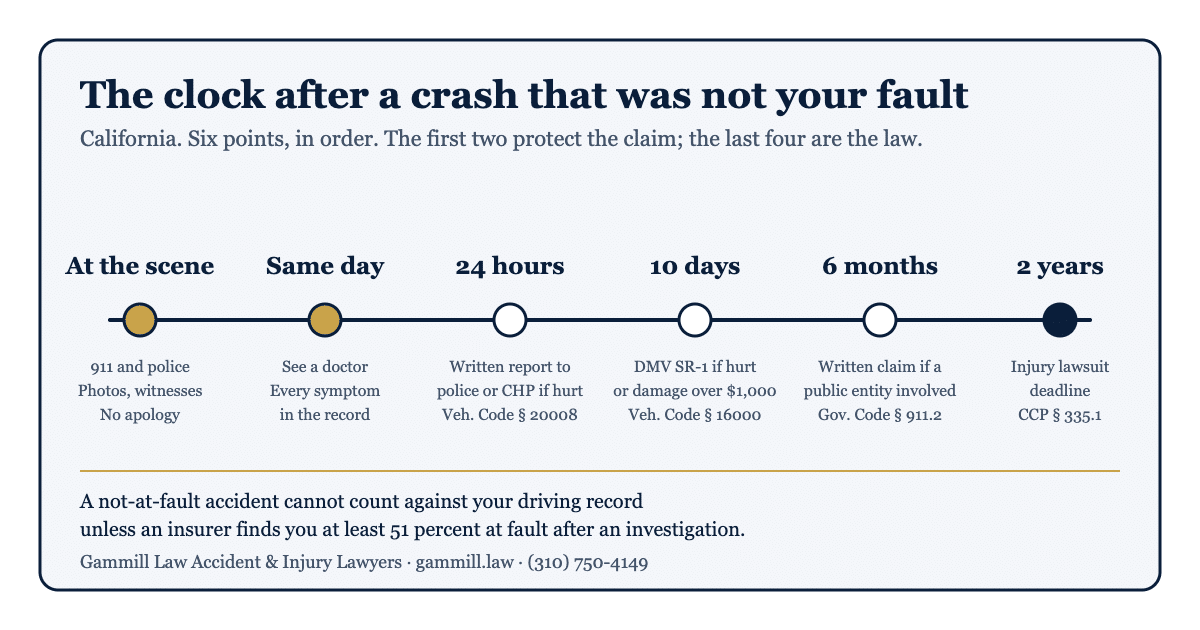
California gives you two years from the date of the crash to file a personal injury lawsuit, and three years for property damage claims. Don’t sit on a serious case. Evidence and witness memories fade fast, and missing the deadline ends your case before it starts. Our guide to California’s statute of limitations explains the exceptions and special rules in detail.
If you were driving uninsured at the time of the accident, Proposition 213 bars you from recovering pain and suffering damages, even if the other driver was 100% at fault. The exception is if the at-fault driver was convicted of a DUI. This is one of the strongest reasons to keep your auto insurance current in California.
Some of these have already come up. They’re worth gathering in one place because they show up over and over again in cases that should have been straightforward. We’ve written a longer breakdown of the 10 most common mistakes to avoid in personal injury claims, but here are the highlights:
Honestly? It depends. A simple property-only claim with clear fault can wrap up in two to six weeks. A claim involving moderate injuries usually takes three to nine months because you need to finish medical treatment before you know what to settle for. Cases that go to litigation can stretch a year or more.
Patience pays here, often literally. The fastest settlement is rarely the best one.
Yes. Most policies require you to report any accident, and your insurer can help coordinate with the other side. Reporting a not-at-fault claim shouldn’t raise your rates in California.
You’re not legally required to give them a recorded statement. You can decline politely and ask them to put their questions in writing, especially if you’re considering hiring a lawyer.
California gives you two years from the date of the crash for personal injury and three years for property damage. Insurance claim deadlines under your own policy are typically much shorter (days to weeks), so check your policy and don’t wait.
If you carry uninsured motorist coverage, your own policy steps in. If you don’t, you may have to sue the driver personally, which often means little practical recovery if they don’t have assets. This is one of many situations where talking to an experienced injury lawyer early can help you understand your real options.
Usually yes. The at-fault driver’s insurer typically covers a rental during the repair period, or your own policy may cover it if you have rental reimbursement coverage.
In California, no. State rules prohibit insurers from raising your rates because of an accident that wasn’t your fault. If your insurer tries to do it anyway, you can challenge it through the California Department of Insurance.