Hi, my name is David Gammill — injury lawyer.

The honest answer to “how long does a car accident settlement take?” is: anywhere from a few weeks to a few years. That range isn’t a dodge. It reflects how different cases actually move.
A simple property damage claim can wrap up in a month. A serious injury case that goes to trial can take three years or more. Most cases land somewhere in the middle, and which factors apply to your situation will tell you roughly where on that spectrum to expect.
This guide walks through realistic timelines for different types of cases, the specific stages that take time, what speeds things up, what slows them down, and what you can do (with or without a car accident lawyer) to keep your case moving.
Here’s a realistic breakdown of how long different kinds of cases take. These are typical ranges, not promises. Your specific case could be faster or slower depending on factors we’ll cover below.
| Case Type | Typical Timeline | Why It Takes That Long |
|---|---|---|
| Property damage only | 2 to 6 weeks | Repair estimates and clear fault speed things up |
| Minor soft-tissue injury | 3 to 6 months | Need to complete physical therapy before settling |
| Moderate injury | 6 to 12 months | Surgery, longer treatment, more documentation |
| Severe injury, no lawsuit | 9 to 18 months | Permanent injury requires expert evaluations |
| Lawsuit filed | 1 to 2 years | Discovery phase adds depositions and motions |
| Trial verdict | 2 to 3+ years | Court calendar, appeals, post-verdict motions |
Whether your case takes two months or two years, it generally moves through the same six stages. The length of each one varies, but the sequence is consistent.
| 1 | Medical treatment and recovery
Usually the longest single phase. You can’t accurately settle until you know the full extent of your injuries. |
| 2 | Investigation and evidence gathering
Police reports, witness statements, medical records, and expert opinions are collected. |
| 3 | Demand letter and initial negotiation
Once treatment ends, your attorney sends a demand to the insurer. The first counteroffer typically arrives within 30 to 60 days. |
| 4 | Negotiation back-and-forth
Several rounds of offers and counteroffers, usually spanning 2 to 6 months for moderate cases. |
| 5 | Lawsuit and discovery (if needed)
If negotiation fails, a lawsuit is filed. Discovery (depositions, document exchange) adds 6 to 18 months. |
| 6 | Settlement, trial, or mediation
Most cases settle before trial. If yours goes the distance, the verdict and any appeals can extend the timeline by another year or more. |
This is the single most important thing to understand about settlement timing: you generally shouldn’t settle until you’ve reached what’s called Maximum Medical Improvement, or MMI. MMI is the point at which your doctor says you’ve recovered as much as you’re going to, or that any remaining condition is permanent.
Settling before MMI is usually a mistake because once you sign a settlement release, you can’t go back and ask for more, even if your injuries turn out to be worse than you thought. If you settle in month two for $20,000 and then need surgery in month four, you’re paying for that surgery yourself.
So the rule of thumb is: the longer your medical treatment, the longer your settlement takes. There’s no shortcut around this, and the lawyers who push settlements before treatment ends are usually the ones not serving their clients well.
Some factors push cases toward faster resolution:
And these typically delay things:
Your attorney spends this time pulling police reports, gathering medical records, identifying witnesses, and preserving evidence. In simple cases, this can wrap up in a few weeks. In complex cases involving multiple vehicles or commercial drivers, it can take longer.
This is the variable phase. Soft-tissue injuries with physical therapy might resolve in 3 to 6 months. Surgery cases often need 6 to 12 months of recovery before MMI. Permanent injuries can require ongoing evaluation that stretches far longer.
Once treatment is done, your attorney drafts a demand letter laying out the case and asking for a specific amount. Insurers typically take 30 to 60 days to respond, sometimes longer if they’re dragging their feet.
Several rounds of counteroffers and back-and-forth. Most cases settle in this phase. The pace depends on how cooperative the insurer is and how aggressively your attorney pushes.
If negotiation fails, your attorney files a lawsuit. Discovery (the formal exchange of evidence and depositions) usually takes 6 to 12 months. Most lawsuits still settle during this phase rather than going to trial.
If the case actually reaches trial, the trial itself might take a few days to a few weeks, but waiting for a court date can add many months due to crowded calendars.
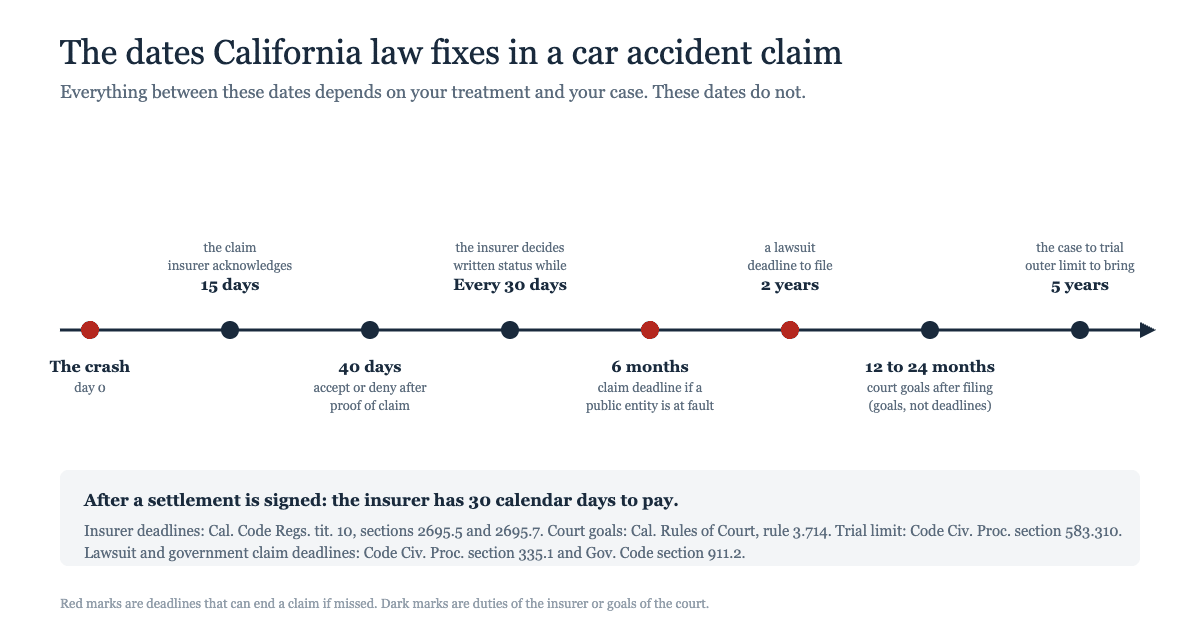
Once you sign a settlement release, the insurer typically has 30 days to issue payment. Your attorney then deposits the check, settles any medical liens, deducts their fee and expenses, and disburses the rest to you. From signed agreement to money in your account is usually 4 to 8 weeks.
| Wondering How Long Your Specific Case Will Take?
Every case is different. A free consultation takes 20 minutes and gives you a realistic timeline based on your specific situation, not a generic guess. Reach out to Gammill Law’s car accident attorneys for a free, no-obligation case review. |
While your case is moving forward, another clock is running in the background. The California statute of limitations gives you two years from the date of the crash to file a personal injury lawsuit, and three years for property damage. If your settlement negotiations stretch close to that deadline, your attorney will file a lawsuit to preserve your rights, even if both sides are still negotiating in good faith.
This is one of many reasons not to delay hiring an attorney. The longer you wait to start the process, the less time everyone has to investigate, negotiate, and resolve the case before the deadline forces a lawsuit.
Almost never. Insurers know that injured people are often stressed about bills and tempted to take quick cash. The first offer is usually 25% to 50% of what your case is actually worth, and it’s specifically designed to close the file before you understand your full damages.
A reasonable settlement should cover:
If the first offer doesn’t include reasonable amounts for all of these, it’s almost certainly a lowball that should be countered, not accepted.
Some of these are surprising. We’ve covered them in detail in our guide to common personal injury claim mistakes, but the ones that most often delay settlements:
Most California car accident settlements resolve in 3 to 12 months. Property damage claims are typically faster (a few weeks). Serious injury cases often take 12 to 24 months, especially if a lawsuit is filed. Cases that go to trial can take 2 to 3 years.
Most often it’s because medical treatment isn’t complete yet, you can’t accurately settle until you know the full extent of your injuries. Other common causes are disputed fault, multiple insurance policies, and insurers known for slow-walking claims.
Pre-settlement funding companies offer advances, but the interest rates are typically very high. Most attorneys recommend avoiding them unless you genuinely cannot pay essential bills. A better option is often negotiating with medical providers to wait for payment until settlement (a medical lien).
Typically 4 to 8 weeks. The insurer issues the check, your attorney deposits it, settles any medical liens, deducts their fee and expenses, and disburses the rest to you. The settlement of liens is often the slowest part.
Your attorney will file a lawsuit to preserve your rights, even if you’re still negotiating. Filing a lawsuit doesn’t mean the case is going to trial. It just stops the clock.
Sometimes, yes. Lawyers don’t accept the first lowball offer, and they take time to build the case properly. The trade-off is that the longer process usually produces substantially higher compensation. If you want to understand the math more precisely, you can use our free injury settlement calculator for a quick estimate.
Most car accident settlements take longer than people expect. That’s not a flaw in the system, it’s a feature. Faster usually means lower. If your case is being thoroughly investigated, your treatment is being properly documented, and your attorney is pushing for fair value, the time it takes is part of what makes the result worth waiting for.
If you want a realistic timeline for your specific case, the fastest way to find out is a free consultation. Twenty minutes on the phone tells you more than any general guide can.