Menu
Call
Contact
Blog

How Is a Car Accident Settlement Calculated in California?

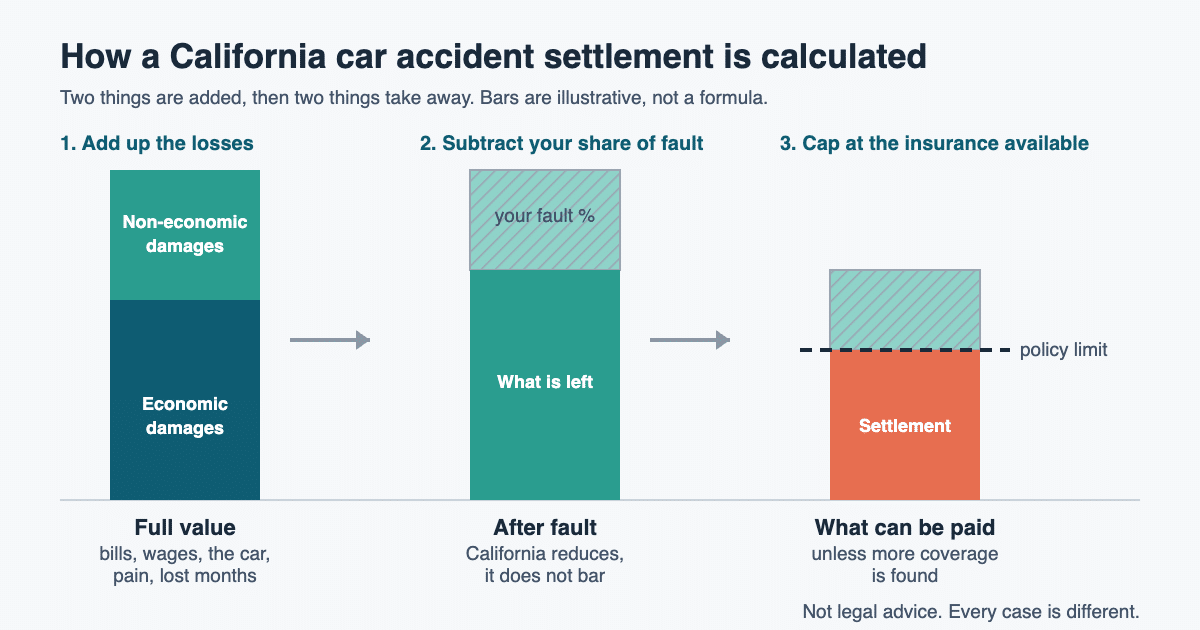
Diagram of how a California car accident settlement is calculated: economic damages plus non-economic damages, reduced by the injured person's percentage of fault, then capped by the insurance policy limits available to pay

Reviewed by David Gammill, California trial attorney · Last reviewed: October 20, 2026

A California car accident settlement is calculated in three steps: add up the economic losses the crash caused, put a dollar value on the non-economic harm (the pain, the lost months, the things you can no longer do), and then apply two reductions that most online calculators ignore, your own share of fault and the policy limits available to pay. There is no formula that turns medical bills into a settlement number, and any tool that claims one is guessing. This guide explains what goes into each step, how insurers and lawyers actually value the subjective part, and why two crashes with the same bills can settle for very different amounts.

The Bottom Line

  • Two kinds of damages: economic damages are the losses with a receipt (medical bills, lost wages, the car), and non-economic damages are the losses without one (pain, suffering, a life that is smaller than it was).
  • The subjective part is usually the larger part: on a serious injury, the value of what you lost in daily life routinely exceeds the medical bills, which is why a bills-times-a-number shortcut undervalues real cases.
  • Fault reduces the number: California cuts your recovery by your percentage of fault, and the insurer’s first job is to build that percentage.
  • Policy limits cap it: a claim is worth what a jury would award only if there is coverage to pay it; the minimum policy in California is $30,000 per person.
  • Punitive damages are the exception, not the rule: they require proof of malice, oppression, or fraud, and in car cases that usually means a drunk driver.

If you want a number for your own crash instead of a method, call 310-750-4149. The consultation is free, and the first thing you will get is a candid read on what the claim is worth and what is in the way.

Diagram of how a California car accident settlement is calculated: economic damages plus non-economic damages, reduced by the injured person's percentage of fault, then capped by the insurance policy limits available to pay

What Is Included in a Car Accident Settlement?

Everything the crash cost you, and everything it took from you. California law sorts those into two categories, and the sorting matters because the two are valued differently, argued differently, and, when more than one driver is at fault, paid differently.

Economic damages

Economic damages are the objectively verifiable monetary losses: the ones that come with a bill, a pay stub, or an estimate. In a car case they usually include:

  • Medical expenses already incurred, from the ambulance through the last physical therapy visit.
  • Future medical expenses, where a doctor can say what treatment the injury will need and roughly what it will cost.
  • Lost wages for the time you could not work, and lost earning capacity if the injury changes what work you can do.
  • Repair or replacement of the vehicle and anything in it.
  • Out-of-pocket costs: prescriptions, mileage to appointments, help around the house you had to pay for.

Economic damages are added, not estimated. The dispute is rarely about arithmetic; it is about whether each item belongs on the list. Insurers argue that a treatment was unnecessary, that a bill was inflated, that you could have gone back to work sooner. The answer to each argument is a record, which is why the first weeks after a crash matter so much. Our guide to what to do after a car accident that was not your fault walks through building that record from day one.

Non-economic damages

Non-economic damages are the subjective, non-monetary losses: pain, suffering, inconvenience, emotional distress, loss of enjoyment of life, and loss of consortium (the effect on a spouse or partner). California law defines both categories in Civil Code § 1431.2, and the same section sets a rule that matters when two drivers share the blame: each defendant is liable only for its own percentage of the non-economic damages, while economic damages can be collected in full from any defendant found at fault. That is why a case with two negligent drivers is valued policy by policy, not as one pot.

There is no receipt for pain and suffering, so there is no column to total. The value is whatever a reasonable jury in your county would award for your injury, on your facts, and the settlement number is each side’s prediction of that award. On a sprain that resolved in six weeks, the prediction is modest. On a fracture that needed surgery, a scar you will see every day, or a back that will never carry a child again, the non-economic damages are usually the largest part of the claim.

Punitive damages

Punitive damages are different in kind. They are not meant to compensate you; they are meant to punish the defendant and deter others, and they are available only where the defendant acted with malice, oppression, or fraud. Ordinary negligence, even careless negligence, does not qualify. In car cases the usual path is a drunk driver who chose to drive knowing the risk. Our guide to Civil Code § 3294 and punitive damages explains the standard and the proof it takes.

How Are Pain and Suffering Damages Calculated in California?

They are argued, not computed, and the two shortcuts you will read about online are negotiating positions, not law. California gives juries no formula for non-economic damages. The jury instruction tells them to use their judgment, and the only real constraint is that the number has to be reasonable on the evidence. Everything else is a way of talking about that judgment before a jury ever sees the case.

The multiplier method takes the economic damages and multiplies them by a factor that is supposed to reflect severity. The per diem method assigns a daily value to living with the injury and multiplies by the number of days until recovery. Adjusters use versions of both because they are fast, and they produce low numbers on exactly the cases where the injury is serious and the bills are not: a concussion treated with rest, a disc injury that was managed without surgery, a scar. A lawyer uses neither as the ceiling. The case is valued on what the injury did to your life, proven through your doctors, your employer, your family, and your own testimony, and compared against what juries in the same courthouse have done on similar injuries.

The practical consequence: if you have been handed a number that seems to be your medical bills times something, you have been handed the insurer’s opening position, and it is almost never the value of the claim.

What Factors Change the Settlement Amount?

Five things move the number more than anything else. Three of them are about the injury; two are about who pays.

  • The severity and permanence of the injury. A broken bone that heals is valued differently from one that leaves a limp; an injury with a surgical recommendation is valued differently from one managed conservatively. Permanence is the single biggest driver of non-economic value.
  • The medical record. A gap between the crash and the first visit, missed appointments, or a doctor’s note that the patient “feels fine” each become an argument that the injury was minor or came from somewhere else. The claim is only as strong as the chart.
  • Lost income and the future. A documented loss of earnings, or a credible opinion that the injury limits future work, adds economic damages that are hard to dispute and raises the whole claim.
  • Your share of fault. California reduces your recovery by your percentage of fault rather than barring it. A $200,000 claim with 25 percent fault on your side pays $150,000. Adjusters build that percentage out of the police report, the recorded statement you did not have to give, and any gap in your account. On a rear-end crash the law starts on your side: a driver struck from behind who was not convicted of a moving violation is presumed not to be principally at fault, and an insurer may not treat a driver as principally at fault unless that driver was at least 51 percent of the legal cause and the insurer investigated first; the presumption can be rebutted.
  • The insurance available. A claim is worth what can be collected. California requires only $30,000 per person and $60,000 per accident for bodily injury, with $15,000 for property damage, for policies issued or renewed on or after January 1, 2025 (Vehicle Code § 16451). Many drivers carry the minimum. When the injury is worth more than the policy, the search turns to your own underinsured motorist coverage, a second at-fault driver, an employer whose employee was driving, or, for a rideshare car or a commercial truck, the company’s policy.

How Does the Settlement Process Actually Work?

The number is set near the end, after the medical picture is complete, by a demand that puts the whole claim in one place. That order is deliberate. Once a release is signed the claim is closed, including for treatment that turns out to be needed later, so a lawyer will not demand until the doctors can say what the future holds.

The demand letter sets out the facts, the liability, every economic item with its proof, and the non-economic damages with the evidence that supports them, and asks for a figure. California’s claims regulations give the insurer 40 calendar days after it receives proof of the claim to accept or deny it, with written notice if it needs more time. What follows is a negotiation, and the insurer’s first offer is a test of whether you will take it. If the gap does not close, the case is filed in court before the deadline, and most filed cases still settle, often after the defense has seen the evidence it refused to credit at the demand stage. Our guide to how long a California car accident settlement takes covers each of those stages and the clocks that run during them.

Can an Online Calculator Tell Me What My Case Is Worth?

It can give you a starting range; it cannot give you a value. A calculator does not know whether your fracture will heal cleanly, whether the other driver had the minimum policy, whether there is a second defendant, or how juries in your courthouse treat your kind of injury, and those four facts are most of the number. Our free injury settlement calculator goes further than the bills-times-a-number tools by asking about the injury itself and the facts of the crash, and it will give you a useful range to bring to a consultation. It is not a prediction, and no honest tool is.

How Much of the Settlement Do I Keep?

The gross settlement minus the attorney’s fee, the case costs, and any medical liens, in that order. Most California personal injury lawyers work on a contingency fee in the range of 33 to 40 percent of the recovery, set out in a written agreement before any work starts; our guide to no-win, no-fee representation explains the percentages, how costs are handled, and what the agreement has to say under California law. Medical providers and health insurers who paid for treatment may hold liens against the recovery, and negotiating those down is part of the work.

Whether a lawyer leaves you with more than you would have had alone is arithmetic. With a one-third fee, the represented recovery has to exceed one and a half times the insurer’s offer plus one and a half times the case costs before you net more. On a no-injury repair claim that rarely happens, and a firm that works on contingency will tell you to handle it yourself. On an injury claim with a low offer it usually does, because the items the offer left out are larger than the fee. Our guide to whether a minor car accident needs a lawyer works through that decision.

What Can I Do to Protect the Value of My Claim?

Five things, most of them in the first two weeks.

  1. See a doctor promptly and follow the plan. The record of your treatment is the record of your injury. A gap at the start, or a stretch of missed appointments, becomes the insurer’s argument that you were not hurt.
  2. Do not give the other driver’s insurer a recorded statement. You are not required to, and the questions are written to produce a fault percentage and an “I felt fine” quote.
  3. Do not sign a broad medical authorization. The insurer needs records for the crash injury, not your history; a prior back strain in an old chart becomes the cause of your current pain.
  4. Keep everything. Bills, receipts, pay stubs, the repair estimate, photographs of the injuries as they heal, and a short written note each week of what you could not do.
  5. Do not settle before the medical picture is complete. The early offer exists because the release is final; the treatment that follows the release is yours to pay.

Frequently Asked Questions

Is there an average car accident settlement in California?

No figure you will read is reliable, and the averages published online are drawn from whatever cases a website chose to count. Settlements range from a few thousand dollars on a soft-tissue claim with a quick recovery to seven figures on a catastrophic injury with clear liability and coverage to pay it, and an average of that range describes nobody’s case. The useful question is what your injury, your fault picture, and the available coverage support.

How long do I have to settle a car accident claim?

The settlement itself has no deadline, but the lawsuit that backs it does. A personal injury lawsuit in California must be filed within two years of the crash, explained in our guide to Code of Civil Procedure § 335.1, and if a city, county, or state vehicle was involved, a written claim must be presented within six months, explained in our guide to the six-month government claim deadline. An insurer that is still “evaluating” at month 23 is not confused about the calendar.

Does a car accident settlement include my car?

It can, but property damage is usually handled as a separate claim and settled first, because the repair estimate is not in dispute the way the injury is. Settling the property claim does not close the injury claim as long as the release you sign is limited to the vehicle. Read it before you sign it.

Will I have to pay taxes on the settlement?

Compensation for a physical injury is generally not taxable income, while portions attributed to lost wages, interest, or punitive damages can be. How a settlement is allocated among those categories affects the answer, and a tax professional should look at the agreement before it is signed.

What if the other driver was uninsured?

The claim moves to your own uninsured motorist coverage, if you carry it, and your own insurer now sits across the table from you with the same incentives the other driver’s insurer would have had. The valuation method is the same; the policy limit is now yours.

Should I accept the first offer?

Almost never, and never before you know whether you are hurt. The first offer is priced on the treatment you have had and nothing else, and it arrives early because a signed release is final. Get the medical picture complete, get a candid read on the value, and then decide. Our guide to choosing a California personal injury lawyer covers the questions to ask whoever gives you that read.

Whatever path your claim takes, download our free guide, Crash Course: A California Car Accident Guide (2026), to keep every deadline and first step in one place.

Related Pages

Our Torrance car accident attorney page explains how the firm handles a crash case from the first call through trial, including the coverage search and the deadlines, for Torrance and the South Bay.

About Gammill Law

David Gammill is a former Los Angeles County Deputy District Attorney who has tried over 100 cases to verdict, first as a prosecutor and then as a trial lawyer for injured people. Every case is different, and past results do not guarantee a similar outcome. Gammill Law Accident & Injury Lawyers represents people in personal injury, wrongful death, and civil rights cases across California, and its attorneys bring more than 40 years of combined legal experience to every case they take. The firm has recovered more than $100 million for California clients across verdicts and settlements. Its results include a $21.1 million wrongful death verdict, a $16 million school sexual abuse verdict, and a $12 million whistleblower retaliation verdict; every case is different, and prior results do not guarantee a similar outcome. You can read more on our case results page. Consultations are free, there is no fee unless the firm recovers, and the firm takes calls in English and Spanish. Call 310-750-4149 or request a free case evaluation.

If you have an offer in hand and no way to tell whether it is fair, call 310-750-4149. We will tell you what the claim is worth and whether the offer is close.

This page is attorney advertising and general information, not legal advice for any specific situation. Deadlines and outcomes are fact-specific; consult a licensed California attorney about your own circumstances. Prior results do not guarantee a similar outcome.

My name is David Gammill. I am a California trial lawyer and the founder of Gammill Law Accident & Injury Lawyers. Our firm has recovered more than $100 million for California clients. Our results include a $21.1 million wrongful death verdict, a $16 million school sexual abuse verdict, and a $12 million whistleblower retaliation verdict. I learned to try cases in front of juries early in my career as a Deputy District Attorney, and trying cases remains the backbone of my practice.

Ask Gammill AI Calculator