Menu
Call
Contact
Blog

Can You Claim a Car Accident Without a Police Report in California?

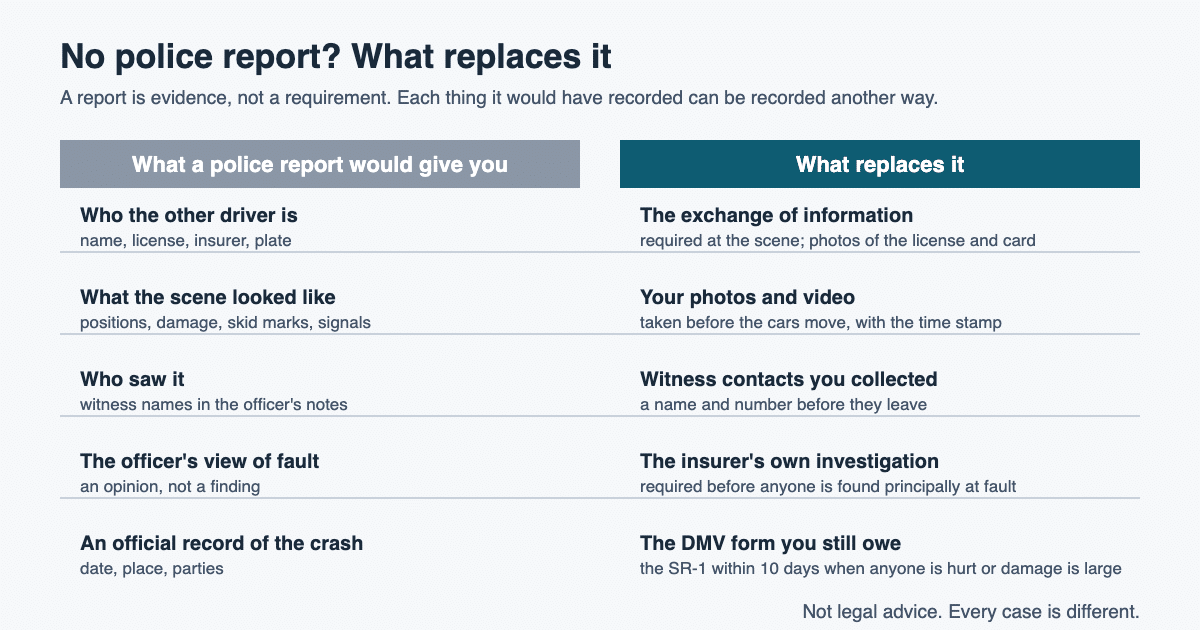
Two-column graphic: what a police report would have recorded after a California car accident (positions, statements, citation, witnesses, injuries) and what replaces each item when there is no report (photographs, the drivers' documents, your own written account, witness contacts, camera footage, the medical record)

Reviewed by David Gammill, California trial attorney · Last reviewed: October 20, 2026

Yes, you can claim a car accident without a police report in California. No law requires one to file an insurance claim or a lawsuit, and insurers pay claims without them every day. What a police report gives you is an independent record of who was where, what each driver said before an adjuster coached them, and whether anyone was cited, and without it you have to build that record yourself, quickly. There is one exception that catches people: a hit-and-run claim under your own uninsured motorist coverage requires that the crash was reported to the police within 24 hours. This guide explains what replaces the report, what you still have to file, and how an insurer behaves when the report is missing.

The Bottom Line

  • No report, still a claim: a police report is evidence, not a requirement, for an insurance claim or a lawsuit. If an officer did write one in Torrance, see how to get a Torrance police accident report.
  • One claim does require it: an uninsured motorist claim for a hit-and-run depends on a police report within 24 hours and a sworn statement to your insurer within 30 days.
  • The DMV is separate: a crash that injures anyone or causes more than $1,000 in property damage must be reported on an SR-1 within 10 days whether or not police came, and the DMV can suspend a license for skipping it.
  • Evidence replaces the report: photographs, the other driver’s documents, witnesses, camera footage, your own written account, and your medical record do the report’s work.
  • The insurer must still investigate: California’s rating rules bar an insurer from treating you as principally at fault for a crash it has not investigated, report or no report.

If the police never came and the other driver’s story has already changed, call 310-750-4149. The consultation is free, and the first job is to find the evidence that still exists.

Two-column graphic: what a police report would have recorded after a California car accident (positions, statements, citation, witnesses, injuries) and what replaces each item when there is no report (photographs, the drivers' documents, your own written account, witness contacts, camera footage, the medical record)

When Is a Police Report Required in California?

Only when someone was hurt or killed, and even then the duty is to report, not to have an officer respond. A crash that injured or killed anyone must be reported in writing to the police or the CHP within 24 hours, and an SR-1 report goes to the DMV within 10 days when anyone is hurt or property damage exceeds $1,000 (Vehicle Code § 16000). The two filings are independent of each other and of whether an officer came to the scene. A property-damage-only crash with no injury carries no police-report duty at all; it may still carry the SR-1 duty if the damage crosses the $1,000 line, and most repairs do.

Separately, every driver in a crash must exchange name, address, driver’s license number, vehicle identification number, the registered owner’s address, and insurance information at the scene under Vehicle Code § 16025, and a driver who leaves without doing so has committed the offense explained in our guide to Vehicle Code § 20001 and hit-and-run. If the other driver exchanged that information and left, there was no hit-and-run and there may have been no duty to call anyone; your claim is simply a claim without a report.

Why Do Police Reports Help a Claim?

Because an officer has no stake in the outcome, and wrote things down before anyone had a reason to change them. A collision report typically records where the vehicles came to rest, a diagram, the road and weather conditions, each driver’s statement as given at the scene, any citation issued, the names and contact information of witnesses, and whether anyone complained of pain. Each of those items becomes an argument later. The other driver’s roadside admission is in the report; the adjuster’s version of it is not. A citation to the other driver is close to a finding of fault. A note that you complained of neck pain at the scene answers the claim that your injury appeared only after you called a lawyer.

None of that is unavailable without a report. It is just harder to get, and it has to be gathered before it disappears.

Why Would a Crash Have No Police Report?

Usually because the police were called and did not come, or because nobody called. Many departments do not respond to crashes with no injury and no blocked lane, and in the City of Los Angeles minor crashes are routed to an online reporting system; LAPD’s own snapshot counted 14,671 online submissions in 2026 through the first week of May. Other common reasons: the other driver talked you out of calling, the crash seemed minor until the bumper came off, it happened in a parking lot or on private property where police often decline to respond, it was a hit-and-run and the driver was gone before you could get a plate, or you were taken to the hospital before anyone took a report. In each case the claim is viable. In the hit-and-run case the report is also mandatory, as the next section explains.

What If the Driver Hit Me and Left?

Report it to the police within 24 hours, even if you got nothing but a color and a direction; your own insurance depends on it. When the driver who hit you cannot be identified, the claim is made against your own uninsured motorist coverage, and California sets three conditions for that claim when the other driver is unknown: the injury must have come from physical contact between the other vehicle and you or the vehicle you were in; the crash must have been reported within 24 hours to the police department of the city where it happened, or to the sheriff or the CHP if it was outside a city; and a sworn statement describing the facts must be filed with your insurer within 30 days after that (Insurance Code § 11580.2). Miss the 24-hour report and the insurer has a defense to the whole claim.

The report also starts the only process that might find the driver. A partial plate, a vehicle description, and the location are often enough once a detective pulls the cameras on the nearest arterial, and a found driver means a liability policy instead of your own. Our hit-and-run accident page covers the uninsured motorist route in detail.

How Do I Build a Claim Without a Police Report?

Replace each thing the report would have recorded with something else, starting today. It does not matter if the crash was last week; the evidence that still exists is worth more than the evidence that is gone.

  • Photographs and video. Whatever you took at the scene, and the damage to both vehicles now, before repairs. If you can safely return to the location, photograph it as it is, including signals, signs, and any camera you can see.
  • The other driver’s documents. The license, the insurance card, the plate. If you have only a name, the insurer can often be identified from the plate.
  • Your own written account. Write it now, dated: the time, the route, the speed, what the other car did, what was said. A late account is weaker than a same-night one and far stronger than none.
  • Witnesses. Anyone you spoke to at the scene, anyone visible in your photographs, employees of nearby businesses. People who saw a crash will usually say so if asked within the week.
  • Camera footage. Intersections, businesses, apartment buildings, buses, and doorbells. Footage is routinely overwritten within days, which is why a preservation letter from a lawyer in the first week is worth more than anything a lawyer does later.
  • The other driver’s own words. A text that says “sorry about your car,” a voicemail, a message through an insurance app. Save all of it.
  • The other driver’s insurance file. If the other driver reported the crash to their own insurer, that report exists and can be obtained in the claim or, if a lawsuit is filed, through discovery.
  • The medical record. See a doctor now if you have not. A report says you complained of pain; a chart says a physician found it, and the chart is the stronger document.

You can also file your own report after the fact. Most departments will take a counter report, a walk-in or online statement from a driver about a past crash. It is your account, not an officer’s investigation, and an adjuster knows the difference, but it is a dated, official record that the crash happened and what you said about it, and it answers the argument that you made the crash up later. In Los Angeles, the online system above is the route; elsewhere, call the non-emergency line and ask. Our guide to what to do immediately after a car accident in Torrance covers the local desk.

What Does an Insurer Do When There Is No Police Report?

It takes its own driver’s word, argues that you were partly at fault, and offers less. Not because the report is magic, but because without it the crash is one account against another, and an adjuster is paid to resolve that doubt in the insurer’s favor. Expect the other driver’s story to have improved, the impact to be described as minor, and your injury to be questioned.

Two rules push back. California’s insurance regulations bar an insurer from treating a driver as principally at fault for a crash unless that driver’s conduct was at least 51 percent of the legal cause and the insurer has investigated first, and the fault finding is only allowed where the crash caused injury or more than $1,000 in damage. On a rear-end crash the regulations go further: a driver struck from behind who was not convicted of a moving violation in connection with the crash is presumed not to be principally at fault, and the presumption can be rebutted only on evidence. The claims regulations also run a clock: 15 calendar days to acknowledge the claim and 40 calendar days after proof of the claim to accept or deny it, with written reasons. An adjuster who says “we cannot do anything without a police report” is describing a preference, not a rule, and the response is to send the evidence above and ask for the written determination the regulations require. Our guide to what to do after a car accident that was not your fault covers the rest of the adjuster’s playbook, and our rear-end accident page explains how the presumption is used.

What About Parking Lots and Private Property?

The same claim, usually with no officer and often with a camera. Police frequently decline to respond to crashes in lots, garages, and apartment complexes, and the Vehicle Code’s right-of-way rules apply only loosely off the public street, so fault is argued from the geometry: who was in a lane of travel, who was backing, who had stopped. The SR-1 duty still applies when anyone is hurt or damage exceeds $1,000. Lots are also the most camera-covered places in the city; the store, the garage, and the complex almost always have cameras, and the footage is gone in days. Ask the property manager for it in writing the same day, and have a lawyer send a preservation letter if the manager hesitates.

What If the Other Driver Says the Crash Never Happened?

This is the case a missing report hurts most, and the case a lawyer is for. Without a report, a driver can tell their insurer they were never in a crash with you, or that your damage came from somewhere else. The answer is corroboration from a source other than you: time-stamped photographs of both vehicles together, footage, a witness, a text from the driver, the driver’s own insurance file, or the physical match between the damage on the two cars, which a body shop or an accident reconstructionist can document. If the insurer still refuses, a lawsuit gives you subpoena power over the records a voluntary request could not reach. Our guide to whether a minor car accident needs a lawyer works through when that step is worth it.

What Mistakes Hurt a Claim With No Police Report?

Six, and most of them come down to waiting.

  1. Waiting to gather evidence. Footage is overwritten, witnesses move on, and the damage gets repaired. The claim is built in the first week or it is built on less.
  2. Letting the other driver talk you out of calling, and then not getting their full information. A name and a phone number is not an insurance claim.
  3. Skipping the SR-1. It is a separate duty with a separate penalty, and the DMV does not care that the police never came.
  4. Giving the other driver’s insurer a recorded statement. With no report, your statement is the only account the adjuster has, and the questions are written to produce a fault percentage.
  5. Negotiating directly with the other driver. An agreement to “handle it between us” is unenforceable in practice and tends to end when the estimate arrives.
  6. Skipping the doctor because it did not seem bad enough. With no officer’s note of your injury, the medical record is the only proof of it, and a gap at the start is the insurer’s strongest argument.

Frequently Asked Questions

Can I file an insurance claim without a police report?

Yes. Insurers process claims without police reports every day, and the claims regulations require a written determination within 40 days of proof of the claim either way. The claim is harder to value and more likely to be disputed, and the evidence above is what closes the gap.

Can I sue without a police report?

Yes. A lawsuit is proven with evidence, and a police report is a piece of evidence that is generally not even admissible at trial for its conclusions. Photographs, witnesses, medical records, and the other driver’s own statements prove a case; the report is a convenience, not an element. The deadline to file is two years from the crash, explained in our guide to Code of Civil Procedure § 335.1, and six months to present a written claim if a city, county, or state vehicle was involved, explained in our guide to the six-month government claim deadline.

How long do I have to file a police report after a car accident?

For an injury crash, the written report to the police or CHP is due within 24 hours, and the SR-1 to the DMV within 10 days. For a hit-and-run uninsured motorist claim, the 24-hour police report is a condition of coverage. For everything else there is no deadline, and a counter report can be filed weeks later; sooner is better because it is more believable.

What if the police came but did not write a report?

Ask the department for the incident number, the dispatch record, or the 911 call log. Each documents that police were called to that place at that time, which corroborates the crash even without a narrative. Then file a counter report for the narrative.

Will my insurance rates go up if I claim without a police report?

California’s rating rules tie rate consequences to a finding that you were principally at fault, which requires the investigation and the 51 percent standard described above, not the presence or absence of a report. A crash that was not your fault should not be rated as one; if it is, the finding can be challenged.

What if I caused the crash and there is no report?

Report it to your own insurer, which has a duty to defend and pay the claim against you up to the policy limits, and exchange the information the law requires if you have not. Without a report, the other side’s account of the damage is unchecked, so photograph both cars yourself. The conversation to have is with your own insurer, not the other driver.

How much is a claim worth, and how long does it take?

The missing report does not change the method, only the amount of work. Our guides to how a California car accident settlement is calculated and how long a California car accident settlement takes explain both, and our Los Angeles car accident lawyer page explains how LAPD and CHP reporting works inside the city.

Related Pages

Our Torrance car accident lawyer page explains how the firm handles a crash case from the first call through trial, including the coverage search and the deadlines, for Torrance and the South Bay.

About Gammill Law

David Gammill is a former Los Angeles County Deputy District Attorney who has tried over 100 cases to verdict, first as a prosecutor and then as a trial lawyer for injured people. Every case is different, and past results do not guarantee a similar outcome. Gammill Law Accident & Injury Lawyers represents people in personal injury, wrongful death, and civil rights cases across California, and its attorneys bring more than 40 years of combined legal experience to every case they take. The firm has recovered more than $100 million for California clients across verdicts and settlements. Its results include a $21.1 million wrongful death verdict, a $16 million school sexual abuse verdict, and a $12 million whistleblower retaliation verdict; every case is different, and prior results do not guarantee a similar outcome. You can read more on our case results page. Consultations are free, there is no fee unless the firm recovers, and the firm takes calls in English and Spanish. Call 310-750-4149 or request a free case evaluation.

If there is no report and the other driver’s story is changing, call 310-750-4149. We will tell you what evidence still exists and send the letters that keep it.

This page is attorney advertising and general information, not legal advice for any specific situation. Deadlines and outcomes are fact-specific; consult a licensed California attorney about your own circumstances. Prior results do not guarantee a similar outcome.

David Gammill, California trial lawyer and founder of Gammill Law

My name is David Gammill. I am a California trial lawyer and the founder of Gammill Law Accident & Injury Lawyers. Our firm has recovered more than $100 million for California clients. Our results include a $21.1 million wrongful death verdict, a $16 million school sexual abuse verdict, and a $12 million whistleblower retaliation verdict. I learned to try cases in front of juries early in my career as a Deputy District Attorney, and trying cases remains the backbone of my practice.

CallFree Case Review
Ask Gammill AI Calculator