Left with few options
Stuck with bills you can’t pay
Anxious to put your injury behind you



Recovered for Clients
Wrongful Death VERDICT
School Sexual Abuse VERDICT
Whistleblower Retaliation VERDICT


Reviewed by David Gammill, California trial attorney · Last reviewed: September 12, 2026
Gammill Law Accident & Injury Lawyers represents people hurt in Uber and Lyft crashes in Torrance and across the South Bay: passengers, drivers and pedestrians hit by a rideshare vehicle, and rideshare drivers hit by someone else. The answer to the question everyone asks is yes, there is insurance, and it is often far larger than an ordinary driver’s policy: California law requires the rideshare company’s coverage to reach $1 million once a ride has been accepted, with separate coverage while the driver is waiting for a request. The firm has recovered more than $100 million for California clients across verdicts and settlements. Its results include a $21.1 million wrongful death verdict, a $16 million school sexual abuse verdict, and a $12 million whistleblower retaliation verdict; every case is different, and prior results do not guarantee a similar outcome. What decides your case is which insurance period the crash fell into, who was at fault, and how fast the trip data is preserved.
Hurt in an Uber or Lyft crash in Torrance? Get your free case evaluation or call 310-750-4149. There is no fee unless we recover for you.
Torrance is a rideshare town: riders move between the Del Amo Fashion Center, the hotels and offices along Hawthorne Boulevard and 190th Street, Torrance Memorial Medical Center, Old Torrance, and the beach cities, and many of those trips run on Uber and Lyft. In 2023, traffic collisions in Torrance killed or injured 647 people, according to the California Office of Traffic Safety’s crash rankings for Torrance, built from SWITRS, the state’s official collision database.
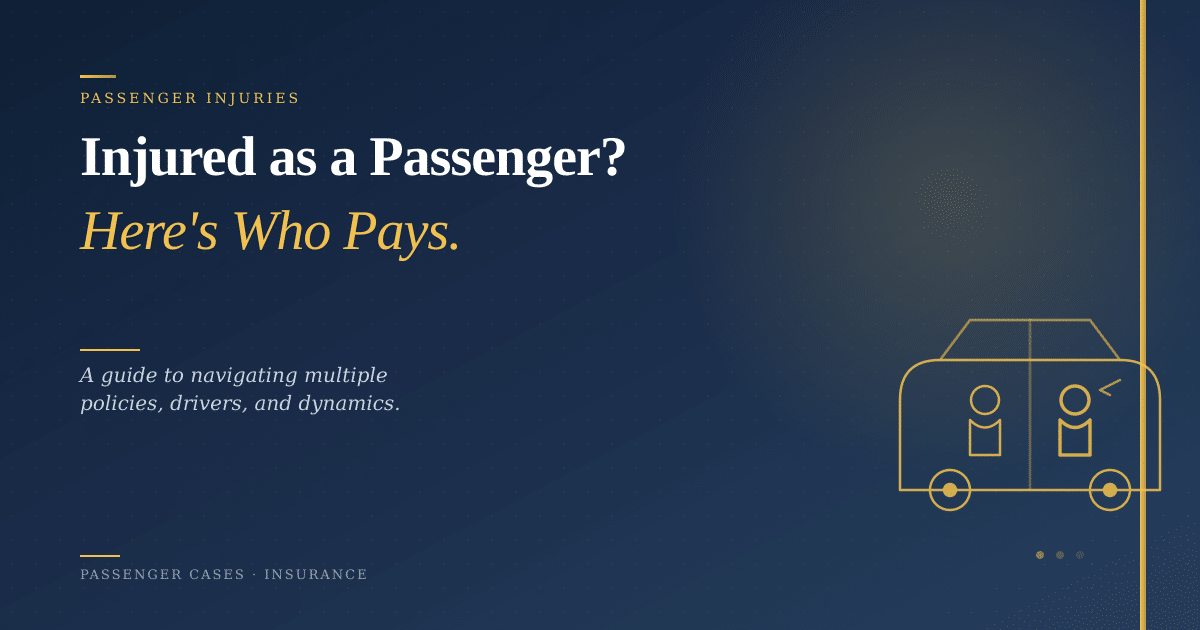
An ordinary crash has two drivers and two insurers. A rideshare crash adds a company with its own policy and its own rules about when that policy applies, and which insurer pays first depends on a few seconds of app data.
California regulates Uber and Lyft as transportation network companies, and Public Utilities Code § 5433 sets the minimum insurance that must be in place depending on what the driver was doing at the moment of the crash.
From log-on until a ride request is accepted, and again after a ride ends until the next one is accepted, the law requires primary coverage of at least $50,000 per person and $100,000 per crash for death and injury, plus $30,000 for property damage, with at least $200,000 in excess coverage per occurrence behind it. This is the thinnest layer.
From the moment the driver accepts a request until the trip is complete or the passenger is dropped off, whichever is later, the company’s insurance must be primary and in the amount of $1 million for death, personal injury, and property damage. From the moment a passenger gets in until the passenger gets out, the company must also provide uninsured and underinsured motorist coverage of $60,000 per person and $300,000 per incident, primary over any other UM or UIM policy and solely the company’s obligation.
Two more rules protect you: the company’s coverage does not depend on the driver’s personal policy denying the claim first, and if the driver’s own policy has lapsed, the company must cover the claim from the first dollar.
Under Business and Professions Code § 7451, enacted by Proposition 22, an app-based driver is treated as an independent contractor rather than an employee or agent of the network company when the statute’s conditions are met. The insurance requirements above, not employer liability, are therefore the usual path to a full recovery. The same law requires network companies to make occupational accident insurance available for injured drivers.
If your driver caused the crash, your claim runs against that driver and the $1 million policy that applies during the ride. If another driver caused it, your claim runs against that driver’s policy, with the company’s UM and UIM coverage behind it if the other driver was uninsured, underinsured, or fled. Report the crash in the app so the trip is documented, but do not give a recorded statement or accept a settlement from the company’s claims team before you have spoken with a lawyer.
If you were in another car, on a bicycle, or on foot, the question is which period the driver was in. A driver carrying a passenger or heading to a pickup brings the $1 million policy into the case; a driver waiting with the app on brings the Period 1 limits and the excess layer; a driver with the app off is an ordinary driver, and the minimum many drivers carry is only $30,000 per person under Vehicle Code § 16451. Establishing the period from the trip record is the first thing we do. If you were walking, our Torrance pedestrian accident lawyer page covers the added rules.
If another driver hit you while you were driving for the app, your claim runs against that driver’s policy first, with the company’s UM or UIM coverage for your period behind it, and occupational accident coverage may pay medical bills and lost earnings. If the other driver fled, our Torrance hit-and-run lawyer page explains the strict conditions on uninsured motorist claims, including the 24-hour police report.
Distraction from the app. A rideshare driver is reading pickup addresses, accepting the next request, and following directions while driving; on Hawthorne Boulevard at rush hour, a glance at the phone is a rear-end crash. Our Torrance rear-end accident lawyer guide covers how fault is proved.
Sudden stops and unsafe pickups. Drivers stop in travel lanes and pull across bike lanes to reach a passenger; the car behind and the cyclist beside pay for it.
Unfamiliar roads, fatigue, and late-night traffic. Many drivers work Torrance from elsewhere in the county and drive long shifts, and late-night trips from bars and the beach cities put impaired drivers on the other side of the crash; see our Torrance drunk driver accident page.
Dangerous roads. When road design or a missing signal contributed, a claim may lie against the public entity under Government Code § 835; our guide to dangerous roads and intersections in Torrance explains when the road is part of the case.
California follows pure comparative negligence (Li v. Yellow Cab Co. (1975) 13 Cal.3d 804): a claimant’s recovery is reduced by their percentage of fault, never eliminated by it. For a passenger the rule is nearly academic. Where it matters is between the two drivers, whose insurers each push the percentage onto the other side while the passenger’s claim stalls in the middle. We pursue every liable party at once and let the evidence assign the percentages.
Two years for most claims. Under CCP § 335.1, most California injury lawsuits must be filed within two years of the crash. Our guide to CCP § 335.1, California’s two-year statute of limitations, covers the rule and its exceptions.
Six months when the government is involved. If a City of Torrance vehicle, a Torrance Transit bus, or a dangerous stretch of public road caused your crash, you must present a written claim to the right entity within six months before you can sue. Our guide to the California government claim deadline walks through the sequence.
Short reporting windows apply too. A crash with injury or death must be reported in writing to the police or CHP within 24 hours (Vehicle Code § 20008), and an SR-1 report goes to the DMV within 10 days when anyone is hurt or property damage exceeds $1,000 (Vehicle Code § 16000). We handle these filings for our clients as part of the case.
The most important evidence in an Uber or Lyft crash is the trip record: when the driver logged on, when the request was accepted, when the passenger was picked up, the route, and the speed. That data sits with the company, and it decides which insurance period applies. We send preservation demands to the company, the driver, and every insurer the same day we are retained. The rest is built the way every serious crash case is built: corridor cameras that overwrite within days, Torrance Transit bus cameras, the driver’s dashcam, the vehicles’ event data recorders, and accident reconstruction in serious cases. The police report is a starting point, not a verdict.
When a crash takes a life, California gives specific family members the right to bring a wrongful death claim for their own losses, and the deadlines have traps of their own. Our Torrance wrongful death attorney page explains these cases, and our complete guide to the California wrongful death filing deadline covers the timing rules.
Motorcyclists and cyclists hit by a rideshare driver have their own pages: our Torrance motorcycle accident lawyer and Torrance bicycle accident lawyer pages cover the rules that apply to each rider. When a rideshare crash leaves permanent injuries, our Torrance catastrophic injury lawyer page explains how those cases are built.
Rideshare claims teams are built to close files fast and cheap. David Gammill is a California trial attorney who prepares every case as though a Torrance jury will decide it. The firm’s results include a $21.1 million wrongful death verdict and a $16 million school sexual abuse verdict, each a real jury verdict in a specific case; outcomes always depend on the facts.
We work on a contingency fee: nothing upfront, no hourly bills, and a fee only out of the recovery, under a written contingency fee agreement that complies with California law. Our guide to what a personal injury lawyer costs in Torrance answers the money questions plainly.
Call any time, including nights, weekends, and holidays: 310-750-4149. If you need treatment now, we connect clients with Torrance-area doctors who work on a lien basis, paid from the recovery rather than upfront. If you cannot travel, we come to you.
Economic damages cover documented losses: emergency care, hospital stays, surgery, therapy, medications, future treatment, lost wages, and reduced earning capacity.
Non-economic damages cover the human losses: physical pain, emotional distress, loss of enjoyment of life, permanent disability or disfigurement, and, for spouses, loss of consortium.
Punitive damages may be available where a driver’s conduct was malicious, oppressive, or fraudulent under Civil Code § 3294, most commonly when the at-fault driver was drunk.
The $1 million policy is a ceiling on one source of recovery, not a measure of your claim’s value. Before you sign anything, use the free case evaluation to learn what your claim is actually worth.
Whichever driver caused the crash. If your driver was at fault, the company’s $1 million policy applies during the ride. If another driver was at fault, that driver’s insurance pays first, and the company’s UM and UIM coverage, $60,000 per person and $300,000 per incident while you are in the car, applies if that driver cannot cover your losses.
Yes, at lower limits. With the app on and no ride accepted, California requires at least $50,000 per person and $100,000 per crash in primary coverage plus $200,000 in excess coverage. The insurer will scrutinize whether the app was on, which is why the trip record matters.
No. That denial is exactly what the statute anticipates: the company’s coverage does not depend on the personal policy denying first, and if the driver’s policy lapsed, the company must cover the claim from the first dollar. A personal-policy denial usually means the commercial policy is the right target.
Two years from the date of the crash for most claims, under CCP § 335.1. If a government vehicle or dangerous public road is involved, a written claim is due within six months under Gov. Code § 911.2; see our government claim guide. Courts rarely excuse a missed deadline.
Nothing upfront and nothing out of pocket. Our fee is a percentage of the recovery, collected only if we win, under a written agreement that complies with California law. Full details: what a personal injury lawyer costs in Torrance.
Corridor cameras overwrite within days, repaired cars lose their data, and the trip record sits on a company server until someone demands that it be preserved. The filing deadlines run whether or not you are ready.
You should not have to decode three layers of insurance from a hospital bed. Your free case review includes a real evaluation with an experienced attorney, a clear explanation of which coverage applies, and an honest assessment of what your claim is worth, with no obligation. If your case is a different kind of crash, start at our Torrance car accident attorney page; for any other injury, begin at our Torrance personal injury attorney page.
Get your free case evaluation or call 310-750-4149 now. There are no upfront legal fees; a fee is collected only if we win.
This page is attorney advertising and general information, not legal advice for any specific situation. Deadlines and outcomes are fact-specific; consult a licensed California attorney about your own circumstances. Prior results do not guarantee a similar outcome. Uber and Lyft are the names of independent companies; this firm is not affiliated with either.
Free Case Review 1

Left with few options
Stuck with bills you can’t pay
Anxious to put your injury behind you


 Serving the South Bay and all of California.

My name is David Gammill. I am a California trial lawyer and the founder of Gammill Law Accident & Injury Lawyers. Our firm has recovered more than $100 million for California clients. Our results include a $21.1 million wrongful death verdict, a $16 million school sexual abuse verdict, and a $12 million whistleblower retaliation verdict. I learned to try cases in front of juries early in my career as a Deputy District Attorney, and trying cases remains the backbone of my practice.