Menu
Call
Contact
Blog

What Is Excessive Force? The Definition Under California and Federal Law

How courts decide whether police force was excessive: the objective reasonableness test and the separate deadly force rule under California law

By David Gammill · Last reviewed: September 27, 2026

Excessive force is force that goes beyond what an objectively reasonable officer would have used under the same facts and circumstances. That is the definition the United States Supreme Court adopted in Graham v. Connor (1989) 490 U.S. 386, and it is the definition written into California’s own use-of-force statute, Penal Code section 835a. The test is objective: the officer’s good or bad intentions do not matter, and the force is judged from the perspective of a reasonable officer on the scene, not with hindsight. It is also a totality-of-the-circumstances test, and in California the circumstances expressly include the officer’s own conduct leading up to the force. Excessive force violates the Fourth Amendment, and in California it violates the Bane Act and the law of battery and negligence, each of which supports a civil lawsuit for damages. This page gives the definition in plain terms, explains how courts decide whether force was excessive, and then covers the federal and California authorities through 2026 for lawyers evaluating a claim.

  • The definition: force is excessive when it is not objectively reasonable in light of the facts confronting the officer. The three factors courts weigh first are the severity of the suspected crime, whether the person posed an immediate threat, and whether the person was actively resisting or fleeing.
  • The whole timeline counts: since Barnes v. Felix (2025), federal courts may not judge a use of force by the final seconds alone. California went further in 2020: Penal Code section 835a defines the totality of the circumstances to include the officer’s own conduct leading up to the force.
  • Deadly force has its own rule: in California an officer may use deadly force only when necessary to defend against an imminent threat of death or serious bodily injury, or to stop a fleeing person who committed a violent felony and will hurt someone unless caught now.
  • Other officers must act: every California agency’s policy must require officers to de-escalate when feasible, to report excessive force by another officer, and to intercede when they see it.
  • The civil remedy: a federal civil rights claim under 42 U.S.C. § 1983, a California Bane Act claim, and battery and negligence claims. The state-law claims against a city or county require a government claim within six months.

If you or someone in your family was hurt by police in Los Angeles County, call Gammill Law Accident & Injury Lawyers at 310-750-4149 for a free consultation, or send us a message through our contact page.

Two ways to read this page. Part 1 answers the questions people ask most, in plain terms. Part 2 is written for lawyers evaluating an excessive force claim and covers the federal cases from Garner to Barnes, the California statute and its difference from federal law, the negligence line, qualified immunity, the Bane Act, damages, and the records a plaintiff can obtain.

Part 1: The Plain Answers

What Is Excessive Force?

Excessive force is any use of force by an officer that a reasonable officer, facing the same facts, would not have used. Police are allowed to use force. An officer making an arrest may use the amount of force reasonably needed to make it, to stop an escape, or to overcome resistance. California’s statute says exactly that: a peace officer with reasonable cause to believe a person has committed an offense “may use objectively reasonable force to effect the arrest, to prevent escape, or to overcome resistance.” The word doing the work is “reasonable.” Force beyond that line is excessive, whether it is a shove, a baton strike, a Taser, a police dog, a chokehold or a gunshot.

The legal source of the definition is the Fourth Amendment, which protects against unreasonable seizures. In Graham v. Connor, the Supreme Court held that every claim that officers used excessive force during an arrest, an investigative stop or any other seizure of a free person is judged under the Fourth Amendment’s reasonableness standard. The Court described the inquiry as a balancing of the intrusion on the person against the government’s interest in the arrest, and it listed the facts that matter most: the severity of the crime at issue, whether the suspect poses an immediate threat to the safety of the officers or others, and whether the suspect is actively resisting arrest or trying to escape. The same definition applies to a person who has already been stopped or arrested; a person held in jail before trial is protected by the Fourteenth Amendment under an objective test that works the same way (Kingsley v. Hendrickson (2015) 576 U.S. 389).

Two things follow from the definition that surprise people. First, force can be excessive without a serious injury. The question is whether the force was reasonable, not how much damage it did, although the injury is evidence of how much force was used. Second, force can be lawful even when it causes a serious injury, if a reasonable officer would have used it. The law does not ask whether the outcome was tragic. It asks whether the decision was reasonable when it was made.

What Is Considered Excessive Force by Police? How Courts Decide

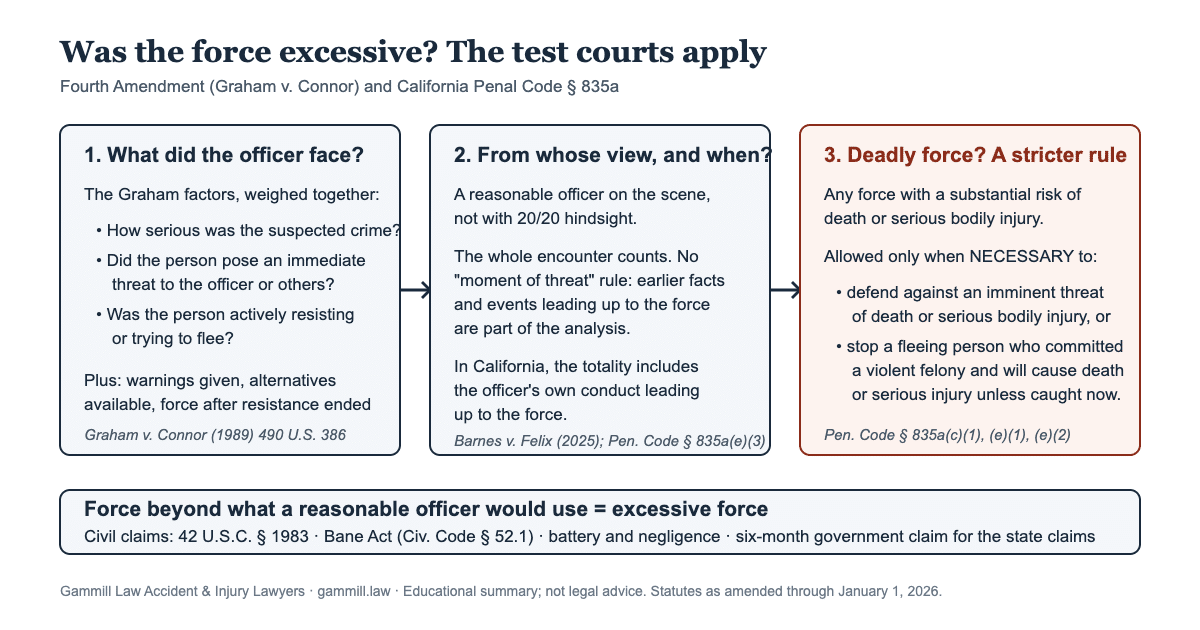
Courts decide by weighing the totality of the circumstances from the point of view of a reasonable officer on the scene, starting with the three Graham factors. No single fact settles the question. A jury, or a judge on a motion, looks at everything the officer knew at the time and asks whether the force used was proportionate to what the officer faced.

  1. How serious was the suspected crime? Force that might be reasonable to arrest an armed robbery suspect is not reasonable to arrest someone for jaywalking, an expired registration or a noise complaint. The less serious the offense, the less force the situation justifies.
  2. Did the person pose an immediate threat to the officer or anyone else? This is usually the most important factor. A person with a weapon, or moving toward someone in a way that suggests an attack, presents a threat. A person who is unarmed, on the ground, handcuffed, walking away or simply arguing does not.
  3. Was the person actively resisting arrest or trying to flee? Active resistance means fighting, pulling away, struggling against handcuffs or running. It does not mean asking why you are being arrested, going limp, being slow to comply, or filming the officer. Courts distinguish active resistance from passive non-compliance, and force that might be reasonable against the first is often excessive against the second.

Beyond those three, courts look at whether the officer gave a warning when one was possible, whether less forceful options were available and practical, how many officers were present, the relationship between the need for force and the amount used, and whether the force continued after the person stopped resisting. Graham also insists on a fair perspective: the reasonableness of a use of force “must be judged from the perspective of a reasonable officer on the scene, rather than with the 20/20 vision of hindsight,” and it allows for the fact that officers sometimes make split-second decisions in tense, uncertain and rapidly evolving situations. That perspective cuts both ways. It protects an officer who made a reasonable choice that turned out badly, and it does not protect an officer who used force a reasonable colleague would have recognized as unnecessary at the time.

One more rule matters, and it is recent. In Barnes v. Felix (2025) 605 U.S. 73, the Supreme Court unanimously rejected the “moment of threat” approach that some federal courts had used to look only at the two seconds before an officer fired. The Court held that the totality-of-the-circumstances inquiry “has no time limit,” that earlier facts may show why a reasonable officer would have seen later conduct as threatening or as harmless, and that a court “cannot review the totality of the circumstances if it has put on chronological blinders.” California had already written that idea into its statute in 2020: Penal Code section 835a defines the totality of the circumstances as “all facts known to the peace officer at the time, including the conduct of the officer and the subject leading up to the use of deadly force.” How the encounter started, and what the officer did to make it better or worse, is part of the case.

How courts decide whether police force was excessive under California and federal law: the objective reasonableness test from Graham v. Connor weighs the severity of the crime, the immediate threat, and active resistance or flight, judged from a reasonable officer's perspective across the whole encounter, with a separate necessity rule for deadly force under Penal Code section 835a
The excessive force test what courts weigh from whose perspective and the separate rule for deadly force

Examples of Excessive Force

The clearest cases share one feature: the force was out of proportion to the threat, or it continued after the threat was gone. The following are the patterns that most often support a claim. Each one still has to be proved on its own facts, and the presence of one of these facts does not decide a case by itself.

  • Force against a person who is already restrained. Strikes, knee pressure, Taser cycles or a chokehold applied to someone who is handcuffed, on the ground and not fighting. Once a person is under control, the justification for force ends.
  • Deadly force against a person who was not an immediate threat. The Supreme Court held in Tennessee v. Garner (1985) 471 U.S. 1 that an officer “may not seize an unarmed, nondangerous suspect by shooting him dead,” and that deadly force to stop a fleeing suspect is reasonable only where the officer has probable cause to believe the person poses a threat of serious physical harm. California’s statute is narrower still, as explained below.
  • Force that is out of proportion to the offense. Takedowns, strikes or a Taser used on a person suspected of a minor, non-violent offense who is not fighting or fleeing.
  • Force against a person who is passively non-compliant. Someone who refuses to move, goes limp, argues, asks for a supervisor or films the officer is not actively resisting. Escalating to significant force against passive resistance is a frequent basis for liability.
  • Force after the person has surrendered or stopped resisting. A person who has put their hands up, lain down, or stopped struggling is no longer resisting, and continued force at that point is measured against no resistance at all.
  • Weapons or techniques used outside their purpose. A police dog left on a bite after the person has given up; a baton used on the head; a Taser used repeatedly on a person who cannot comply because they are being shocked; a carotid restraint or choke hold, which no California law enforcement agency may authorize under Government Code section 7286.5.
  • Retaliatory force. Force used because the person talked back, recorded the officer, or asked for a badge number. Recording an officer in public is not obstruction and is not a reason to detain, arrest or use force under Penal Code section 148, subdivision (g).

Just as important is what is usually not excessive force: a firm grip to guide a person into handcuffs, a takedown of someone actively fighting, pointing a weapon at a person reasonably believed to be armed, or the use of force needed to stop a real attack. Officers are permitted to use force, and the law expects a jury to give weight to what the officer faced. The claim is about the gap between what was faced and what was done.

What Counts as Deadly Force, and When Is It Allowed in California?

Deadly force is any force that creates a substantial risk of death or serious bodily injury, and in California an officer may use it only when necessary for one of two reasons. The rule was rewritten in 2019 by Assembly Bill 392 and took effect January 1, 2020. It replaced an older statute that had allowed deadly force to arrest for any felony, and it is one of the stricter standards in the country. The operative text of Penal Code section 835a reads:

(c)(1) Notwithstanding subdivision (b), a peace officer is justified in using deadly force upon another person only when the officer reasonably believes, based on the totality of the circumstances, that such force is necessary for either of the following reasons:

(A) To defend against an imminent threat of death or serious bodily injury to the officer or to another person.

(B) To apprehend a fleeing person for any felony that threatened or resulted in death or serious bodily injury, if the officer reasonably believes that the person will cause death or serious bodily injury to another unless immediately apprehended.

(e)(1) “Deadly force” means any use of force that creates a substantial risk of causing death or serious bodily injury, including, but not limited to, the discharge of a firearm.

(e)(3) “Totality of the circumstances” means all facts known to the peace officer at the time, including the conduct of the officer and the subject leading up to the use of deadly force.

Source: Cal. Penal Code § 835a, California Legislative Information, as amended through January 1, 2026 (verified September 27, 2026).

Three words in that text matter most. “Necessary” is a higher bar than “reasonable”: the statute’s findings say the Legislature intends that officers “use deadly force only when necessary in defense of human life,” and that officers “shall use other available resources and techniques if reasonably safe and feasible to an objectively reasonable officer.” “Imminent” means the threat is happening now, not that it could develop; the statute elsewhere defines an imminent threat as one that a reasonable officer believes the person has the present ability, opportunity and apparent intent to carry out, and says a fear of future harm is not enough. And “including the conduct of the officer” means that an officer who created the danger by a reckless approach cannot ask the jury to ignore how the danger arose. Deadly force includes a gunshot, but it also includes a carotid hold, a vehicle used as a weapon, and any other force that carries a substantial risk of death or serious injury.

Is Excessive Force Illegal in California?

Yes. Excessive force violates the Fourth Amendment, the California Constitution’s search-and-seizure clause, and Penal Code section 835a, and it gives rise to civil liability under federal and state law. The Legislature wrote its reasons into the statute itself. Section 835a opens with a set of findings, and the first two set the tone for everything that follows:

(a) The Legislature finds and declares all of the following:

(1) That the authority to use physical force, conferred on peace officers by this section, is a serious responsibility that shall be exercised judiciously and with respect for human rights and dignity and for the sanctity of every human life.

(2) As set forth below, it is the intent of the Legislature that peace officers use deadly force only when necessary in defense of human life. In determining whether deadly force is necessary, officers shall evaluate each situation in light of the particular circumstances of each case, and shall use other available resources and techniques if reasonably safe and feasible to an objectively reasonable officer.

Source: Cal. Penal Code § 835a, California Legislative Information, as amended through January 1, 2026 (verified September 27, 2026).

California also regulates force at the agency level. Government Code section 7286, added by Senate Bill 230 in 2019, requires every law enforcement agency in the state to maintain a written use-of-force policy that meets minimum standards, and it requires the agency to make that policy available to the public. The policy must require officers to use “de-escalation techniques, crisis intervention tactics, and other alternatives to force when feasible,” must set out the circumstances in which deadly force is permitted consistent with section 835a, and must include the reporting and intervention duties described in the next section. When an officer uses force contrary to the agency’s own policy, that violation does not automatically prove the force was excessive, but the policy is evidence of what a reasonable officer would have done, and California courts admit it for that purpose.

Do Other Officers Have to Step In?

Yes. Under California law, an officer who sees another officer using clearly excessive force must intercede, and an officer who sees potential excessive force must report it immediately to a supervisor. Section 7286 requires every agency policy to include both duties:

(3) A requirement that officers immediately report potential excessive force to a superior officer when present and observing another officer using force that the officer believes to be beyond that which is necessary, as determined by an objectively reasonable officer under the circumstances based upon the totality of information actually known to the officer.

(9) A requirement that an officer intercede when present and observing another officer using force that is clearly beyond that which is necessary, as determined by an objectively reasonable officer under the circumstances, taking into account the possibility that other officers may have additional information regarding the threat posed by a subject.

Source: Cal. Gov. Code § 7286, subd. (b), California Legislative Information, as amended through January 1, 2026 (verified September 27, 2026).

The statute defines “intercede” broadly. It includes physically stopping the force, recording it on a body-worn camera, confronting the officer during the use of force, documenting efforts to intervene and de-escalate, and, if the force continues, reporting the officer by name, unit, location and time to dispatch or the watch commander. In a civil case, the duty matters in two directions. An officer who stood by can be a defendant for failing to intervene when there was a realistic opportunity to do so. And every officer on scene is a witness whose own body camera, report and statement can be compared with the others.

What Are Your Rights If Police Used Excessive Force?

You have the right to medical care, the right to the records of what happened, the right to record officers in public, and the right to sue. Here is what each of those means in practice.

  • Medical care. If you are injured during an arrest, you are entitled to medical treatment, and the jail must provide it if you are in custody. Ask for it, and ask again if it is refused. The medical records become the first objective evidence of what force was used.
  • The records. Since 2019, California has made records of serious uses of force public. Under Penal Code section 832.7, subdivision (b), records relating to an officer’s discharge of a firearm at a person, a use of force that caused death or great bodily injury, a sustained finding of unreasonable or excessive force, and a sustained finding that an officer failed to intervene against excessive force are all public records, and the release includes the body camera video, audio, investigative reports, interview recordings and findings. Video of a “critical incident,” meaning a shooting or a use of force causing death or great bodily injury, is subject to a separate 45-day release clock under Government Code section 7923.625. Our page on police body camera footage in California explains how to get it.
  • Recording. Filming an officer in public is not obstruction and is not grounds for a detention or arrest under Penal Code section 148, subdivision (g). Keep a reasonable distance and keep recording. Ask witnesses to do the same and to save what they have.
  • The agency’s own policy. Every agency’s use-of-force policy is public under Government Code section 7286, subdivision (c). What the department told its own officers they may and may not do is admissible evidence of the standard of care.
  • A civil claim. The right to be free from excessive force is enforced through a lawsuit, described below. A criminal charge against the officer is a separate matter decided by prosecutors, and a civil case does not depend on it.

How Do You Prove Excessive Force?

An excessive force case is proved by reconstructing the whole encounter from every available source and comparing what the officer did with what a reasonable officer would have done. Because the test is objective, the case does not depend on proving the officer’s state of mind. It depends on the facts, and most of the facts are recorded somewhere.

  • Video. Body-worn camera, dash camera, surveillance cameras from nearby businesses, doorbell cameras, and bystander phones. The body camera footage is usually the single most important piece of evidence, and where it clearly contradicts an officer’s account, courts credit the video. It can also be turned off, missing or late-activated, and the reasons for that become part of the case.
  • Radio and dispatch records. The computer-aided dispatch log and radio traffic establish the timeline to the second: when the call came in, what the officers were told, when they arrived, when force was used, when medical aid was called.
  • The reports. California agencies must document uses of force, and section 7286 requires policies for reporting and reviewing them. The officer’s own report, written before the video is reviewed, is compared line by line against the footage.
  • Medical evidence. Emergency room records, photographs of injuries taken within hours, and treating physicians who can explain what kind of force produces what kind of injury.
  • Witnesses. Bystanders, other officers, the people in the car or the house. Statements taken early, before memories fade, and before the department’s version circulates.
  • The agency’s policy and training. The written use-of-force policy, the de-escalation training the officer received, and the department’s own use-of-force review of the incident, obtainable in litigation and in many cases under the public records statute.
  • The officer’s history. Sustained findings of excessive force or dishonesty are public records under section 832.7, and other complaints can be reached through discovery.
  • Experts. A police practices expert who can explain, from the agency’s own standards and California training requirements, what a reasonable officer would have done at each step, and a medical or biomechanical expert where the mechanism of injury is disputed.

The pre-force timeline matters as much as the moment of force. After Barnes, and under section 835a in California, the question is not just whether the officer’s final act was reasonable, but whether the officer’s approach, commands, positioning, and choices about timing and backup were reasonable, and whether those choices created the situation in which force was used.

What Can You Do If You Experience Excessive Force?

Get medical care, preserve the evidence, note the deadlines, and talk to a civil rights lawyer before you talk to the department. In order:

  • Get treated and photographed. Go to an emergency room or urgent care the same day if you can. Describe how the injuries happened. Photograph every injury in good light, then again over the following days as bruising develops.
  • Write it down while it is fresh. Date, time, place, what you were doing, what the officers said, what they did and in what order, how long it lasted, what you said, and every officer’s name or badge number you can recall. Save your own video and get copies of any witness video.
  • Send a preservation request. Agency retention schedules for body camera footage can be short for incidents that do not lead to an arrest. A written request to the agency to preserve all video, audio, dispatch records and reports should go out within days. A lawyer will do this for you, and it is the first thing we do.
  • Know the two deadlines. The state-law claims against a city, county or other public entity (Bane Act, battery, negligence) require a written government claim presented to that entity within six months of the incident under Government Code section 911.2. The federal claim under 42 U.S.C. § 1983 borrows California’s two-year personal injury period under Code of Civil Procedure section 335.1. The six-month deadline is the one that catches people.
  • Be careful with the internal complaint. A complaint to the department can be appropriate, but what you write in it is a statement the department will have in the lawsuit. Make it with counsel, not before.
  • If there is a criminal case against you, tell your civil lawyer immediately. The two proceedings interact, and the sequencing matters.

Can You Sue the Police for Excessive Force in California?

Yes. Excessive force supports a federal civil rights claim, a California Bane Act claim, and California battery and negligence claims, usually filed together against the officers and the agency that employs them. Our FAQ answers the question whether you can sue the police in California in short form; this is the longer version.

  • 42 U.S.C. § 1983. The federal statute allows a lawsuit against any person who, acting under color of state law, deprives you of a constitutional right. Excessive force during a seizure is an unreasonable seizure under the Fourth Amendment. The claim runs against the individual officers; the city or county is liable under federal law only if a policy, custom or failure to train caused the violation.
  • The Bane Act, Civil Code section 52.1. California’s civil rights statute provides damages, attorney’s fees and injunctive relief for interference with a constitutional right by threat, intimidation or coercion. Force is coercion. The Bane Act has no qualified immunity defense, which makes it the claim that most often survives when the federal claim does not. Our Bane Act explainer covers the statute in depth.
  • Battery. In California, a battery claim against a peace officer is the state-law counterpart of the federal excessive force claim: the plaintiff proves the officer used unreasonable force. The public entity is vicariously liable for its officer’s battery under Government Code section 815.2.
  • Negligence. California negligence law is broader than the Fourth Amendment. Under Hayes v. County of San Diego (2013) 57 Cal.4th 622, an officer’s tactical conduct and decisions before a shooting are part of the totality of circumstances that determine whether the use of deadly force was negligent. The entity is again vicariously liable.
  • Wrongful death. Where the force was fatal, the decedent’s heirs bring the state claims as a wrongful death action, and the estate brings the federal claim as a survival action.

Excessive force cases are often paired with a claim that the underlying stop or arrest was unlawful in the first place. That is a separate claim with its own rules, explained on our page about illegal detentions in California. A lawful stop can still involve excessive force, and an unlawful stop can involve reasonable force; the two claims are pleaded and proved separately. Part 2 explains how.

Part 2: For Lawyers Evaluating an Excessive Force Claim

The Federal Standard from Garner to Barnes

CaseYearWhat it holds
Tennessee v. Garner, 471 U.S. 11985Deadly force to prevent a fleeing suspect’s escape is reasonable only where the officer has probable cause to believe the suspect poses a threat of serious physical harm to the officer or others; where feasible, a warning must precede it. An unarmed, nondangerous suspect may not be seized by shooting him dead.
Graham v. Connor, 490 U.S. 3861989All excessive force claims arising from an arrest, investigatory stop or other seizure of a free person are governed by the Fourth Amendment’s objective reasonableness standard. Factors: severity of the crime, immediate threat, active resistance or flight. Judged from a reasonable officer on the scene, without hindsight; the officer’s intent or motivation is irrelevant.
Scott v. Harris, 550 U.S. 3722007Ramming a fleeing driver’s car during a dangerous chase was reasonable; Garner states no rigid preconditions for deadly force but is an application of the general reasonableness inquiry. Where video blatantly contradicts a party’s account, the court credits the video at summary judgment.
Plumhoff v. Rickard, 572 U.S. 7652014Firing on a fleeing driver who had led a high-speed chase and was attempting to resume flight was reasonable; if lethal force is justified, officers need not stop shooting until the threat has ended. Qualified immunity granted.
Kingsley v. Hendrickson, 576 U.S. 3892015A pretrial detainee’s excessive force claim under the Fourteenth Amendment requires only that the force purposely or knowingly used was objectively unreasonable; no subjective intent element.
County of Los Angeles v. Mendez, 581 U.S. 4202017The Ninth Circuit’s “provocation rule” is rejected: a separate Fourth Amendment violation cannot transform a later, reasonable use of force into an unreasonable seizure. Damages proximately caused by the separate violation (there, a warrantless entry) remain recoverable. The Court declined to decide whether Graham‘s totality inquiry itself accounts for unreasonable pre-force conduct.
Kisela v. Hughes, 584 U.S. 1002018Per curiam reversal of a denial of qualified immunity; Graham and Garner are cast at too high a level of generality to clearly establish the law in a specific case, and the plaintiff must identify precedent squarely governing the facts.
Torres v. Madrid, 592 U.S. 3062021The application of physical force to the body with intent to restrain is a seizure even if the person does not submit and is not subdued; shooting at a fleeing driver who escaped was a seizure.
Barnes v. Felix, 605 U.S. 732025Unanimous. The “moment of threat” rule is rejected. The totality inquiry has no time limit; a court must consider all relevant circumstances, including facts and events leading up to the use of force. Whether and how an officer’s own creation of a dangerous situation factors into reasonableness was expressly left open.

Read together, the line has a shape. Garner and Graham supply the standard. Scott, Plumhoff and Kisela apply it in the defendant’s favor on vehicle-flight facts and tighten qualified immunity. Kingsley extends the objective test to pretrial detainees. Torres settles what counts as a seizure. Mendez and Barnes address the timeline, and they leave the same door open from opposite sides: Mendez rejected a rule that converted reasonable force into unreasonable force by reference to a prior violation, but expressly declined to decide whether Graham‘s own totality inquiry accounts for unreasonable pre-force conduct; Barnes held that the totality inquiry has no time limit, but expressly declined to decide whether an officer’s creation of the danger factors into reasonableness. California law answers the question that the Supreme Court has twice reserved.

Barnes v. Felix and the Pre-Force Timeline

Barnes is the currency anchor for every federal excessive force claim filed after May 2025, and it changes the summary judgment record. The Fifth Circuit had affirmed summary judgment for an officer who shot a driver after stepping onto the doorsill of the moving car, confining its review to the two seconds before the shot. The Supreme Court vacated. Justice Kagan’s opinion for a unanimous Court held that the totality-of-the-circumstances inquiry “has no time limit,” that prior events may show why a reasonable officer would have perceived a suspect’s conduct as threatening or as innocuous, and that a court “cannot review the totality of the circumstances if it has put on chronological blinders.” The Court then returned “everything else” to the lower courts, including the reasonableness of the shooting under the longer timeframe and the relevance, if any, of the officer having stepped onto the doorsill.

For a plaintiff, Barnes means the pre-force record is admissible on the constitutional question in every circuit, not only on state-law claims. The approach, the commands, the officer’s decision to escalate or to wait for backup, and the officer’s own movements are all part of the reasonableness inquiry. What Barnes does not do is adopt the officer-created-danger doctrine as a matter of federal law; the Ninth Circuit’s own version of that doctrine survives Mendez only as a proximate-cause theory tied to a separate constitutional violation, and the question the Court reserved in both cases remains open. In California, the practical answer is that the state claims fill the gap, as the next two sections explain.

California’s Standard: Penal Code § 835a After AB 392

Section 835a, as rewritten by Assembly Bill 392 effective January 1, 2020, is both the state-law standard for a battery or negligence claim and, on its own terms, the codification of what the Legislature found a reasonable officer must do. Subdivision (b) states the general rule: an officer with reasonable cause to believe the person has committed a public offense may use “objectively reasonable force” to effect the arrest, prevent escape or overcome resistance. Subdivision (c) states the deadly force rule quoted in Part 1: deadly force only when the officer reasonably believes, based on the totality of the circumstances, that it is “necessary” to defend against an imminent threat of death or serious bodily injury, or to apprehend a fleeing person for a felony that threatened or resulted in death or serious bodily injury where the person will cause death or serious bodily injury unless immediately apprehended. Subdivision (e) supplies the definitions, and (e)(3) is the provision that separates California from federal law: the totality of the circumstances “means all facts known to the peace officer at the time, including the conduct of the officer and the subject leading up to the use of deadly force.”

Three drafting choices matter in litigation. First, the deadly force standard is “necessary,” not merely “reasonable,” and the findings direct officers to use other available resources and techniques if reasonably safe and feasible. A defense expert who testifies only that the shooting was “reasonable” under Graham has not addressed the statutory question. Second, subdivision (c)(1)(B), the fleeing-felon prong, is narrower than Garner: it requires a felony that threatened or resulted in death or serious bodily injury, and a reasonable belief that the person will cause death or serious bodily injury unless immediately apprehended. Third, (e)(3) makes the officer’s own pre-force conduct part of the standard by definition. Where Mendez and Barnes reserved the officer-created-danger question, section 835a answers it for the state claims. The statute is a criminal-law provision, and it does not itself create a civil cause of action, but it states the standard of care that the battery and negligence claims apply, and it is the text a jury is instructed on through the California Civil Jury Instructions for battery by a peace officer.

Negligence and Pre-Shooting Conduct: Hayes and Koussaya

California negligence law reached the pre-force timeline before the statute did. In Hayes v. County of San Diego (2013) 57 Cal.4th 622, the California Supreme Court answered a certified question from the Ninth Circuit: law enforcement personnel’s tactical conduct and decisions preceding the use of deadly force are relevant considerations under California law in determining whether the use of deadly force gives rise to negligence liability, and such liability can arise if the tactical conduct and decisions show, as part of the totality of circumstances, that the use of deadly force was unreasonable. The Court expressly confirmed that the state and federal standards are not the same: the Fourth Amendment tends to focus more narrowly on the moment force is used and places less emphasis on pre-shooting conduct, while California tort law has long held that an officer’s duty to act reasonably when using deadly force extends to the totality of circumstances, including the officer’s pre-shooting conduct. Hayes disapproved Munoz v. City of Union City to the extent it held otherwise.

Hayes has limits, and Koussaya v. City of Stockton (2020) 54 Cal.App.5th 909 marks two of them. Where the plaintiff alleges no injury separate from the shooting, pre-shooting conduct is relevant only as evidence that the shooting itself was negligent, not as a freestanding theory; Hayes declined to decide what independent duty, if any, governs pre-shooting conduct that causes a separate injury. And Koussaya held that the rule applies to the conduct of the officers who used the force, and declined to extend it to the conduct of other officers not involved in the shooting. Koussaya also confirms that a department’s general orders do not themselves set the standard of care, but are admissible evidence of what due care requires, and that on a sufficiently one-sided record a court may find the force reasonable as a matter of law. The negligence claim is therefore pleaded against the shooting officers, with the entity vicariously liable under Government Code section 815.2, and the pre-force facts are marshaled to show that those officers’ own tactical choices made the ultimate use of force unreasonable.

Pleading the Federal Claim and Meeting Qualified Immunity

Under 42 U.S.C. § 1983, excessive force is pleaded as an unreasonable seizure under the Fourth Amendment against the individual officers, with entity liability only under Monell v. Department of Social Services (1978) 436 U.S. 658. The elements are a seizure, force that was objectively unreasonable under Graham, and action under color of state law. For a pretrial detainee, the claim is under the Fourteenth Amendment on Kingsley‘s objective test. The limitations period is California’s two-year personal injury period, Code of Civil Procedure section 335.1, borrowed under Wallace v. Kato (2007) 549 U.S. 384. No government claim is required for the federal cause of action, and fees are available under 42 U.S.C. § 1988.

Qualified immunity is the defense that decides most federal excessive force cases before trial. Under Pearson v. Callahan (2009) 555 U.S. 223, the officer prevails unless the right was clearly established in the specific context, and Kisela, Plumhoff and their predecessors hold that Graham and Garner, standing alone, do not clearly establish the law in any but the most obvious case. The plaintiff’s task is to identify Supreme Court or Ninth Circuit authority with materially similar facts, or to show that the violation was obvious. Two things help. Tolan v. Cotton (2014) 572 U.S. 650 requires the court to view the facts in the light most favorable to the plaintiff at summary judgment, including on the clearly-established prong, and reversed a circuit court for crediting the officer’s version. And Barnes expands the record on the constitutional prong, so that a pre-force timeline that a court would previously have excluded is now part of the reasonableness analysis. Monell liability requires a policy, custom, or failure to train that was the moving force behind the violation; the agency’s use-of-force policy, its training records, its use-of-force review of the incident and the officer’s prior sustained findings under Penal Code section 832.7 are the sources.

The Bane Act Claim: Specific Intent and No Qualified Immunity

Civil Code section 52.1 reaches interference by threat, intimidation or coercion with rights secured by the state or federal constitutions or laws, and excessive force is coercion by definition. Venegas v. County of Los Angeles (2004) 32 Cal.4th 820 settled that the plaintiff need not belong to a protected class. The statute provides actual damages, the statutory damages of Civil Code section 52, injunctive relief and attorney’s fees under subdivision (i), and it states in subdivision (n) that the Government Code immunities in sections 821.6, 844.6 and 845.6 do not apply to peace officer conduct. Federal qualified immunity is not a defense to the state claim at all. Our Bane Act explainer quotes the statute and covers the elements; this section addresses the intent element as it applies to force.

Under Cornell v. City and County of San Francisco (2017) 17 Cal.App.5th 766, the Bane Act’s egregiousness requirement is tested by whether the officer had a specific intent to violate the plaintiff’s right, not by whether there was coercion beyond the coercion inherent in the underlying violation; reckless disregard of the right suffices, and the officer need not have known the conduct was unlawful. The Ninth Circuit adopted that reading in Reese v. County of Sacramento (9th Cir. 2018) 888 F.3d 1030, an excessive force case, holding that the Bane Act requires specific intent but does not require coercion independent of the constitutional violation, and that a jury finding of unreasonable force does not by itself establish the intent element. Reese is also the clearest illustration of why the claim matters: the jury found a Fourth Amendment violation, the officer won qualified immunity on the federal claim, and the Bane Act claim went back for trial on specific intent. In an excessive force case the specific-intent evidence is usually the same evidence that proves the force was unreasonable: force after restraint, force after surrender, force disproportionate to a minor offense, retaliatory force, and any statement the officer made while using it. Plead the intent expressly and plead those facts.

Battery, Immunities and Damages

Battery by a peace officer is the state-law counterpart of the federal claim, and it is pleaded with the negligence and Bane Act claims against the officers and the entity. The plaintiff proves the officer used unreasonable force; the standard is the one in section 835a and the same totality analysis. The public entity is vicariously liable for its officers’ torts under Government Code section 815.2, and section 52.1(n) removes the section 821.6, 844.6 and 845.6 immunities from the Bane Act analysis for peace officer conduct. Each state claim requires a timely government claim under Government Code section 911.2 (six months) and suit within six months of the entity’s written rejection under section 945.6; the claim deadline page walks through the late-claim process.

On damages, the Bane Act supports actual damages, the section 52 statutory damages and fees; the federal claim supports compensatory damages and fees under section 1988. Punitive damages are available against individual officers under Civil Code section 3294 and under federal law, but Government Code section 818 provides that “a public entity is not liable for damages awarded under Section 3294 of the Civil Code or other damages imposed primarily for the sake of example and by way of punishing the defendant.” One further rule is specific to intentional force. In B.B. v. County of Los Angeles (2020) 10 Cal.5th 1, a restraint-asphyxia death case in which the jury found a deputy liable for battery by unreasonable force and allocated fault among the deputy, other deputies and the decedent, the California Supreme Court held that Civil Code section 1431.2 does not authorize a reduction in an intentional tortfeasor’s liability for noneconomic damages based on the negligence of other actors, including the plaintiff. An officer found liable for battery is therefore jointly and severally liable for the full noneconomic award, without a comparative fault reduction, and the entity stands behind that liability under section 815.2.

Records, Decertification and the Officer’s Own Exposure

Two post-2018 statutes changed what a plaintiff can obtain before filing and what an officer stands to lose. Penal Code section 832.7, subdivision (b), as amended by Senate Bill 1421 (2018) and Senate Bill 16 (2021), makes public the records relating to an officer’s discharge of a firearm at a person, a use of force resulting in death or great bodily injury, a sustained finding of unreasonable or excessive force, and a sustained finding of a failure to intervene against excessive force, and paragraph (b)(3) specifies that the disclosure includes the body camera and other video and audio, the investigative reports, the interview recordings, the findings and the discipline. Government Code section 7923.625 imposes the 45-day release clock for critical incident video, with a delay past one year only on clear and convincing evidence. Records still confidential are reached through the Pitchess procedure under Evidence Code sections 1043 to 1047 once suit is filed. The mechanics are on our body camera page.

The officer’s exposure extends past the lawsuit. Senate Bill 2 (2021) gave the Commission on Peace Officer Standards and Training the authority, in Penal Code section 13510.8, to suspend or revoke a peace officer’s certification for serious misconduct, and the statute requires the definition of serious misconduct to include “physical abuse, including, but not limited to, the excessive or unreasonable use of force,” as well as tampering with body camera data to conceal misconduct. Agencies must report qualifying findings to the Commission. Decertification is discretionary and is decided in a separate administrative proceeding, but a civil verdict of unreasonable force, and the records that produce it, feed that process.

Is This Law Current?

Yes. The statutes quoted and cited on this page reflect California law as of the review date at the top, verified against the official California Legislative Information site. Penal Code section 835a and Government Code section 7286 are quoted in the versions in effect since January 1, 2026; the substance of section 835a’s deadly force standard has been unchanged since Assembly Bill 392 took effect on January 1, 2020, and the substance of section 7286 since Senate Bill 230 took effect the same day. The most recent United States Supreme Court decision on the excessive force standard is Barnes v. Felix (May 15, 2025). The controlling California Supreme Court decisions on pre-force conduct and on comparative fault for intentional force are Hayes (2013) and B.B. (2020). The question reserved in both Mendez and Barnes, whether an officer’s creation of the danger is part of the federal reasonableness analysis, remains open as of the review date.

Legal References

  1. U.S. Const. amend. IV and XIV; Cal. Const. art. I, § 13.
  2. 42 U.S.C. § 1983; 42 U.S.C. § 1988 (fees).
  3. Cal. Penal Code § 835a (use of force; deadly force; definitions; AB 392, Stats. 2019).
  4. Cal. Gov. Code § 7286 (agency use-of-force policy minimum standards; duties to de-escalate, report and intercede; public access; SB 230, Stats. 2019); § 7286.5 (carotid restraint and choke hold prohibited).
  5. Cal. Civ. Code § 52.1 (Tom Bane Civil Rights Act); § 52 (statutory damages); § 3294 (punitive damages); § 1431.2 (Proposition 51).
  6. Cal. Penal Code § 148, subd. (g) (recording officers).
  7. Cal. Penal Code § 832.7, subd. (b) (public records of serious uses of force; SB 1421, Stats. 2018; SB 16, Stats. 2021).
  8. Cal. Gov. Code § 7923.625 (critical incident video release).
  9. Cal. Penal Code § 13510.8 (peace officer decertification; SB 2, Stats. 2021).
  10. Cal. Gov. Code § 911.2 (six-month government claim); § 945.6; § 815.2 (vicarious liability); § 818 (no punitive damages against entities).
  11. Cal. Code Civ. Proc. § 335.1 (two-year period borrowed for § 1983).
  12. Cal. Evid. Code §§ 1043 to 1047 (Pitchess procedure).
  13. Tennessee v. Garner (1985) 471 U.S. 1.
  14. Graham v. Connor (1989) 490 U.S. 386.
  15. Monell v. Department of Social Services (1978) 436 U.S. 658.
  16. Scott v. Harris (2007) 550 U.S. 372.
  17. Wallace v. Kato (2007) 549 U.S. 384.
  18. Pearson v. Callahan (2009) 555 U.S. 223.
  19. Plumhoff v. Rickard (2014) 572 U.S. 765.
  20. Tolan v. Cotton (2014) 572 U.S. 650.
  21. Kingsley v. Hendrickson (2015) 576 U.S. 389.
  22. County of Los Angeles v. Mendez (2017) 581 U.S. 420.
  23. Kisela v. Hughes (2018) 584 U.S. 100.
  24. Torres v. Madrid (2021) 592 U.S. 306.
  25. Barnes v. Felix (2025) 605 U.S. 73.
  26. Venegas v. County of Los Angeles (2004) 32 Cal.4th 820.
  27. Hayes v. County of San Diego (2013) 57 Cal.4th 622.
  28. Cornell v. City and County of San Francisco (2017) 17 Cal.App.5th 766.
  29. Reese v. County of Sacramento (9th Cir. 2018) 888 F.3d 1030.
  30. B.B. v. County of Los Angeles (2020) 10 Cal.5th 1.
  31. Koussaya v. City of Stockton (2020) 54 Cal.App.5th 909.

About the Author, and How to Reach Gammill Law

David Gammill is a former Los Angeles County Deputy District Attorney who has tried over 100 cases to verdict, first as a prosecutor and then as a trial lawyer for injured people. Every case is different, and past results do not guarantee a similar outcome. Gammill Law represents people in personal injury, wrongful death and civil rights cases across California, and accepts trial referrals and co-counsel arrangements for trial from other attorneys.

The firm has recovered more than $100 million for California clients across verdicts and settlements. Its results include a $21.1 million wrongful death verdict, a $16 million school sexual abuse verdict, a $12 million whistleblower retaliation verdict and a $1 million excessive force result; each came from a specific case with its own facts, and no result is a promise about any other case. The full list is on the firm’s case results page.

If you or someone in your family was hurt by police, request a free case evaluation or call 310-750-4149. There are no upfront legal fees; a fee is collected only if we win, under a written contingency fee agreement that complies with California law.

Disclaimer: This article is educational and informational in nature. It does not constitute legal advice for any specific situation, and reading it does not create an attorney-client relationship. Every case turns on its own facts, and no result is guaranteed; consult a licensed California attorney about your own circumstances.

My name is David Gammill. I am a California trial lawyer and the founder of Gammill Law Accident & Injury Lawyers. Our firm has recovered more than $100 million for California clients. Our results include a $21.1 million wrongful death verdict, a $16 million school sexual abuse verdict, and a $12 million whistleblower retaliation verdict. I learned to try cases in front of juries early in my career as a Deputy District Attorney, and trying cases remains the backbone of my practice.

Ask Gammill AI Calculator