Menu
Call
Contact
Blog

Police Body Camera Footage in California: How to Get It, How Long It Is Kept, and How It Is Used in Civil Rights Cases

California critical incident video release clock: 45 days, delay to one year on substantial interference, family may view under Government Code section 7923.625

By David Gammill · Last reviewed: September 27, 2026

In California, police body camera footage of a shooting or a use of force that causes death or great bodily injury is a public record, and the agency must release it within 45 days unless it can show that release would substantially interfere with an active investigation. Footage of any incident that leads to a detention, an arrest, a use of force, or a complaint should be kept for at least two years under the state’s best-practice statute. The person in the video, or that person’s family, has a right to see it even when the public does not. And once a civil rights lawsuit is filed, the footage, the officer’s report and the department’s own review of the incident are all discoverable. This page explains how to get body camera footage in California, how long agencies keep it, what happens when the camera was off or the video is missing, and how footage decides civil rights cases in practice. Part 2 covers the statutes, the cases and the litigation mechanics for lawyers.

  • No statewide mandate, but nearly universal use: California does not require every agency to wear body cameras. Penal Code section 832.18 sets best practices for the agencies that do, and every large agency in Los Angeles County runs a program.
  • Retention: under section 832.18, footage tied to a use of force, a shooting, a detention or arrest, or a complaint should be kept at least two years; other footage at least 60 days. The word is “should,” so a preservation letter still matters.
  • Public records: since 2019, Penal Code section 832.7 makes the records of police shootings, force causing death or great bodily injury, and sustained findings of excessive force public, including the video and audio.
  • The 45-day clock: Government Code section 7923.625 requires release of critical incident video within 45 days, allows delay up to one year only if release would substantially interfere with the investigation, and beyond one year only on clear and convincing evidence.
  • If the camera was off: there is no lawsuit for destroying evidence in California, but a jury may be told to draw an inference against a party that willfully suppressed it, and courts can impose discovery sanctions.

If you or someone in your family was hurt by police in Los Angeles County and you need the footage preserved and obtained, call Gammill Law Accident & Injury Lawyers at 310-750-4149 for a free consultation, or send us a message through our contact page.

Two ways to read this page. Part 1 answers the questions people ask most, in plain terms. Part 2 is written for lawyers and covers the SB 1421 / SB 16 / AB 748 framework, retroactivity, the Pitchess route for what remains confidential, preservation and spoliation practice, the video-at-summary-judgment rule, and how the footage is authenticated and used at trial.

Part 1: The Plain Answers

Are Police Body Cameras Required in California?

No. California has no statute requiring every peace officer to wear a body camera, but the state regulates the programs that agencies adopt, and most agencies have adopted one. Penal Code section 832.18 states the Legislature’s intent to establish policies for downloading and storing body-worn camera data and says those policies “shall be based on best practices.” It then lists the practices an agency “shall consider” when it writes its policy: who downloads the data, how it is stored, how long it is kept, and how officers may use it. The statute does not say “every officer shall wear a camera.” It says that if the agency has cameras, this is how the footage should be handled.

In practice, the question of whether an officer had a camera is answered by the agency’s own policy, which is a public document, and by the incident records. A separate California statute, Government Code section 7286, requires every agency’s use-of-force policy to be public, and those policies typically address camera activation. Whether the camera was on, and if not why not, is one of the first questions in every civil rights case, and the answer is usually in the agency’s records rather than in any statewide rule.

How Long Do Police Keep Body Cam Footage in California?

At least 60 days for routine footage, and at least two years for footage of a use of force, a shooting, an incident leading to a detention or arrest, or an incident that is the subject of a complaint. Those are the minimums in Penal Code section 832.18, and the statute’s own words matter here:

(A) Unless subparagraph (B) or (C) applies, nonevidentiary data including video and audio recorded by a body-worn camera should be retained for a minimum of 60 days, after which it may be erased, destroyed, or recycled. An agency may keep data for more than 60 days to have it available in case of a civilian complaint and to preserve transparency.

(B) Evidentiary data including video and audio recorded by a body-worn camera under this section should be retained for a minimum of two years under any of the following circumstances:

(i) The recording is of an incident involving the use of force by a peace officer or an officer-involved shooting.

(ii) The recording is of an incident that leads to the detention or arrest of an individual.

(iii) The recording is relevant to a formal or informal complaint against a law enforcement officer or a law enforcement agency.

Source: Cal. Penal Code § 832.18, subd. (b)(5), California Legislative Information (verified September 27, 2026).

Notice the word “should.” Section 832.18 is a best-practices statute; it tells agencies what to consider when writing their policies, and most Los Angeles County agencies have adopted the two-year period or longer. But it is not a command, and an agency’s actual retention schedule is set by its own policy. That is why the first step after any police encounter that may become a case is a written preservation request, described below. A related rule, Government Code section 34090.6, allows a city department to destroy routine video monitoring recordings after one year, and states that when recordings “are evidence in any claim filed or any pending litigation, they shall be preserved until pending litigation is resolved.” Filing a government claim, which the state-law civil rights claims require anyway, triggers that preservation duty.

Is Body Cam Footage a Public Record in California?

For the most serious incidents, yes. Since January 1, 2019, the records of a police shooting, a use of force causing death or great bodily injury, and any sustained finding of excessive force are public records, and the release includes the video. Senate Bill 1421 (2018) rewrote Penal Code section 832.7 to make those categories public, and Senate Bill 16 (2021) added sustained findings of a failure to intervene, unlawful arrests and searches, and discriminatory conduct. The core force categories read:

(A) A record relating to the report, investigation, or findings of any of the following:

(i) An incident involving the discharge of a firearm at a person by a peace officer or custodial officer.

(ii) An incident involving the use of force against a person by a peace officer or custodial officer that resulted in death or in great bodily injury.

(iii) A sustained finding involving a complaint that alleges unreasonable or excessive force.

(iv) A sustained finding that an officer failed to intervene against another officer using force that is clearly unreasonable or excessive.

Source: Cal. Penal Code § 832.7, subd. (b)(1)(A), California Legislative Information, as amended through January 1, 2026 (verified September 27, 2026).

Paragraph (b)(3) of the same section spells out what “record” means: “all investigative reports; photographic, audio, and video evidence; transcripts or recordings of interviews; autopsy reports,” the materials presented to the district attorney or to whoever decides discipline, the findings, and the disciplinary records. Body camera footage of a qualifying incident is inside that list. Two limits apply. First, the categories are specific: a use of force that caused a minor injury and produced no sustained finding is not public under section 832.7, and the footage is reached instead through the civil case. Second, the video of a “critical incident” has its own release timetable, explained next.

How Long Can Police Withhold Body Cam Footage? The 45-Day Rule

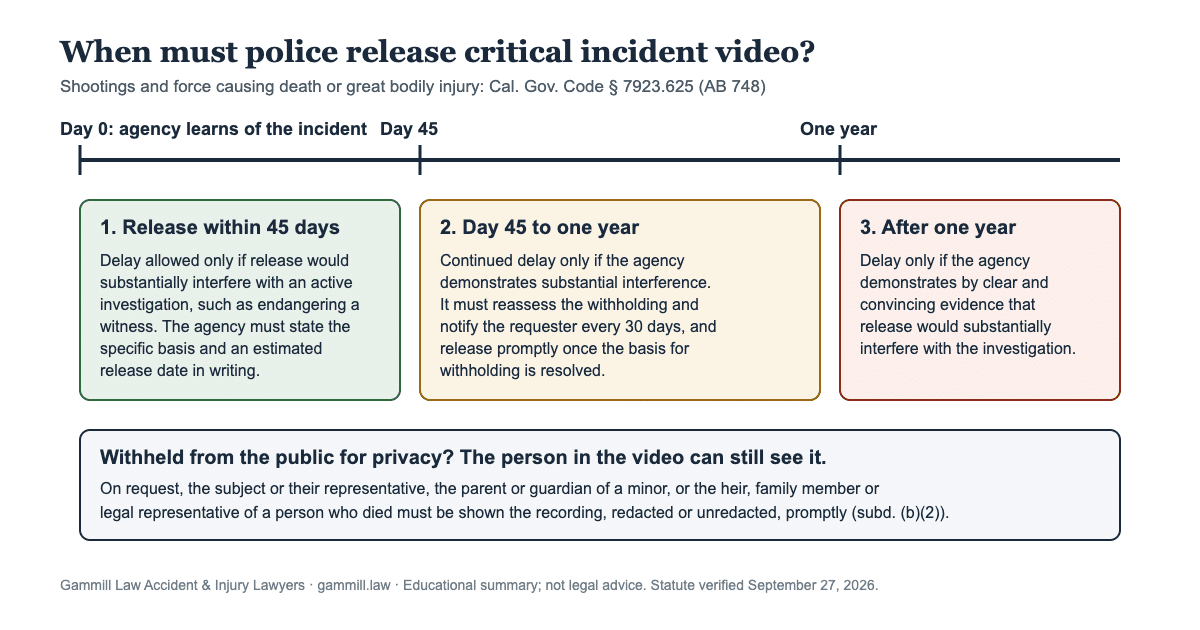
For a shooting or a use of force that caused death or great bodily injury, the agency must release the video within 45 days of learning of the incident, and may delay only if release would substantially interfere with an active investigation. Assembly Bill 748 (2018) created the rule, now Government Code section 7923.625, and it is written as a set of narrowing steps:

(a)(1) During an active criminal or administrative investigation, disclosure of a recording related to a critical incident may be delayed for no longer than 45 calendar days after the date the agency knew or reasonably should have known about the incident, if, based on the facts and circumstances depicted in the recording, disclosure would substantially interfere with the investigation, such as by endangering the safety of a witness or a confidential source. If an agency delays disclosure pursuant to this section, the agency shall provide in writing to the requester the specific basis for the agency’s determination that disclosure would substantially interfere with the investigation and the estimated date for disclosure.

(2) After 45 days from the date the agency knew or reasonably should have known about the incident, and up to one year from that date, the agency may continue to delay disclosure of a recording if the agency demonstrates that disclosure would substantially interfere with the investigation. After one year from the date the agency knew or reasonably should have known about the incident, the agency may continue to delay disclosure of a recording only if the agency demonstrates by clear and convincing evidence that disclosure would substantially interfere with the investigation.

Source: Cal. Gov. Code § 7923.625, California Legislative Information (verified September 27, 2026).

Three more provisions of the same section matter to a family. A “critical incident” is defined as the discharge of a firearm at a person by an officer, or a use of force by an officer that resulted in death or great bodily injury. An agency that keeps withholding must reassess every 30 days and notify the requester, and must release the video promptly once the basis for withholding is gone. And when an agency withholds a video from the public to protect the privacy of a person in it, the statute requires that the video be disclosed “promptly, upon request” to the subject of the recording or that person’s authorized representative, to the parent or guardian of a minor subject, and, when the subject has died, to “an heir, beneficiary, designated immediate family member, or authorized legal representative.” Redaction is permitted to protect privacy, but the statute says the redaction “shall not interfere with the viewer’s ability to fully, completely, and accurately comprehend the events captured in the recording.” Blurring a face is allowed; cutting the seconds that matter is not.

The release clock for California police critical incident video under Government Code section 7923.625: release within 45 days of the agency learning of the incident; delay to one year only if release would substantially interfere with an active investigation, with reassessment every 30 days; delay beyond one year only on clear and convincing evidence; the subject or family may view the video even when it is withheld from the public
The critical incident video release clock 45 days then one year then clear and convincing evidence

How Do You Get Body Camera Footage in California?

There are four routes, and a civil rights lawyer usually uses all of them in order: a preservation letter, a Public Records Act request, the subject-and-family access rule, and discovery once suit is filed.

  1. Send a preservation letter first. A written demand to the agency, its records custodian and its city attorney or county counsel, identifying the date, time, location, officers and the incident, and asking that all body camera, dash camera, surveillance, dispatch, radio and report records be preserved. This is the step that protects footage that falls outside the two-year categories, and it puts the agency on notice for the spoliation rules discussed below. It should go out within days.
  2. Make a Public Records Act request. A written request under the California Public Records Act (Government Code section 7920.000 and following) for the records made public by Penal Code section 832.7 and for the critical incident video under Government Code section 7923.625. The agency must decide within 10 days whether it has disclosable records and say so in writing, with one 14-day extension for unusual circumstances, and it must state in writing the specific basis for any delay of a critical incident video and the estimated date of release. Name the statutes in the request. An agency cannot charge for the staff time it spends redacting video: the California Supreme Court so held in National Lawyers Guild v. City of Hayward (2020) 9 Cal.5th 488.
  3. Use the subject-and-family rule. If the video is being withheld from the public on privacy grounds, the person in it, the parent of a minor, or the family or representative of a person who died is entitled to see it on request under section 7923.625, subject only to the same investigation-interference limits and clock.
  4. Take discovery once the lawsuit is filed. Everything above is what a member of the public can get. Once a civil rights case is on file, the footage, the reports, the use-of-force review, the training records and the other officers’ cameras are obtained through ordinary discovery, and records that remain confidential under section 832.7 are obtained through the Pitchess procedure described in Part 2.

A practical note on timing. The state-law civil rights claims against a city or county (the Bane Act, battery, negligence) require a government claim within six months under Government Code section 911.2, and the federal claim under 42 U.S.C. § 1983 has a two-year limit under Code of Civil Procedure section 335.1. The records process runs in parallel with those deadlines, not before them. Do not wait for the video to arrive before talking to a lawyer. The claims the footage supports are explained on our Bane Act explainer and in our FAQ on whether you can sue the police in California.

Cases Where Body Cameras Helped: How Footage Decides a Civil Rights Case

Body camera footage decides civil rights cases in three ways: it fixes the timeline, it tests the officer’s report, and it can end the case at summary judgment for whichever side it supports. Here is how each works.

  • The timeline. An excessive force claim is judged on the totality of the circumstances, including what happened before the force, and an unlawful detention claim is judged at the moment the detention began. The camera’s timestamp, matched against the dispatch log, answers when the stop started, when the commands were given, how long the person had to comply, when the force began and when it stopped. The rules those timelines feed into are on our pages about excessive force by police and illegal detentions in California.
  • The report. Officers write reports; the camera records what happened. Where the two diverge, the divergence is itself evidence, both of what occurred and of the officer’s credibility. California’s own decertification statute lists tampering with body camera data to conceal misconduct as serious misconduct, and dishonesty in a report is a public-record category under section 832.7.
  • Summary judgment. In Scott v. Harris (2007) 550 U.S. 372, the Supreme Court held that when one party’s account is “blatantly contradicted by the record, so that no reasonable jury could believe it,” a court deciding a summary judgment motion should not adopt that account, and it viewed the facts “in the light depicted by the videotape.” That rule cuts both ways. Clear footage that shows a person complying while force continued can defeat qualified immunity; clear footage that shows a real threat can end the plaintiff’s case. Footage that is ambiguous, partial or from a poor angle goes to the jury, because Scott applies only where the video leaves no room for a reasonable dispute.

The candid answer to the question in the heading is that body cameras help whichever side the truth favors. What they reliably do is shorten the argument about what happened, so that the case turns on whether what happened was lawful. For a person who was in fact detained without reason or subjected to force after complying, that is the best possible development.

What If the Camera Was Off or the Footage Is Missing?

California does not allow a separate lawsuit for destroying evidence, but it gives a jury permission to draw an inference against the party that suppressed it, and it gives the court sanctions to impose. The California Supreme Court held in Cedars-Sinai Medical Center v. Superior Court (1998) 18 Cal.4th 1 that there is no tort remedy for a party’s intentional spoliation of evidence in a case where the other side learns of it before trial, and pointed to two existing remedies instead. The first is Evidence Code section 413, which allows the trier of fact to consider a party’s “willful suppression of evidence” in deciding what inferences to draw, and the standard jury instruction that tells jurors they may consider that fact. The second is the discovery statute, under which a court may impose monetary, issue, evidence or terminating sanctions for destroying evidence after litigation begins or in anticipation of a discovery request.

In a body camera case, the inference is built from the agency’s own rules. If the policy required activation and the officer did not activate, if the camera was activated late or turned off during the encounter, if the footage was not uploaded, or if it was deleted before the retention period ran, each fact is put to the jury alongside the policy that required otherwise. The federal courts apply a parallel rule for electronically stored information under Federal Rule of Civil Procedure 37(e), which authorizes measures to cure prejudice and, on a finding of intent to deprive, an adverse-inference instruction. Whether footage is “missing” is also often a question of where it is: other officers’ cameras, the patrol car’s dash camera, the jail’s cameras and nearby businesses’ systems frequently captured what the one camera did not. A preservation letter should name all of them.

Does Body Cam Footage Help or Hurt a Civil Rights Case?

Both, and a lawyer who tells you otherwise before watching it is guessing. Footage helps when it shows what the person says happened: a stop with no stated reason, commands that were contradictory or impossible to follow, force after compliance, a report that does not match the video. Footage hurts when it shows what the officer says happened, and it can also hurt in a subtler way, by showing the person’s own conduct in a light a jury will weigh. The right approach is to get the footage, all of it, before deciding anything, and to read it against the timeline and the policy rather than as a highlight reel. That is what a civil rights firm does in the first weeks of a case, and it is the reason the preservation letter comes first.

What Should You Do Now?

  • Write down the details the footage will need to be matched against: date, time, location, agency, the officers’ names or badge numbers, the unit or car number, and what happened in order.
  • Save your own recording and get witness recordings. Filming an officer in public is protected under Penal Code section 148, subdivision (g), and bystander video is often the only footage of the moments before the officer’s camera came on.
  • Get medical care if you were hurt, and keep the records; they date the injuries against the video’s timestamp.
  • Send a preservation letter within days, or have a lawyer send it. Retention for routine footage can be as short as 60 days.
  • Note the six-month government claim deadline for the state-law claims, and the two-year federal limit.
  • Talk to a civil rights lawyer before filing an internal complaint, because what you write in the complaint becomes a statement in the case.

Part 2: For Lawyers Using Body Camera Footage in a Civil Rights Case

The Statutory Framework: SB 1421, SB 16, AB 748 and Section 832.18

ProvisionEnactedWhat it does
Pen. Code § 832.182015 (AB 69), amended through 2022Best practices for body-worn camera data: download, storage, retention (60 days routine; two years for use of force, shootings, detention or arrest, complaints), supervisor custody of the camera after a serious incident. “Should,” not “shall”; agencies “shall consider” the practices in writing policy.
Pen. Code § 832.7(b), SB 14212018, operative Jan. 1, 2019Public records: records of a firearm discharge at a person; force causing death or great bodily injury; sustained findings of sexual assault and of dishonesty. Paragraph (b)(3) lists the records released, including video and audio evidence, investigative reports, interviews, findings and discipline.
Pen. Code § 832.7(b), SB 162021, operative Jan. 1, 2022Adds sustained findings of unreasonable or excessive force, of a failure to intervene, of unlawful arrest or search, and of discriminatory conduct; records of incidents in which the officer resigned before the investigation concluded.
Gov. Code § 7923.625, AB 7482018, operative July 1, 2019; recodified in the CPRA reorganizationCritical incident video (firearm discharge at a person; force causing death or great bodily injury): release within 45 days; delay to one year on substantial interference; beyond one year only on clear and convincing evidence; 30-day reassessment; redaction limits; subject and family access.
Gov. Code § 34090.62010 version currentCity departments may destroy routine video monitoring recordings after one year; recordings that are evidence in a claim filed or pending litigation “shall be preserved until pending litigation is resolved.”
Pen. Code § 13510.8, SB 22021Decertification: “serious misconduct” includes tampering with data recorded by a body-worn camera for purposes of concealing misconduct.

Two points about the framework’s reach. First, section 832.7(b) applies to records of incidents that predate 2019. In Walnut Creek Police Officers’ Association v. City of Walnut Creek (2019) 33 Cal.App.5th 940, the Court of Appeal rejected the retroactivity objection because the event that triggers the statute is the request, which occurs after the effective date, and because the statute changes only the public’s right of access, not the legal consequences of the officer’s conduct; Ventura County Deputy Sheriffs’ Association v. County of Ventura (2021) 61 Cal.App.5th 585 reached the same result. Second, the disclosure duty runs to any agency that holds the records, not only the employing agency: Becerra v. Superior Court (2020) 44 Cal.App.5th 897 required the Department of Justice to produce qualifying records in its possession concerning other agencies’ officers, subject to the CPRA’s ordinary exemptions.

Officer Names, and What Remains Confidential

The names of officers involved in on-duty shootings are public, and everything section 832.7(b) does not reach is obtained through Pitchess. In Long Beach Police Officers Association v. City of Long Beach (2014) 59 Cal.4th 59, the California Supreme Court held that the names of officers involved in shootings are not “personnel records” under Penal Code section 832.8 merely because the shooting was investigated, that the public interest in disclosure generally outweighs the officers’ privacy interest, and that generalized safety concerns do not justify withholding; a particularized showing that disclosure would endanger a specific officer can. That decision predates SB 1421 and remains the rule for records outside the statutory categories.

For everything else in the officer’s file, including complaints that were not sustained, earlier incidents that did not meet the statutory thresholds, and internal affairs materials outside the released categories, the route in a civil case is the Pitchess motion under Evidence Code sections 1043 to 1047, which codified Pitchess v. Superior Court (1974) 11 Cal.3d 531. The motion requires a written notice to the agency, an affidavit showing good cause and materiality, and an in camera review by the court, which then orders disclosure of the relevant material. In a body camera case, Pitchess is how a plaintiff reaches the officer’s prior complaints for non-activation or dishonesty, the pattern evidence that supports a Monell claim against the entity, and the internal review of the incident when it did not produce a sustained finding. The statutory categories and Pitchess are complements, not alternatives: the public records come first and free, the confidential records come by motion.

Public Records Act Mechanics and Enforcement

A request that names the statutes, states the incident precisely and asks for the record categories by paragraph is answered faster and denied less. The request should cite Penal Code section 832.7, subdivision (b), identify which of the (b)(1) categories the incident falls in, ask for each class of record listed in (b)(3) by name, and separately cite Government Code section 7923.625 for the critical incident video with a demand for the written basis and estimated release date if the agency delays. The agency’s 10-day determination and 14-day extension under the CPRA, the 45-day video clock and the 30-day reassessments give the requester a set of dates to hold the agency to, and every missed date is a fact in the later writ petition.

Enforcement is by petition for writ of mandate in the superior court under the CPRA’s enforcement provisions, and a requester who prevails recovers attorney’s fees and costs. On cost, National Lawyers Guild v. City of Hayward held that the CPRA’s provision allowing an agency to charge for “data compilation, extraction, or programming” to produce an electronic record does not permit a charge for the staff time spent redacting exempt material from body camera video, which the Court characterized as redaction of an otherwise producible record by technologically advanced means; the Court left open whether searching and collecting the responsive videos could be charged as data compilation. In practice, an agency’s demand for redaction fees is a basis to cite Hayward and refuse, and a demand for search fees is a basis to negotiate the scope of the request.

Preservation, Spoliation and the Section 413 Inference

Because section 832.18 retention is a “should” and Cedars-Sinai forecloses a spoliation tort, the plaintiff’s protection is a preservation record built from day one. The sequence is: a written preservation demand to the agency, the records custodian and the entity’s counsel, identifying every camera and system by name (body-worn, in-car, jail, facility, dispatch, radio, CAD, and any third-party storage vendor); the government claim under section 911.2, which triggers the preserve-until-resolved duty in Government Code section 34090.6 for city recordings and gives every agency notice of a “claim filed”; the CPRA request, which creates a second written record of what was asked for and when; and, once suit is filed, an early request for production and a deposition of the records custodian on activation policy, upload logs, retention schedule and audit trail.

When footage is missing, the remedy is built in layers. Under Cedars-Sinai, the trial court may give the Evidence Code section 413 instruction on willful suppression, adapted to “the egregiousness of the spoliation and the strength and nature of the inference,” and may impose discovery sanctions under the Civil Discovery Act, from monetary sanctions through issue, evidence and terminating sanctions, for destruction after litigation began or in anticipation of a discovery request. In federal court, Rule 37(e) governs electronically stored information: on a finding of prejudice the court may order measures no greater than necessary to cure it, and on a finding that the party acted with intent to deprive, it may presume the lost information was unfavorable, instruct the jury that it may or must so presume, or enter judgment. The audit trail matters more than the argument: modern body camera systems log activation, deactivation, upload, access, and deletion, and the custodian’s deposition on that trail usually settles whether the absence of footage was a policy failure, an officer’s choice, or a system limit.

Video at Summary Judgment and at Trial

Scott v. Harris governs how a court treats footage on a motion, and Tolan v. Cotton (2014) 572 U.S. 650 marks its limit. Scott permits a court to disregard a party’s account when the video “blatantly contradict[s]” it so that no reasonable jury could believe it. Tolan reversed a circuit court for weighing the evidence in the officer’s favor at summary judgment and reaffirmed that the facts, including on the clearly-established prong of qualified immunity, are viewed in the light most favorable to the non-movant. Between them: unambiguous footage is dispositive, and ambiguous footage is for the jury. In excessive force cases the totality rule of Barnes v. Felix (2025) 605 U.S. 73, which requires courts to consider the events leading up to the force rather than the final seconds alone, makes the full recording, from activation to the end of the encounter, the relevant record, and a defense motion built on a clip should be met with the whole file.

At trial, the footage is authenticated under Evidence Code sections 1400 and 1401 as a writing whose proponent must show it is what it purports to be, usually through the custodian’s testimony on the system, the officer’s testimony that it depicts the encounter, and the metadata. The audio raises a separate hearsay question for statements captured on it; the officer’s own statements are party admissions against the officer and, through Government Code section 815.2, are used against the entity, while statements of bystanders come in, if at all, under an exception such as spontaneous statement. Synchronizing multiple officers’ cameras and the CAD log into a single timeline exhibit, with the agency’s policy and the officer’s report displayed against it, is the standard presentation, and it is the exhibit the jury asks to see again.

Is This Law Current?

Yes. The statutes quoted and cited on this page reflect California law as of the review date at the top, verified against the official California Legislative Information site. Penal Code section 832.7 is quoted in the version in effect since January 1, 2026, which carries the SB 1421 (2019) and SB 16 (2022) categories unchanged; Government Code section 7923.625 in its current version, which recodified the AB 748 rule without substantive change; and Penal Code section 832.18 in the version in effect since 2022. The controlling California Supreme Court decisions are Long Beach Police Officers Association (2014), Cedars-Sinai (1998) and National Lawyers Guild v. City of Hayward (2020); the most recent United States Supreme Court decision affecting how footage is read in a force case is Barnes v. Felix (May 15, 2025).

Legal References

  1. Cal. Penal Code § 832.18 (body-worn camera data: download, storage, retention best practices).
  2. Cal. Penal Code § 832.7, subd. (b) (public records of serious uses of force; SB 1421, Stats. 2018, ch. 988; SB 16, Stats. 2021, ch. 402); § 832.8 (definition of personnel records).
  3. Cal. Gov. Code § 7923.625 (critical incident video; AB 748, Stats. 2018, ch. 960).
  4. Cal. Gov. Code § 7922.535 (CPRA 10-day determination and 14-day extension).
  5. Cal. Gov. Code § 34090.6 (city video recordings; preservation when evidence in a claim or litigation).
  6. Cal. Gov. Code § 7286 (use-of-force policies public).
  7. Cal. Penal Code § 13510.8 (decertification; body camera data tampering as serious misconduct).
  8. Cal. Penal Code § 148, subd. (g) (recording officers).
  9. Cal. Evid. Code § 413 (inference from willful suppression of evidence); Cal. Evid. Code §§ 1043 to 1047 (Pitchess procedure); Cal. Evid. Code §§ 1400, 1401 (authentication).
  10. Cal. Gov. Code § 911.2 (six-month government claim); § 815.2 (vicarious liability).
  11. Cal. Code Civ. Proc. § 335.1 (two-year period borrowed for § 1983).
  12. Fed. R. Civ. P. 37(e) (failure to preserve electronically stored information).
  13. Pitchess v. Superior Court (1974) 11 Cal.3d 531.
  14. Cedars-Sinai Medical Center v. Superior Court (1998) 18 Cal.4th 1.
  15. Scott v. Harris (2007) 550 U.S. 372.
  16. Long Beach Police Officers Association v. City of Long Beach (2014) 59 Cal.4th 59.
  17. Tolan v. Cotton (2014) 572 U.S. 650.
  18. Walnut Creek Police Officers’ Association v. City of Walnut Creek (2019) 33 Cal.App.5th 940.
  19. Becerra v. Superior Court (2020) 44 Cal.App.5th 897.
  20. National Lawyers Guild, San Francisco Bay Area Chapter v. City of Hayward (2020) 9 Cal.5th 488.
  21. Ventura County Deputy Sheriffs’ Association v. County of Ventura (2021) 61 Cal.App.5th 585.
  22. Barnes v. Felix (2025) 605 U.S. 73.

About the Author, and How to Reach Gammill Law

David Gammill is a former Los Angeles County Deputy District Attorney who has tried over 100 cases to verdict, first as a prosecutor and then as a trial lawyer for injured people. Every case is different, and past results do not guarantee a similar outcome. Gammill Law represents people in personal injury, wrongful death and civil rights cases across California, and accepts trial referrals and co-counsel arrangements for trial from other attorneys.

The firm has recovered more than $100 million for California clients across verdicts and settlements. Its results include a $21.1 million wrongful death verdict, a $16 million school sexual abuse verdict, a $12 million whistleblower retaliation verdict and a $1 million excessive force result; each came from a specific case with its own facts, and no result is a promise about any other case. The full list is on the firm’s case results page.

If you or someone in your family was hurt by police, request a free case evaluation or call 310-750-4149. There are no upfront legal fees; a fee is collected only if we win, under a written contingency fee agreement that complies with California law.

Disclaimer: This article is educational and informational in nature. It does not constitute legal advice for any specific situation, and reading it does not create an attorney-client relationship. Every case turns on its own facts, and no result is guaranteed; consult a licensed California attorney about your own circumstances.

David Gammill, California trial lawyer and founder of Gammill Law

My name is David Gammill. I am a California trial lawyer and the founder of Gammill Law Accident & Injury Lawyers. Our firm has recovered more than $100 million for California clients. Our results include a $21.1 million wrongful death verdict, a $16 million school sexual abuse verdict, and a $12 million whistleblower retaliation verdict. I learned to try cases in front of juries early in my career as a Deputy District Attorney, and trying cases remains the backbone of my practice.

CallFree Case Review
Ask Gammill AI Calculator