Menu
Call
Contact
Blog

Can Police Detain You Without Probable Cause? California Illegal Detention Law Explained

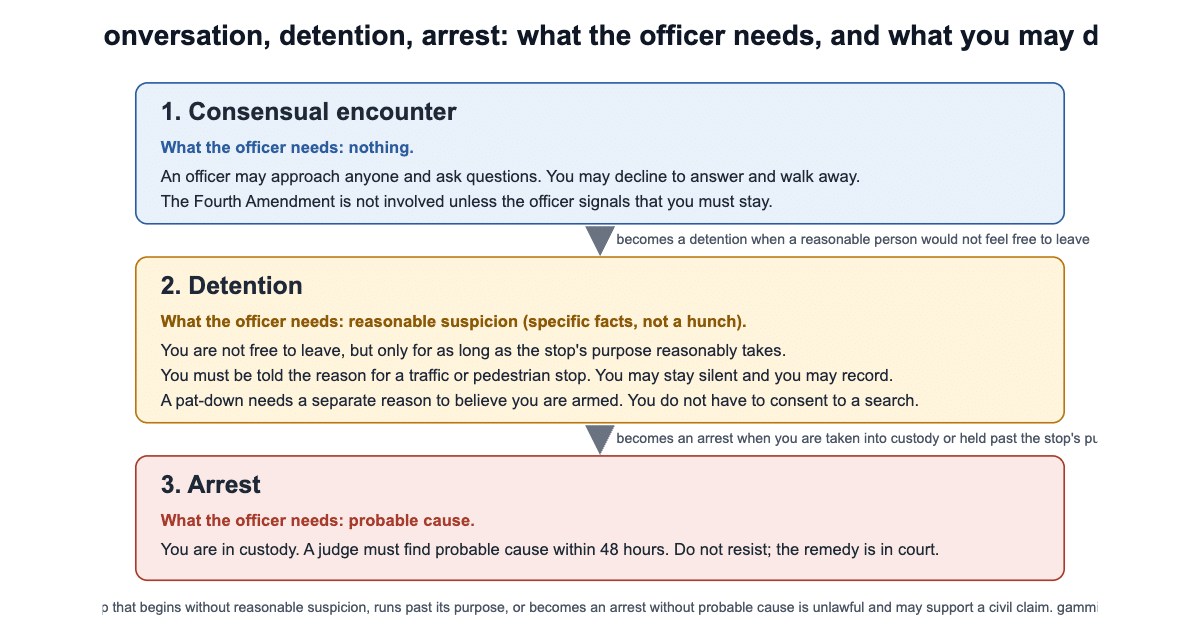
Three levels of police contact under California law: consensual encounter, detention on reasonable suspicion, arrest on probable cause

By David Gammill · Last reviewed: September 27, 2026

In California, police do not need probable cause to detain you. They need reasonable suspicion: specific facts that reasonably suggest you are involved in criminal activity. Probable cause is the higher standard required for an arrest. A detention on reasonable suspicion is lawful only for as long as it reasonably takes the officer to confirm or dispel that suspicion. A detention becomes illegal when it starts without reasonable suspicion, runs longer than its purpose allows, or turns into an arrest without probable cause. When that happens, you may have a civil claim under federal law and under California’s Bane Act. This page explains the rules in plain terms first, then covers the California and United States Supreme Court decisions through 2026 for lawyers evaluating a claim.

  • Three levels of police contact: a consensual conversation (no suspicion needed; you can walk away), a detention (reasonable suspicion; you are not free to leave for a short time), and an arrest (probable cause; you are in custody).
  • No fixed clock: California and federal law set no number of minutes. A detention may last as long as the stop’s purpose reasonably requires and no longer. Extending a traffic stop to wait for a drug dog or run unrelated checks, without new suspicion, is unlawful.
  • You are entitled to the reason: since January 1, 2024, an officer making a traffic or pedestrian stop in California must state the reason for the stop before asking questions, with a narrow exception for imminent threats.
  • Recording is protected: filming an officer in public is not, by itself, obstruction, reasonable suspicion or probable cause under California law.
  • The civil remedy: an illegal detention can support a federal civil rights claim under 42 U.S.C. § 1983, a California Bane Act claim, and a false imprisonment claim. The state-law claims against a city or county require a government claim within six months.

If you were stopped, held or arrested without a lawful reason in Los Angeles County, call Gammill Law Accident & Injury Lawyers at 310-750-4149 for a free consultation, or send us a message through our contact page.

Two ways to read this page. Part 1 answers the questions people ask most, in plain terms. Part 2 is written for lawyers evaluating an unlawful detention claim and covers the seizure test, the reasonable suspicion cases through 2026, the California Supreme Court line, prolonged stops, and how the federal and Bane Act claims are pleaded and defended.

Part 1: The Plain Answers

What Is the Difference Between Being Detained and Being Arrested?

A detention is a temporary stop to investigate; an arrest takes you into custody. The law recognizes three kinds of contact between police and the public, and each one requires something different from the officer.

  1. A consensual encounter. An officer may walk up to anyone and ask questions. No suspicion is required, because you are free to decline and walk away. The Fourth Amendment is not involved unless the officer does something that a reasonable person would understand as a command to stay.
  2. A detention. The officer briefly holds you to investigate. You are not free to leave. This requires reasonable suspicion, meaning specific facts that reasonably suggest you are involved in a crime. The rule comes from Terry v. Ohio (1968) 392 U.S. 1, and the California Supreme Court adopted the same standard in In re Tony C. (1978) 21 Cal.3d 888.
  3. An arrest. You are taken into custody. This requires probable cause: facts that would lead a reasonable officer to believe you committed a crime. Probable cause is more than reasonable suspicion, and it is the standard most people have in mind when they ask whether police can hold them “without probable cause.”

Handcuffs, a pat-down or being ordered to sit on the curb do not by themselves turn a detention into an arrest. Courts look at whether the restraint was reasonable for the purpose of the stop. But a detention that goes on too long, moves you somewhere else without reason, or involves more force than the situation calls for can become a de facto arrest, and at that point the officer needs probable cause.

Can a Cop Detain You for No Reason?

No. An officer needs reasonable suspicion to detain you, and a hunch is not enough. The Supreme Court in Terry required “specific and articulable facts” that, taken together with the reasonable inferences from those facts, justify the intrusion. A feeling that someone looks suspicious, a refusal to answer questions, or simply being in a neighborhood where crime is common does not meet that test.

The California Supreme Court applied that rule in People v. Flores (2024) 15 Cal.5th 1032. Officers in a high-crime area at night saw a man duck behind a parked car, crouch near his shoe, and avoid looking at them. The Court held that this conduct, even in that location, did not supply reasonable suspicion. It wrote that a person’s presence in a high-crime area “cannot be said to transform them into suspects,” that behavior which is merely “odd” does not signal crime, and that a refusal to cooperate “does not furnish the minimal level of objective justification needed for a detention or seizure.” The officers were free to keep watching and to approach him for a voluntary conversation. They were not free to detain him.

Courts also consider the whole picture rather than each fact alone. The most recent word from the United States Supreme Court is District of Columbia v. R.W. (Apr. 20, 2026) 608 U.S. ___, which reversed a lower court for “excising” facts from the analysis. A late-night dispatch about a suspicious car, two passengers running from the police, and the driver backing out with a rear door still open added up to reasonable suspicion when weighed together, even though no single fact would have. So the answer runs both ways: an officer cannot stop you on a hunch, and an officer can stop you when several individually innocent facts combine into a reasonable, particularized suspicion.

Do Police Need Probable Cause to Detain You?

No. Probable cause is the standard for an arrest, a search of your home, or a warrant. Reasonable suspicion, a lower standard, is enough for a brief detention. This distinction is where most confusion about “detainment laws” starts. If an officer detains you with reasonable suspicion and the suspicion does not develop into probable cause, the officer must let you go. If the officer arrests you without probable cause, the arrest is unlawful even if the initial stop was fine.

Two examples show the line. In People v. Brown (2015) 61 Cal.4th 968, a 911 caller reported a fight with a possible gun in an alley; a deputy arrived within minutes and found a single car leaving the otherwise empty alley. The California Supreme Court held that the reliable, contemporaneous report plus the driver’s presence at the scene supported a brief detention, even without a description of the suspects. In Flores, the same Court found that ducking behind a car in a known drug area, with no report and no flight, did not. Reasonable suspicion is a low bar, but it is a real one.

How Long Can Police Detain You in California?

There is no set number of minutes. A detention may last as long as it reasonably takes to complete the purpose of the stop, and no longer. The Supreme Court’s plurality in Florida v. Royer (1983) 460 U.S. 491 wrote that an investigative detention “must be temporary and last no longer than is necessary to effectuate the purpose of the stop.” The California courts apply the same rule.

For a traffic stop, the purpose is to address the traffic violation: checking the license, registration and insurance, running a warrant check, and writing the ticket or warning. In Rodriguez v. United States (2015) 575 U.S. 348, the Court held that once those tasks are done, or reasonably should have been done, the authority for the stop ends. An officer who has finished the ticket cannot hold the driver for a drug-sniffing dog, even for a few extra minutes, unless something during the stop produced new reasonable suspicion. The same logic applies to a pedestrian stop: an officer who has confirmed or dispelled the original suspicion cannot keep you standing there while looking for something else.

The picture changes if the detention becomes an arrest. Once you are arrested, a judge must find probable cause within 48 hours under County of Riverside v. McLaughlin (1991) 500 U.S. 44, and California’s Penal Code section 825 requires arraignment within 48 hours of arrest, excluding Sundays and holidays. Those are custody rules, not detention rules, and an arrest still has to begin with probable cause. The 48-hour figure that appears on many websites answers the question “how long can I be held after an arrest,” not “how long can I be detained on the street.”

Can Police Detain You Without Telling You Why?

For a traffic or pedestrian stop in California, no. Since January 1, 2024, the officer must state the reason for the stop before questioning you. The rule is in Vehicle Code section 2806.5, added by Assembly Bill 2773, and it also requires the reason to be written on any citation or report:

(a) A peace officer making a traffic or pedestrian stop, before engaging in questioning related to a criminal investigation or traffic violation, shall state the reason for the stop. The officer shall document the reason for the stop on any citation or police report resulting from the stop.

(b) Subdivision (a) does not apply when the officer reasonably believes that withholding the reason for the stop is necessary to protect life or property from imminent threat, including, but not limited to, cases of terrorism or kidnaping.

Source: Cal. Veh. Code § 2806.5, California Legislative Information (verified September 27, 2026).

The statute does not say what happens if an officer ignores it, and a violation does not by itself make the detention unconstitutional. It matters in a civil case for a different reason: the reason the officer gives, or fails to give, is evidence of whether reasonable suspicion existed at the moment of the stop. California also requires every law enforcement agency to report the reason for each stop, the reason given to the person, and the basis for any search under the Racial and Identity Profiling Act, Government Code section 12525.5, and that data is public.

Am I Being Detained, or Am I Free to Go?

You are detained when a reasonable person in your position would not feel free to leave or to end the encounter, and you actually submit. That is the test from United States v. Mendenhall (1980) 446 U.S. 544, as the California Supreme Court restated it in People v. Brown and People v. Tacardon (2022) 14 Cal.5th 235. The courts look at things like the number of officers, whether a weapon is displayed, sirens or emergency lights, physical contact, a patrol car blocking your way, and language or tone that indicates compliance is required.

Two California cases mark the boundary. In Brown, a deputy pulled up behind a parked car and turned on his overhead emergency lights; the Court held that a reasonable driver would understand the lights as an order to stay, so the driver was detained the moment they came on. In Tacardon, a deputy parked behind a car, turned a spotlight on it and walked toward it, without lights, siren, commands or a drawn weapon; the Court held that a spotlight alone did not detain the occupants. Neither case adopts a bright-line rule. The question is always what a reasonable person would understand from everything the officer did.

If you are unsure, you can ask: “Am I being detained, or am I free to go?” A clear answer settles the question. If the officer says you are free to go, you may leave. If the officer says you are detained, you are not free to leave, and the officer now has to be able to point to reasonable suspicion for holding you.

Three levels of police contact under California and federal law: a consensual encounter needs no suspicion and the person may walk away; a detention requires reasonable suspicion and may last only as long as the stop reasonably takes; an arrest requires probable cause and places the person in custody
Conversation detention arrest what the officer needs at each level and what you may do

Do You Have to Show ID When Detained in California?

California has no “stop and identify” statute. Refusing to give your name during a detention is not, by itself, a crime. Some states make it an offense to refuse to identify yourself during a lawful stop, and the Supreme Court upheld one such law in Hiibel v. Sixth Judicial District Court (2004) 542 U.S. 177. California never enacted one. In In re Chase C. (2015) 243 Cal.App.4th 107, the Court of Appeal reversed a resisting conviction based on a detained teenager’s refusal to give his name, holding that before booking a person is free to refuse to identify himself without violating Penal Code section 148.

There are limits. If you are driving, Vehicle Code section 12951 requires you to present your license when a peace officer asks. If an officer is writing a citation and you refuse to identify yourself, the officer may take you into custody instead of citing and releasing you, and a court has treated that refusal as obstruction. And once you are arrested and booked, refusing to identify yourself does violate section 148. Giving a false name is a separate offense. Outside those situations, silence is lawful.

Can You Record the Police in California?

Yes. Filming or recording an officer in public is not obstruction, and it is not a reason to detain or arrest you. California wrote that rule into the obstruction statute itself in 2016. Penal Code section 148, subdivision (g), reads in full:

(g) The fact that a person takes a photograph or makes an audio or video recording of a public officer or peace officer, while the officer is in a public place or the person taking the photograph or making the recording is in a place he or she has the right to be, does not constitute, in and of itself, a violation of subdivision (a), nor does it constitute reasonable suspicion to detain the person or probable cause to arrest the person.

Source: Cal. Penal Code § 148, California Legislative Information (verified September 27, 2026).

The words “in and of itself” do the work. Recording is protected; physically interfering with an officer while you record is not. Keep a reasonable distance, do not reach toward the officer or the person being detained, and keep recording. A recording that shows the officer never had a reason to stop you is often the best evidence in a civil case, which is one reason the police body camera rules in California matter so much. We explain those on our page about body camera footage in civil rights cases.

What Are My Rights During a Traffic Stop in California?

A traffic stop is a detention of everyone in the car, and the same limits apply. The Supreme Court held in Brendlin v. California (2007) 551 U.S. 249 that a passenger is seized when the car is pulled over, so a passenger can challenge an unlawful stop just as the driver can. In practical terms:

  • The officer needs a reason for the stop. Any observed traffic violation is enough (Whren v. United States (1996) 517 U.S. 806), and so is a reasonable mistake about what the law requires (Heien v. North Carolina (2014) 574 U.S. 54). A stop with no violation and no reasonable suspicion is unlawful from the start.
  • The officer must tell you the reason before questioning, under Vehicle Code section 2806.5.
  • You must provide your license, registration and proof of insurance if you are the driver. You do not have to answer questions about where you are going or where you have been.
  • You do not have to consent to a search. An officer may search the car without consent only with probable cause or another recognized exception. You can say, clearly and calmly, that you do not consent. Do not physically resist a search; the remedy for an unlawful search is in court, not on the roadside.
  • The stop must end when its purpose is complete. Under Rodriguez, the officer cannot extend the stop to wait for a drug dog or a second unit without new reasonable suspicion.
  • You may record. Section 148(g) applies on the roadside as it does anywhere else.

What Makes a Detention Illegal?

A detention is unlawful when it fails any one of four tests. These are the questions a civil rights lawyer asks first:

  1. Was there reasonable suspicion when the detention began? Facts learned after the stop cannot justify it. Presence in a high-crime area, nervousness, refusal to talk, or recording the officer are not enough on their own (Flores; Penal Code section 148(g)).
  2. Did the detention last longer than its purpose? A stop extended past the point where its tasks were, or reasonably should have been, complete is unlawful without new suspicion (Rodriguez; Royer).
  3. Did the detention turn into an arrest without probable cause? Moving you to a station, holding you for an extended period, or using restraint well beyond what the stop required can convert a detention into an arrest, and an arrest needs probable cause.
  4. Was force used beyond what the stop required? Even a lawful detention can involve unlawful force. That is a separate claim, explained on our page about excessive force by police in California.

What Can You Do After an Illegal Detention?

An unlawful detention violates the Fourth Amendment, and California gives you two routes to sue for it: a federal civil rights claim and a state Bane Act claim, usually filed together. Here is what each involves and what to do first.

  • Write down everything now. Date, time, location, what the officer said the reason was, how long you were held, what you were asked, whether you were searched, handcuffed or moved, the officers’ names and badge numbers, and the names of any witnesses. Save your own recording and ask witnesses to save theirs.
  • Preserve the video. Most Los Angeles County agencies wear body cameras. Their retention schedules can be short for footage not tied to an arrest, so a written request to preserve the recording should go out quickly. Our body camera page explains how.
  • Get medical care if you were hurt, and keep the records.
  • Know the two deadlines. A claim against a city, county or state agency under California law (Bane Act, false imprisonment, battery, negligence) must be presented to that agency within six months of the incident under Government Code section 911.2. The federal claim under 42 U.S.C. § 1983 borrows California’s two-year personal injury period under Code of Civil Procedure section 335.1. The six-month deadline is the one that catches people.
  • Talk to a civil rights lawyer before you file a complaint with the department. An internal complaint can be useful, but what you say in it is a statement the department will have, and it is better to make it with counsel.

The federal claim is under 42 U.S.C. § 1983, which allows a lawsuit against any person who, acting under color of state law, deprives you of a constitutional right; an unreasonable seizure is exactly that. The state claim is under Civil Code section 52.1, the Tom Bane Civil Rights Act, which provides damages, attorney’s fees and other relief when someone interferes with your rights by threat, intimidation or coercion. Our Bane Act explainer covers the statute in depth, and our FAQ answers whether you can sue the police in California. Part 2 explains how the two claims differ in practice, including why the Bane Act often survives when the federal claim does not.

Part 2: For Lawyers Evaluating an Unlawful Detention Claim

The Seizure Question: When Did the Detention Begin?

Reasonable suspicion is measured at the moment of seizure, so fixing that moment is the first task in every case. A seizure by show of authority requires both an objective show of authority that would lead a reasonable person to believe they were not free to leave or end the encounter (Mendenhall; Florida v. Bostick (1991) 501 U.S. 429) and actual submission (California v. Hodari D. (1991) 499 U.S. 621). Brendlin settled that submission can take the form of passive acquiescence, such as a passenger remaining in a stopped car, and Brown applied that to a driver who stayed in his parked car after the emergency lights came on. Torres v. Madrid (2021) 592 U.S. 306 added that the application of physical force with intent to restrain is a seizure even if the person escapes.

The California Supreme Court’s factor list in Tacardon is the working checklist: multiple officers, a displayed weapon, siren or overhead emergency lights, physical touching, a patrol car used to block movement, and commanding language or tone. Brown holds that emergency lights directed at a parked car will ordinarily detain its occupants, while declining a per se rule (a motorist broken down on the shoulder might reasonably read the lights as an offer of help). Tacardon holds that a spotlight alone ordinarily does not, again without a per se rule. Between them, the Court has made clear that the analysis is cumulative, and that a defense expert’s attempt to characterize the encounter as consensual has to account for every coercive element, not the mildest one.

Reasonable Suspicion in the Supreme Court, 2000 to 2026

CaseYearWhat it holds
Terry v. Ohio, 392 U.S. 11968A brief investigative stop on “specific and articulable facts” is reasonable; a frisk requires a separate reasonable belief that the person is armed and dangerous.
Florida v. Royer, 460 U.S. 4911983Plurality: a detention must be temporary and last no longer than necessary to effectuate its purpose; moving the suspect to a small room and holding his ticket and license exceeded a Terry stop.
Illinois v. Wardlow, 528 U.S. 1192000Unprovoked, headlong flight from police in a high-crime area supports reasonable suspicion; presence in the area alone does not.
Hiibel v. Sixth Judicial Dist. Court, 542 U.S. 1772004A state may criminalize refusal to identify oneself during a lawful Terry stop. California has no such statute.
Brendlin v. California, 551 U.S. 2492007A passenger is seized in a traffic stop and may challenge its legality.
Navarette v. California, 572 U.S. 3932014A contemporaneous, eyewitness 911 report with indicia of reliability can supply reasonable suspicion for a traffic stop.
Heien v. North Carolina, 574 U.S. 542014An officer’s objectively reasonable mistake of law can support reasonable suspicion.
Rodriguez v. United States, 575 U.S. 3482015A traffic stop may not be prolonged beyond the time reasonably required to complete its mission; a dog sniff that adds time without independent suspicion violates the Fourth Amendment.
Manuel v. City of Joliet, 580 U.S. 3572017Pretrial detention without probable cause is a Fourth Amendment violation actionable under § 1983 even after legal process begins.
Kansas v. Glover, 589 U.S. 3762020An officer who runs a plate and learns the registered owner’s license is revoked has reasonable suspicion to stop the car, absent information that the owner is not driving.
Torres v. Madrid, 592 U.S. 3062021Application of physical force with intent to restrain is a seizure even if the person does not submit or stop.
District of Columbia v. R.W., 608 U.S. ___ (per curiam)Apr. 20, 2026Summary reversal for “excising” the dispatch call and companions’ flight before weighing; the totality analysis “precludes the evaluation and rejection of factors in isolation from each other.” Justice Jackson dissented.

Two things are not in that table on purpose. United States v. Carter, No. 25-885, presented the question whether a person’s race may inform the “free to leave” analysis; the Court denied certiorari on June 22, 2026, over a dissent, so the question remains open and the D.C. court’s approach is not law in California. And nothing in the federal line displaces the California constitutional cases, because after Proposition 8 the California courts apply federal Fourth Amendment law to suppression questions; the state-law civil claims discussed below borrow the same reasonableness analysis.

The California Supreme Court Line

CaseYearWhat it adds
In re Tony C., 21 Cal.3d 8881978California’s detention standard: the officer must be able to point to specific articulable facts that some activity relating to crime has taken place, is occurring or is about to occur, and that the person is involved.
People v. Souza, 9 Cal.4th 2241994Flight on seeing police, at 3 a.m., in a high-crime area, with companions who also fled, supported reasonable suspicion. Flight is a factor, not a rule.
People v. Brown, 61 Cal.4th 9682015Emergency lights behind a parked car detained the occupant; passive acquiescence is submission; a reliable 911 report of a fight with a possible gun plus presence at the scene minutes later supported the detention.
People v. Tacardon, 14 Cal.5th 2352022Parking behind a car, spotlighting it and approaching on foot did not detain the occupants; the factor list; no bright-line rule for spotlights.
People v. Flores, 15 Cal.5th 10322024Ducking behind a car, crouching near a shoe and avoiding officers in a high-crime area at night did not supply reasonable suspicion. Presence in the area and “odd” behavior are not enough; refusal to cooperate adds nothing. Reversed, suppression ordered.

Flores is the case to lead with in any post-2024 California detention claim. It distinguishes Wardlow (headlong flight) and Souza (multiple people fleeing at 3 a.m.) on their facts, and it says in plain language that many law-abiding Californians live and work in high-crime areas and that their presence there “cannot be said to transform them into suspects.” The Court also reaffirmed the consensual-encounter alternative: officers may watch, approach and ask, and if the response gives them more, the analysis changes. In a civil case that passage frames the defense theory (the encounter was consensual) and the plaintiff’s answer (it was not, because of the show of authority, and at that moment there was nothing).

Prolonged Stops After Rodriguez

Rodriguez shifted the prolonged-stop analysis from “how long” to “what for.” The mission of a traffic stop is to address the infraction and attend to related safety concerns: license, registration, insurance, warrants, the citation. Inquiries unrelated to that mission are permitted only if they do not lengthen the stop. Time spent waiting for a dog, a second unit, or a records check unrelated to the violation counts against the officer unless independent reasonable suspicion had developed. The critical time is when the mission’s tasks were, or reasonably should have been, completed; an officer cannot slow-walk the ticket to buy time.

For a civil plaintiff, the body camera timeline and the CAD log establish the mission’s end point. A stop that ran twenty minutes past the completed citation while officers questioned the occupants about unrelated matters is a Rodriguez violation whether or not anything was found, and the passenger has standing under Brendlin. Where the prolonged stop produced an arrest, Manuel and Wallace v. Kato (2007) 549 U.S. 384 govern the Fourth Amendment claim through the period of custody and its accrual.

Pleading the Federal Claim

Under 42 U.S.C. § 1983, an unlawful detention is pleaded as an unreasonable seizure under the Fourth Amendment against the individual officers, with entity liability only under Monell v. Department of Social Services (1978) 436 U.S. 658. The elements are a seizure, the absence of reasonable suspicion (or a detention that exceeded its lawful scope or duration), and action under color of state law. The limitations period is California’s two-year personal injury period, Code of Civil Procedure section 335.1, borrowed under Wallace. No government claim is required for the federal cause of action.

Qualified immunity is the principal defense. Under Pearson v. Callahan (2009) 555 U.S. 223, the officer prevails unless the right was clearly established in the specific context, and the Supreme Court has repeatedly reversed circuit courts for defining the right at too high a level of generality. For detentions, the plaintiff’s task is to identify controlling authority holding that the particular combination of facts did not amount to reasonable suspicion; Flores is state authority, useful but not controlling on the federal question, so Ninth Circuit and Supreme Court cases do the work. Monell liability requires a policy, custom or failure to train that caused the violation; RIPA stop data for the agency, obtainable under the Racial and Identity Profiling Act, is one source of custom evidence.

Pleading the Bane Act Claim, and the Specific Intent Split

Civil Code section 52.1 reaches interference, by threat, intimidation or coercion, with rights secured by the state or federal constitutions or laws. Venegas v. County of Los Angeles (2004) 32 Cal.4th 820 held that the plaintiff need not belong to a protected class and that an unreasonable seizure is a qualifying predicate. The statute provides damages, including the statutory damages of Civil Code section 52, injunctive relief and attorney’s fees, and it now states that the Government Code immunities in sections 821.6, 844.6 and 845.6 do not apply to peace officer conduct. Our Bane Act explainer quotes the statute and covers the elements; this section covers the point that decides most detention cases.

The contested question is what “coercion” means when the only coercion is the detention itself. Allen v. City of Sacramento (2015) 234 Cal.App.4th 41 held that “a wrongful arrest or detention, without more, does not satisfy both elements of section 52.1,” and that conclusory allegations of coercion do not state a claim. Cornell v. City and County of San Francisco (2017) 17 Cal.App.5th 766 went the other way after a full trial: where an unlawful arrest is properly pleaded and proved, the Bane Act’s egregiousness requirement “is tested by whether the circumstances indicate the arresting officer had a specific intent to violate the arrestee’s right to freedom from unreasonable seizure, not by whether the evidence shows something beyond the coercion ‘inherent’ in the wrongful detention.” Reckless disregard of the right suffices; the officer need not have known the arrest was unlawful. Cornell treated Allen as a pleading decision and affirmed the judgment and fee award.

The Ninth Circuit adopted Cornell in Reese v. County of Sacramento (9th Cir. 2018) 888 F.3d 1030, holding that the Bane Act does not require coercion independent of the constitutional violation, but does require specific intent, so a jury finding of an objectively unreasonable seizure does not by itself establish the Bane Act claim. Reese is also the clearest illustration of why the state claim matters: the jury found a Fourth Amendment violation, the officer won qualified immunity on the § 1983 claim, and the court sent the Bane Act claim back for a new trial on specific intent, because federal qualified immunity is not a defense to the state claim. The Court of Appeal has not fallen into line behind Cornell, however. Animal Protection and Rescue League v. County of Riverside (2025) 111 Cal.App.5th 914 followed Allen in a case involving only a spoken threat of arrest, quoted Allen‘s “without more” language, and noted Cornell‘s contrary conclusion in a footnote without adopting it. Until the California Supreme Court resolves the split, plead specific intent expressly, plead the coercive facts beyond the bare detention where they exist (weapons drawn, handcuffs, threats, duration, the stated reason versus the real one), and expect the federal courts to apply Cornell and some state trial courts to apply Allen.

The Companion State Claims, Immunities and Damages

False imprisonment is the common-law tort that fits an unlawful detention, and it is pleaded alongside the Bane Act claim. Its elements are an intentional confinement without lawful privilege for an appreciable time, however short. The public entity is vicariously liable for its officers’ torts under Government Code section 815.2, and the entity, not the officer, is the practical defendant on the state claims. Each state claim requires a timely government claim under Government Code section 911.2 (six months) and suit within six months of the entity’s written rejection under section 945.6; the claim deadline page walks through the late-claim process.

On damages, the Bane Act supports actual damages, the section 52 statutory damages, and fees under section 52.1(i); § 1983 supports compensatory damages and fees under 42 U.S.C. § 1988. Punitive damages are available against individual officers under Civil Code section 3294 and under federal law, but Government Code section 818 bars punitive damages against a public entity. The recording the plaintiff made under section 148(g), and the agency’s own body camera footage, are usually the difference between a claim that settles and one that does not; the retention and disclosure rules for that footage are on our body camera page.

Is This Law Current?

Yes. The statutes quoted and cited on this page reflect California law as of the review date at the top, verified against the official California Legislative Information site. Vehicle Code section 2806.5 has been operative since January 1, 2024, and Penal Code section 148, subdivision (g), in its current form since 2016. The most recent United States Supreme Court decision on reasonable suspicion is District of Columbia v. R.W. (April 20, 2026), and the most recent California Supreme Court decision on the detention standard is People v. Flores (May 2, 2024). The Bane Act specific-intent split between Cornell and Allen remains unresolved as of the review date; Animal Protection and Rescue League (June 2025) is the most recent published Court of Appeal decision on it.

Legal References

  1. U.S. Const. amend. IV; Cal. Const. art. I, § 13.
  2. 42 U.S.C. § 1983; 42 U.S.C. § 1988 (fees).
  3. Cal. Civ. Code § 52.1 (Tom Bane Civil Rights Act); § 52 (statutory damages); § 3294 (punitive damages).
  4. Cal. Penal Code § 148, subd. (a)(1) (obstruction) and (g) (recording officers).
  5. Cal. Penal Code § 825 (arraignment within 48 hours of arrest).
  6. Cal. Veh. Code § 2806.5 (reason for the stop; AB 2773); § 12951 (driver’s license on demand).
  7. Cal. Gov. Code § 12525.5 (Racial and Identity Profiling Act stop data).
  8. Cal. Gov. Code § 911.2 (six-month government claim); § 945.6; § 815.2 (vicarious liability); § 818 (no punitive damages against entities).
  9. Cal. Code Civ. Proc. § 335.1 (two-year period borrowed for § 1983).
  10. Terry v. Ohio (1968) 392 U.S. 1.
  11. United States v. Mendenhall (1980) 446 U.S. 544; Florida v. Bostick (1991) 501 U.S. 429; California v. Hodari D. (1991) 499 U.S. 621.
  12. Florida v. Royer (1983) 460 U.S. 491.
  13. County of Riverside v. McLaughlin (1991) 500 U.S. 44.
  14. Whren v. United States (1996) 517 U.S. 806; Heien v. North Carolina (2014) 574 U.S. 54.
  15. Illinois v. Wardlow (2000) 528 U.S. 119.
  16. Hiibel v. Sixth Judicial District Court of Nevada (2004) 542 U.S. 177.
  17. Brendlin v. California (2007) 551 U.S. 249.
  18. Wallace v. Kato (2007) 549 U.S. 384.
  19. Pearson v. Callahan (2009) 555 U.S. 223.
  20. Navarette v. California (2014) 572 U.S. 393.
  21. Rodriguez v. United States (2015) 575 U.S. 348.
  22. Manuel v. City of Joliet (2017) 580 U.S. 357.
  23. Kansas v. Glover (2020) 589 U.S. 376.
  24. Torres v. Madrid (2021) 592 U.S. 306.
  25. District of Columbia v. R.W. (Apr. 20, 2026, No. 25-248) 608 U.S. ___ (per curiam).
  26. United States v. Carter (June 22, 2026, No. 25-885) (certiorari denied).
  27. Monell v. Department of Social Services (1978) 436 U.S. 658.
  28. In re Tony C. (1978) 21 Cal.3d 888.
  29. People v. Souza (1994) 9 Cal.4th 224.
  30. People v. Brown (2015) 61 Cal.4th 968.
  31. People v. Tacardon (2022) 14 Cal.5th 235.
  32. People v. Flores (2024) 15 Cal.5th 1032.
  33. In re Chase C. (2015) 243 Cal.App.4th 107; People v. Knoedler (2019) 257 Cal.Rptr.3d 586 (App. Div.) (citation refusal).
  34. Venegas v. County of Los Angeles (2004) 32 Cal.4th 820.
  35. Allen v. City of Sacramento (2015) 234 Cal.App.4th 41.
  36. Cornell v. City and County of San Francisco (2017) 17 Cal.App.5th 766.
  37. Reese v. County of Sacramento (9th Cir. 2018) 888 F.3d 1030.
  38. Animal Protection and Rescue League v. County of Riverside (2025) 111 Cal.App.5th 914.

About the Author, and How to Reach Gammill Law

David Gammill is a former Los Angeles County Deputy District Attorney who has tried over 100 cases to verdict, first as a prosecutor and then as a trial lawyer for injured people. Every case is different, and past results do not guarantee a similar outcome. Gammill Law represents people in personal injury, wrongful death and civil rights cases across California, and accepts trial referrals and co-counsel arrangements for trial from other attorneys.

Before founding the firm, David tried a federal civil rights case in Utah for a couple whose home had been entered and searched by a narcotics unit; the jury returned a verdict for the couple, finding that two officers had violated their Fourth Amendment rights, and the city later settled for $500,000. The result belongs to that case and its facts, and every case is different.

The firm has recovered more than $100 million for California clients across verdicts and settlements. Its results include a $21.1 million wrongful death verdict, a $16 million school sexual abuse verdict, a $12 million whistleblower retaliation verdict and a $1 million excessive force result; each came from a specific case with its own facts, and no result is a promise about any other case. The full list is on the firm’s case results page.

If you or someone in your family was stopped, held or hurt by police without a lawful reason, request a free case evaluation or call 310-750-4149. There are no upfront legal fees; a fee is collected only if we win, under a written contingency fee agreement that complies with California law.

Disclaimer: This article is educational and informational in nature. It does not constitute legal advice for any specific situation, and reading it does not create an attorney-client relationship. Every case turns on its own facts, and no result is guaranteed; consult a licensed California attorney about your own circumstances.

My name is David Gammill. I am a California trial lawyer and the founder of Gammill Law Accident & Injury Lawyers. Our firm has recovered more than $100 million for California clients. Our results include a $21.1 million wrongful death verdict, a $16 million school sexual abuse verdict, and a $12 million whistleblower retaliation verdict. I learned to try cases in front of juries early in my career as a Deputy District Attorney, and trying cases remains the backbone of my practice.

Ask Gammill AI Calculator