Menu
Call
Contact
Blog

Spinal Cord Injury Claims in California: What the Case Must Prove and What It Can Recover

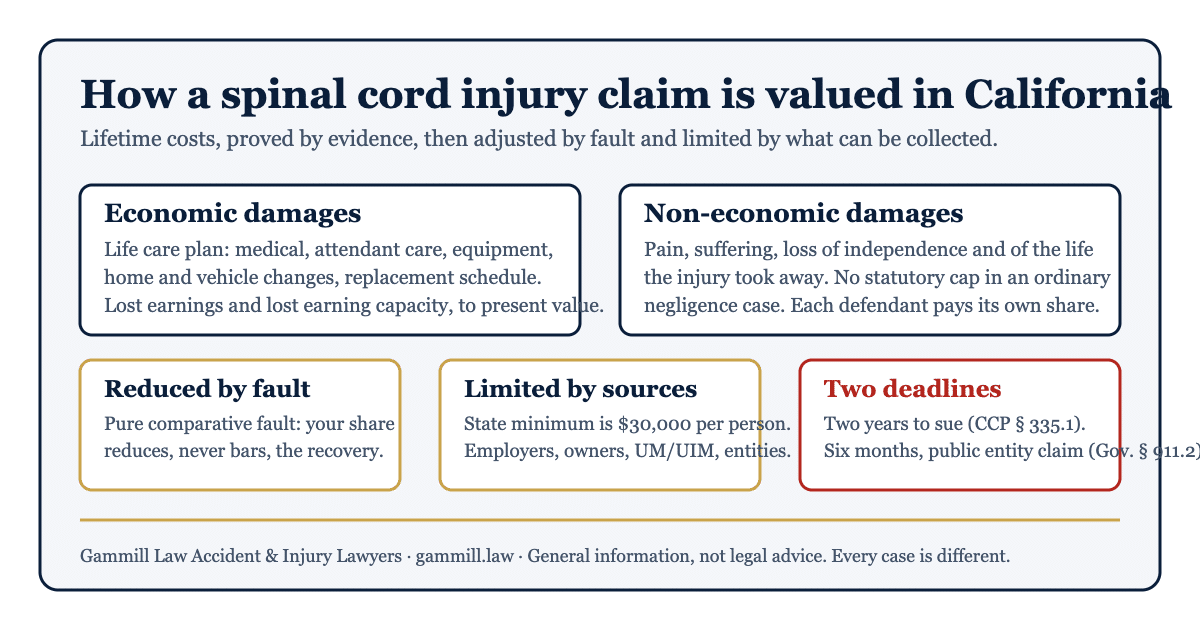
How a California spinal cord injury claim is valued: life care plan, lost earnings, non-economic damages, comparative fault, and insurance limits

Reviewed by David Gammill, California trial attorney · Last reviewed: October 11, 2026

A spinal cord injury claim in California is a claim for everything the injury will cost over a lifetime, not for the hospital bill you have in hand today. The case has to prove that someone else’s negligence caused the injury, and then it has to prove, with medical and economic evidence, what the injury will cost in care, equipment, lost earnings, and lost life for as long as you live. Those numbers run into the millions for most cord injuries, which is why the insurance limits of the person who hurt you, the share of fault assigned to each party, and the two deadlines that end a case if they are missed all matter more here than in an ordinary injury claim. This guide explains how the claim is built, what it can recover, and where it most often goes wrong.

The Bottom Line

  • The claim is valued over a lifetime: future medical care, attendant care, equipment, home and vehicle changes, and lost earning capacity are all recoverable, and they are proved by a life care plan and an economist, not by the bills so far.
  • Future costs are large and documented: the National Spinal Cord Injury Statistical Center puts the first-year cost of a paraplegia-level injury at more than $600,000 in health care and living expenses alone, before lost wages.
  • Fault is shared, not all-or-nothing: California reduces your recovery by your own share of fault but does not bar it, and each defendant pays its own share of the pain-and-suffering damages.
  • Insurance limits decide where the money comes from: a driver carrying the state minimum has $30,000 of bodily-injury coverage per person, so the case is usually about finding every other policy and every other responsible party.
  • Two clocks: two years to file suit in most cases, and six months to present a written claim if a city, county, or the State is responsible for the road or the vehicle.

If you or a family member has a spinal cord injury from a crash, a fall, or any other event someone else caused, call 310-750-4149. The consultation is free, and the evidence that proves fault is being lost while you read this.

How a California spinal cord injury claim is valued: life care plan, lost earnings, non-economic damages, comparative fault, and insurance limits

What Counts as a Spinal Cord Injury in a Claim?

Any damage to the spinal cord that changes sensation, movement, or body function below the point of injury, whether or not it is permanent. Doctors describe the injury by two things: where on the cord it happened and how completely it cut off signals. An injury in the neck, at the cervical vertebrae C1 through C8, can affect all four limbs and is called tetraplegia (also called quadriplegia); an injury lower down, in the thoracic, lumbar, or sacral spine, affects the legs and trunk and is called paraplegia. A complete injury means no movement or sensation below the injury; an incomplete injury means some signals still get through. Doctors grade this on the ASIA Impairment Scale from A, complete, to D, where motor function is preserved and useful, and E, normal. Incomplete tetraplegia is the most common category of new injury in the United States, and fewer than one person in a hundred recovers full neurological function by the time they leave the hospital. For the claim, the level and the grade are the starting point for every cost that follows, which is why the first thing a lawyer does is get the hospital’s neurological exam and the rehabilitation discharge summary.

Two related injuries are handled on their own pages. A traumatic brain injury that happens in the same crash is covered in our guide to brain injury claims, and the broader category of permanent, life-changing injuries is covered on our catastrophic injury page.

Where Do Spinal Cord Injuries Come From?

Mostly from vehicle crashes, then falls. The National Spinal Cord Injury Statistical Center’s 2023 data sheet reports that vehicle crashes have been the leading cause of traumatic spinal cord injury in the United States since 2015, at 37.6 percent of new cases, followed by falls at 31.5 percent, with violence and sports behind them. That matters for the claim because each cause has its own defendants and its own rules. A crash is a claim against the other driver and, often, that driver’s employer or the owner of the vehicle; our car accident page explains how those cases are built. A fall on someone else’s property is a premises liability claim against the owner or the business in control of the property. A crash caused by a road defect, a missing guardrail, or a crash cushion that was not reset is a claim against the public entity that owns the road under Government Code § 835. A crash while you were working for someone else is still an ordinary negligence case against the other driver, separate from any benefits through your employer.

What Does the Claim Have to Prove?

Four things: that the defendant owed you a duty of care, that the defendant breached it, that the breach caused the injury, and what the injury costs. In a crash case the first two are usually the easiest, because every driver owes everyone else on the road the duty to drive with reasonable care and the police report, the vehicle data, and the video tend to show who did not. Causation is where the defense spends its money in a spinal cord case. The defense will argue that a pre-existing disc condition, an old back injury, or a degenerative change on the MRI explains the symptoms rather than the crash. California law takes the injured person as it finds them: a defendant who hurts someone with a weak back is responsible for the harm the crash did to that back, even though a healthier person would have been hurt less. That rule does not stop the argument, though, so the case needs the treating surgeon and usually an independent spine expert to tie the injury on the imaging to the mechanism of the crash. The fourth element, damages, is its own project and is covered next.

What Can a Spinal Cord Injury Claim Recover?

Economic damages, non-economic damages, and in some cases punitive damages. California’s Civil Code defines economic damages as objectively verifiable monetary losses, including medical expenses, lost earnings, the cost of substitute domestic services, and lost employment and business opportunities, and defines non-economic damages as subjective, non-monetary losses, including pain, suffering, inconvenience, mental suffering, emotional distress, and loss of society and companionship. In a spinal cord case the economic side includes:

  • Past and future medical care: the acute hospitalization, surgery, inpatient rehabilitation, and then a lifetime of physician visits, therapy, medication, and the treatment of complications such as pressure injuries, infections, and respiratory problems.
  • Attendant care: the hours of paid help a person needs each day, which for a high cervical injury can be around the clock, and which is often the largest single number in the case.
  • Equipment and replacement: wheelchairs, cushions, transfer equipment, ventilators where needed, and the replacement of each item on a schedule for life.
  • Home and vehicle modification: ramps, widened doors, an accessible bathroom, and an adapted vehicle, or the cost difference of an accessible home.
  • Lost earnings and lost earning capacity: the wages already lost and the difference between what you would have earned over a working life and what you can earn now, with the benefits and raises that would have come with it.
  • Household services: the cooking, cleaning, yard work, and child care you did before and now must pay someone else to do.

Non-economic damages compensate the injury itself: the pain, the loss of independence, the loss of the activities and relationships the injury takes away, and the years of living with it. There is no statutory cap on non-economic damages in an ordinary California negligence case. Punitive damages are available only when the defendant acted with malice, oppression, or fraud, which in a crash case most often means a drunk driver; our guide to Civil Code § 3294 explains the standard.

How Are Future Costs Proved?

With a life care plan, an economist, and the published cost data that supports both. A life care planner, usually a nurse or rehabilitation professional, works from the medical records and the treating doctors’ opinions to list every item of care the injury will require for the rest of your life expectancy, how often, and at what cost. An economist then converts that plan, and your lost earning capacity, into a present value, which is the lump sum that would fund those costs if invested today. The defense hires its own planner and economist, and the gap between the two plans is often where a spinal cord case is tried.

The published data shows why the numbers are what they are. The National Spinal Cord Injury Statistical Center, in its 2023 data sheet, reports average first-year health care and living expenses of $641,153 for a paraplegia-level injury, with $84,934 for each year after that, in 2022 dollars. The same source estimates the lifetime cost of that injury for a person hurt at age 25 at about $2.85 million, discounted to present value. For a high cervical injury at age 25 the same estimate is more than $5.8 million. Those figures exclude lost wages, lost benefits, and lost productivity entirely, which the Center estimates separately at more than $88,000 per year. They are averages across the country, not a value for any one case, and the life care plan in your case will be built on your injury, your doctors, and the cost of care where you live.

What if I Was Partly at Fault?

Your recovery is reduced by your share of fault, not eliminated. California follows pure comparative fault under Li v. Yellow Cab Co. (1975): the jury assigns a percentage of fault to everyone involved, including you, and your damages are reduced by your percentage. A person found 30 percent at fault for a crash recovers 70 percent of the damages, and even a person found mostly at fault can recover the remaining share. In a case worth millions, a dispute over ten percentage points is a dispute over hundreds of thousands of dollars, which is why the defense works hard on seat belt use, speed, and what you were doing in the seconds before impact.

Fault also splits among defendants. Under Civil Code § 1431.2, each defendant is liable for the full amount of your economic damages, but is liable for non-economic damages only in proportion to its own percentage of fault, with a separate judgment against each for that share. If a trucking company is 80 percent at fault and a second driver 20 percent, the second driver pays 20 percent of the pain-and-suffering award and no more, and an uninsured or bankrupt defendant’s share of that award is simply lost. Deciding whom to sue, and proving each defendant’s share, is a strategic decision made early, not after the verdict.

Why Do Insurance Limits Decide So Much?

Because a verdict is only worth what can be collected. For policies issued or renewed on or after January 1, 2025, California requires drivers to carry only $30,000 of bodily-injury liability coverage per person, $60,000 per accident, and $15,000 for property damage under Vehicle Code § 16451. A driver at those limits cannot pay a spinal cord claim, and most individuals have no other assets worth pursuing. The work of the case, therefore, is to find every other source: the employer of a driver who was working at the time; the owner of the vehicle if it was not the driver’s; a rideshare or delivery company’s commercial policy; the manufacturer, if a vehicle or safety component failed; the public entity that designed or maintained the road; the bar that overserved a drunk driver in the narrow circumstances California law allows; and your own uninsured and underinsured motorist coverage, which pays when the at-fault driver’s limits are too low. The amount of underinsured motorist coverage you bought before the crash is often the single largest policy in the case.

One rule cuts the other way. Under Civil Code § 3333.4, a person who owned a vehicle involved in the crash and did not have it insured as California requires cannot recover non-economic damages, meaning pain and suffering, in a claim arising from that crash, and the same bar applies to an injured driver who cannot show financial responsibility, and to a driver convicted of driving under the influence at the time. The one exception written into the statute protects an uninsured owner who was hit by a driver convicted of a DUI offense for that crash. The medical and wage losses are still recoverable under that section; what is lost is the part of the award that compensates the injury itself.

What Are the Deadlines?

Two years to file suit in most cases, and six months to present a written claim when a public entity is responsible. The general deadline to file a personal injury lawsuit in California is two years from the date of injury under Code of Civil Procedure § 335.1. If a city, county, the State, or any other public entity is a defendant, because the road was dangerous, the vehicle that hit you was a city vehicle, or the driver was a public employee on duty, a written claim must be presented to that entity within six months of the injury, before any lawsuit, under Government Code § 911.2. A spinal cord case takes time to value correctly, because the prognosis has to stabilize before anyone can say what the lifetime needs are, and the deadlines do not wait for that. The usual answer is to file within the deadline and let the case develop in litigation rather than to delay filing.

What Does the First Year Cost, and Why Does the Claim Account for It?

The first year after a spinal cord injury is the most expensive year and the one the insurance company most wants to settle before it is counted. It includes the emergency and surgical care, the inpatient rehabilitation stay, the first wheelchair and the first set of equipment, the first changes to the home, the first months of attendant care while the family learns what the injury requires, and the first round of complications, which commonly send people back to the hospital. The National Spinal Cord Injury Statistical Center’s 2023 figure for that first year, for a high cervical injury, is $1,315,554 in health care and living expenses in 2022 dollars, with $228,450 in each later year, before any lost wages. Every one of those items is a documented economic loss that belongs in the claim, and the ones that happen after a settlement is signed cannot be added back. That is the reason a spinal cord claim is not settled in the first year unless the policy limits are all there is to collect, and the reason the lawyer’s first job is to make sure every bill, every piece of equipment, and every hour of family care is recorded from the first week.

Frequently Asked Questions About Spinal Cord Injury Claims

I had back problems before the crash. Do I still have a claim?

Yes. The claim is for the harm the crash caused, including the worsening of a condition you already had. The defense will use your old records to argue that the symptoms were already there, so your lawyer will use the same records to show what you could do before and cannot do now. Tell your lawyer about every prior injury and every prior doctor at the first meeting; a prior condition the other side discovers first does far more damage than one your own lawyer explains first.

The driver who hit me only has minimum insurance. Is the case over?

No. The driver’s policy is the first source, not the only one. The questions are whether the driver was working, who owned the vehicle, whether a company or a public entity shares responsibility, whether a product failed, and how much underinsured motorist coverage you carry on your own policy. Most spinal cord recoveries come from a combination of those sources, and finding them is the job.

Will I have to pay back my health insurance from the settlement?

Usually some of it. A health plan, Medicare, or Medi-Cal that paid for your treatment generally has a right to be reimbursed out of the recovery, and the rules differ by the type of plan. Those claims, called liens, are negotiated as part of the settlement, and reducing them is part of what the lawyer does. Ask any lawyer you are considering how they handle liens, because the answer changes what you actually take home.

What does a spinal cord injury lawyer cost?

Nothing up front. These cases are taken on a contingency fee, a percentage of the recovery, under a written agreement California law requires. Our guide to how no-win, no-fee agreements work explains what the agreement must say and how case costs, which are significant in a case with life care planners and economists, are handled.

About Gammill Law

David Gammill is a former Los Angeles County Deputy District Attorney who has tried over 100 cases to verdict, first as a prosecutor and then as a trial lawyer for injured people. Every case is different, and past results do not guarantee a similar outcome. Gammill Law Accident & Injury Lawyers represents people in personal injury, wrongful death, and civil rights cases across California, and its attorneys bring more than 40 years of combined legal experience to every case they take. The firm has recovered more than $100 million for California clients across verdicts and settlements. Its results include a $21.1 million wrongful death verdict, a $16 million school sexual abuse verdict, and a $12 million whistleblower retaliation verdict; every case is different, and prior results do not guarantee a similar outcome. You can read more on our case results page. Consultations are free, there is no fee unless the firm recovers, and the firm takes calls in English and Spanish. Call 310-750-4149 or request a free case evaluation.

If a family member is still in the hospital and you are not sure what to do first, call 310-750-4149. We will tell you what to preserve, what to write down, and what not to sign.

This page is attorney advertising and general information, not legal advice for any specific situation. Deadlines and outcomes are fact-specific; consult a licensed California attorney about your own circumstances. Prior results do not guarantee a similar outcome.

My name is David Gammill. I am a California trial lawyer and the founder of Gammill Law Accident & Injury Lawyers. Our firm has recovered more than $100 million for California clients. Our results include a $21.1 million wrongful death verdict, a $16 million school sexual abuse verdict, and a $12 million whistleblower retaliation verdict. I learned to try cases in front of juries early in my career as a Deputy District Attorney, and trying cases remains the backbone of my practice.

Ask Gammill AI Calculator