Menu
Call
Contact
Blog

Top 7 Causes of Motorcycle Accidents in Los Angeles

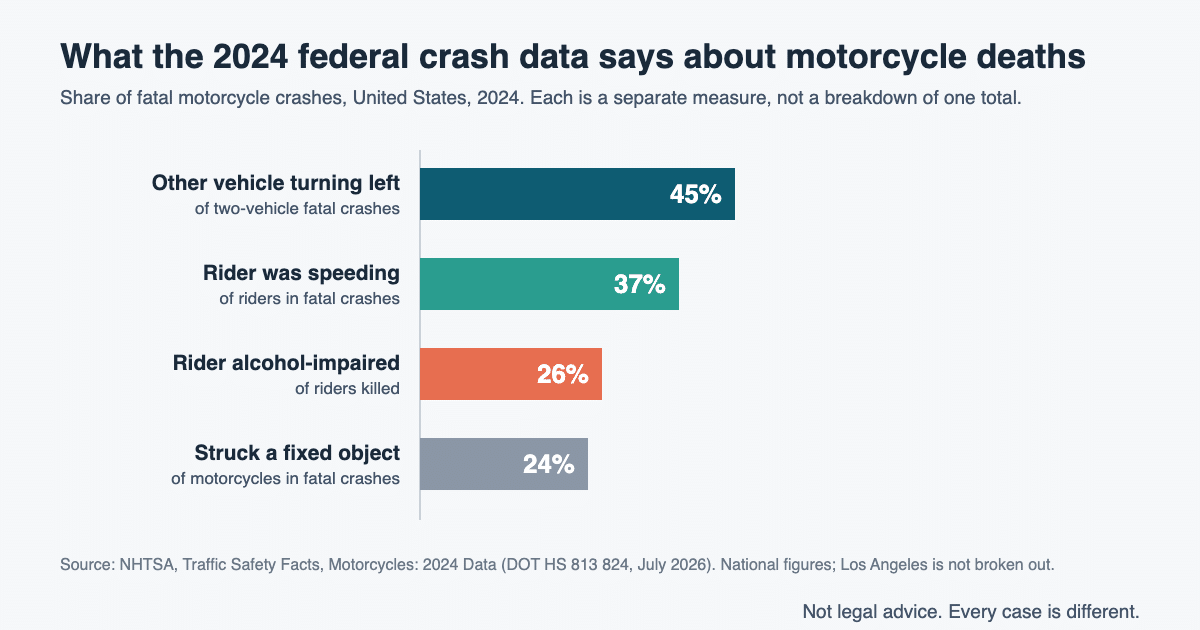
Bar chart of 2024 federal motorcycle crash data comparing the share of two-vehicle fatal motorcycle crashes where the other vehicle was turning left, the share of riders in fatal crashes who were speeding, the share of riders killed who were alcohol-impaired, and the share of motorcycles in fatal crashes that struck a fixed object

Reviewed by David Gammill, California trial attorney · Last reviewed: October 20, 2026

The top causes of motorcycle accidents in Los Angeles are the same seven that kill riders everywhere, with the city’s traffic turning the dial up on each: drivers turning left across a rider’s path, lane splitting that goes wrong, speed, drivers changing lanes without looking, alcohol, road hazards, and drivers on their phones. Nationally, 6,228 motorcyclists died in crashes in 2024, 16 percent of all traffic deaths, and per mile traveled a rider is almost 27 times more likely to die than a car occupant. This guide takes each cause in turn, with the 2024 federal data behind it and the California rule that decides who pays when it happens.

The Bottom Line

  • The left turn is the big one: in 45 percent of the two-vehicle fatal motorcycle crashes in the United States in 2024, the other vehicle was turning left while the motorcycle was going straight, and California law puts the duty to yield on the turning driver.
  • Lane splitting is legal, and that cuts both ways: a rider between lanes is not breaking the law, but the driver who hits one will argue the rider was, and the facts of the split decide it.
  • Speed is argued against the rider: more than a third of riders in fatal crashes nationally were speeding in 2024, and an insurer will reach for that number whether or not it applies to you.
  • Fault is a percentage, not a verdict: California reduces a rider’s recovery by the rider’s share of fault; it does not bar it, and a missing helmet or a legal lane split does not end the claim.
  • Los Angeles adds its own facts: 340 people died in crashes inside the city in 2025 by the state crash data, and the city’s own safety study found unsafe speed to be the primary factor in a large share of fatal vehicle-only collisions.

If you were hurt riding in Los Angeles and the driver’s insurer is already telling you it was your fault, call 310-750-4149. The consultation is free.

Bar chart of 2024 federal motorcycle crash data comparing the share of two-vehicle fatal motorcycle crashes where the other vehicle was turning left, the share of riders in fatal crashes who were speeding, the share of riders killed who were alcohol-impaired, and the share of motorcycles in fatal crashes that struck a fixed object

1. Drivers Turning Left Across a Rider’s Path

A car turns left at an intersection or into a driveway, a motorcycle coming the other way has nowhere to go, and the driver says afterward that the bike came out of nowhere. This is the most common fatal collision between a motorcycle and another vehicle, and it is not close. Federal data for 2024 counts 3,396 two-vehicle fatal crashes involving a motorcycle, and in 1,532 of them, 45 percent, the other vehicle was turning left while the motorcycle was going straight, passing, or overtaking. Drivers misjudge a motorcycle’s speed and distance because its narrow profile gives the eye less to work with, and some do not register the bike at all.

California law is written for exactly this crash. Under Vehicle Code § 21801, a driver turning left or making a U-turn must yield to every oncoming vehicle close enough to be a hazard at any point during the turn, and must keep yielding until the turn can be completed safely. The oncoming rider has the right of way unless the rider was doing something that changed the picture, which is where the insurer will go: the rider was speeding, the rider’s headlight was off, the rider was lane splitting past a stopped car and invisible until the last second. Those are comparative-fault arguments, and in Los Angeles they are made at intersections where the city’s own study found the stakes highest: about 11 percent of intersections are signalized, but they account for over half of the city’s fatal and severe-injury collisions. For a rider, the practical defense is position and visibility: cover the brake through every intersection, assume the waiting car has not seen you, and keep a lane position that puts you in the driver’s windshield rather than behind the car ahead.

2. Lane Splitting That Goes Wrong

California allows riding between lanes of stopped or slow traffic, and Los Angeles traffic is why riders do it. Vehicle Code § 21658.1 defines lane splitting as riding a two-wheeled motorcycle between rows of stopped or moving vehicles in the same lane, on divided and undivided roads alike, and authorizes the California Highway Patrol to publish safety guidelines for it. The CHP’s guidelines are advice rather than law, and they say what experienced riders already know: the risk rises with the rider’s speed over surrounding traffic, with the speed of that traffic, and with the gap between vehicles.

Legal does not mean safe, and it does not mean a driver can ignore you. The crash happens when a driver changes lanes into the gap, opens a door, or drifts, and the rider has no room to react. In the claim that follows, the fact that lane splitting is lawful matters: an insurer cannot treat the split itself as the rider’s fault. What it can argue is the manner of the split, the speed differential, the traffic speed, the weather, the light, and whether the rider was between a truck and a bus with no sight line. That is a comparative-fault argument, and it is won or lost on the physical evidence: the damage pattern on both vehicles, the lane markings, and any camera on the 405 or the 10 that caught the moment. A rider who was splitting carefully in slow traffic and was hit by a driver who did not signal has a strong claim; a rider splitting fast between moving lanes has a reduced one.

3. Speed

Speed shortens the time everyone has to react, and in a motorcycle crash it is argued against the rider by default. In 2024, 37 percent of motorcycle riders in fatal crashes nationally were speeding, compared with 22 percent of passenger car drivers, and the share was highest among riders 15 to 20 years old. Los Angeles is not an exception: the city’s 2024 safety study found unsafe speed to be the primary collision factor in 40 percent of the vehicle-only collisions that killed someone, and the state crash data put about 54 percent of the city’s 2024 crashes on freeways, where speed is the baseline.

Two things follow for a rider’s claim. First, California’s basic speed law is not the posted number; it is the duty to drive at a speed that is reasonable for the conditions, and a driver who was under the limit but too fast for the traffic, the light, or the road can still be at fault, as our guide to Vehicle Code § 22350 explains. Second, the rider’s own speed will be reconstructed from the damage, the skid, and any data in the bike, and an insurer will use the national statistic as if it described you. The answer is evidence: a dash camera, a GPS log, a witness, or a reconstruction that shows what the bike was actually doing.

4. Drivers Changing Lanes Without Looking

A motorcycle fits inside a car’s blind spot, and a driver who checks the mirror and not the shoulder will not see it. The unsafe lane change is the freeway version of the left turn: the driver moves into the rider’s lane, the rider is forced onto the shoulder or into the next lane, and the bike goes down with or without contact. On the 405, the 101, and the 110 at commute speed it is a daily event.

The rule is Vehicle Code § 22107: no driver may turn from a direct course or move right or left on a roadway until the movement can be made with reasonable safety, and then only after signaling if any other vehicle may be affected. A driver who merged into a rider without a signal, or with a signal but without looking, violated it. The usual defense is that the rider was in the blind spot by choice, or was splitting, or appeared from nowhere; the usual proof is the point of impact on the car’s rear quarter, which an accident reconstructionist can read. If the driver never stopped, the claim becomes a hit-and-run and turns on your own uninsured motorist coverage and a police report within 24 hours, which our guide to Vehicle Code § 20001 and hit-and-run explains.

5. Alcohol and Drugs

Impairment is a cause on both sides of the crash, and the law treats the two sides very differently. Nationally in 2024, 26 percent of the riders killed in crashes were alcohol-impaired, and 40 percent of those who died in single-vehicle crashes were. Of the 507 riders killed in California that year, 26 percent were impaired. An impaired rider who crashes alone has no claim against anyone; an impaired rider hit by a negligent driver has a claim reduced by the rider’s share of fault, which an insurer will push toward the whole.

When the driver was the impaired one, the claim changes character. A drunk driver who hits a rider is liable for the injury like any negligent driver, and may also be liable for punitive damages, which California allows where the defendant acted with malice, oppression, or fraud; choosing to drive drunk, knowing the risk, is the classic car-case example, as our guide to Civil Code § 3294 and punitive damages explains. The driver’s own insurer will not pay a punitive award, but the threat of one at trial changes how the case settles. Our drunk driver accident victim page covers how those cases are built, including the bar or host that served the driver.

6. Road Hazards and Bad Pavement

A pothole that a car rolls over can put a motorcycle on its side. Nationally, 24 percent of motorcycles in fatal crashes in 2024 struck a fixed object, compared with 16 percent of passenger cars, and 62 percent of motorcyclist deaths happened away from intersections. Gravel in a curve, a steel plate left proud of the asphalt, a seam between lanes, a pool of oil at a bus stop, a broken signal: each is a hazard a rider cannot ride through the way a driver can.

When the hazard was the road itself, the defendant is a public entity, and the claim runs on different rules. A city, the county, or the State can be liable for a dangerous condition of public property if it knew or should have known about the hazard and failed to fix it in a reasonable time, a standard our guide to Government Code § 835 and dangerous conditions explains. The deadline is the one most riders miss: a written claim must be presented to the responsible entity within six months of the crash, before any lawsuit, as our guide to the six-month government claim deadline explains. In Los Angeles, which entity owns the road matters: city streets belong to the City, freeways belong to Caltrans, and a claim presented to the wrong one does not stop the clock on the right one. Photograph the hazard the same day, before a crew repairs it.

7. Distracted Drivers

A driver looking at a phone for three seconds covers the length of a block without seeing it, and a motorcycle is the vehicle most likely to be in that block. California’s hands-free law bars holding a phone while driving, and the violation is the easiest fault fact to prove when it can be proved: phone records, the car’s infotainment log, a passenger’s account, or the driver’s own admission at the scene. Distraction also explains the left turn and the lane change above; the driver who “never saw” the rider was often looking at something else.

For the rider, distracted drivers are a reason to ride as if invisible: high-visibility gear, a headlight on in daylight, and a lane position that keeps you out of the mirror’s blind arc. For the claim, they are a reason to ask early for the driver’s phone records before they are gone, which is a lawyer’s job and one that a preservation letter in the first week makes possible.

How Does Fault Work in a California Motorcycle Crash?

California compares fault and reduces the recovery by the rider’s share; it does not bar the claim. A rider found 30 percent at fault for a crash recovers 70 percent of the damages. That rule is the reason every section above ends with the insurer’s argument: the adjuster’s job on a motorcycle claim is to move the rider’s percentage up, using speed, lane position, gear, and the general belief that riders take risks. Two of those arguments need a direct answer.

A missing helmet does not end the claim. California requires every rider and passenger to wear a helmet that meets the state standard, fastened and fitted (Vehicle Code § 27803), and in 2024, by known use, 92 percent of the motorcyclists killed in California were wearing one. A rider who was not may face an argument that the head injury would have been less severe, which bears on damages for that injury; it does not excuse the driver who caused the crash, and it has nothing to do with a broken leg. And a lawful lane split is not negligence. The insurer has to show the manner of the split was unreasonable, not that the split happened.

What Can an Injured Rider Recover?

Medical care past and future, lost income and earning capacity, the bike, and the non-economic harm: pain, scarring, and a life that no longer includes riding. Motorcycle injuries are disproportionately severe, which makes the coverage question urgent. California requires drivers to carry only $30,000 per person and $60,000 per accident for bodily injury, with $15,000 for property damage, for policies issued or renewed on or after January 1, 2025 (Vehicle Code § 16451), and a serious rider injury can exceed that in the first week. The recovery then depends on the rider’s own uninsured and underinsured motorist coverage, a second negligent driver, an employer behind the driver, or a public entity that owned the road. Finding every policy is most of the work on a motorcycle case.

The deadline to file a lawsuit for a rider’s injuries is two years from the crash, explained in our guide to Code of Civil Procedure § 335.1; the six-month government claim deadline above applies whenever a public entity is a defendant.

Frequently Asked Questions

What is the most common cause of motorcycle accidents in Los Angeles?

Another vehicle turning left across the rider’s path. It is the most common two-vehicle fatal collision type in the federal data, and Los Angeles intersection density makes it the most common one here. The turning driver has the duty to yield under Vehicle Code § 21801.

Is lane splitting legal in Los Angeles?

Yes, everywhere in California, under Vehicle Code § 21658.1. The CHP publishes safety guidelines, and the manner of a split can still be argued as comparative fault, but the split itself is lawful.

Can I recover if I was not wearing a helmet?

Yes. The helmet law is Vehicle Code § 27803, and a violation may reduce damages for a head injury if the insurer can show the helmet would have changed it. It does not reduce the driver’s fault for causing the crash or affect any other injury.

What if the driver who hit me left the scene?

Report it to the police within 24 hours, which your own uninsured motorist coverage requires for a hit-and-run claim, and get the plate, the make, and the direction of travel to the officer. Cameras along the arterials and on nearby businesses are overwritten within days.

How long do I have to file?

Two years from the crash for a claim against a driver; six months to present a written claim when a city, the county, the State, or Caltrans is responsible for the road or the vehicle. The six-month deadline is the one riders miss, because the road defect is not obvious as a claim until a lawyer looks at the scene.

Related Pages

Our Los Angeles motorcycle accident lawyer page explains how the firm builds a rider’s case in the City of Los Angeles, from the coverage search to the City claim; our Torrance motorcycle accident lawyer page does the same for the South Bay; and our Los Angeles car accident lawyer page carries the city’s crash data and the two-agency reporting picture in detail.

About Gammill Law

David Gammill is a former Los Angeles County Deputy District Attorney who has tried over 100 cases to verdict, first as a prosecutor and then as a trial lawyer for injured people. Every case is different, and past results do not guarantee a similar outcome. Gammill Law Accident & Injury Lawyers represents people in personal injury, wrongful death, and civil rights cases across California, and its attorneys bring more than 40 years of combined legal experience to every case they take. The firm has recovered more than $100 million for California clients across verdicts and settlements. Its results include a $21.1 million wrongful death verdict, a $16 million school sexual abuse verdict, and a $12 million whistleblower retaliation verdict; every case is different, and prior results do not guarantee a similar outcome. You can read more on our case results page. Consultations are free, there is no fee unless the firm recovers, and the firm takes calls in English and Spanish. Call 310-750-4149 or request a free case evaluation.

If a driver turned, merged, or drifted into you and the insurer is already talking about your speed, call 310-750-4149. We will tell you what the fault picture looks like and what evidence to save this week.

This page is attorney advertising and general information, not legal advice for any specific situation. Deadlines and outcomes are fact-specific; consult a licensed California attorney about your own circumstances. Prior results do not guarantee a similar outcome.

My name is David Gammill. I am a California trial lawyer and the founder of Gammill Law Accident & Injury Lawyers. Our firm has recovered more than $100 million for California clients. Our results include a $21.1 million wrongful death verdict, a $16 million school sexual abuse verdict, and a $12 million whistleblower retaliation verdict. I learned to try cases in front of juries early in my career as a Deputy District Attorney, and trying cases remains the backbone of my practice.

Ask Gammill AI Calculator