Hi, my name is David Gammill — injury lawyer.
If you were rear-ended at 5 mph, walked away unhurt, and the other driver’s insurance is paying to fix your bumper without a fight, you almost certainly don’t need a lawyer. If you’ve got whiplash, a stack of medical bills, and an adjuster who’s trying to convince you that $4,000 is generous, you almost certainly do.
Most cases fall somewhere between those two extremes, which is why “is it worth getting an attorney for a car accident” is one of the most-searched questions after a crash. This guide gives you an honest answer instead of the marketing version. We’ll cover when hiring a car accident lawyer makes sense, when it doesn’t, what an attorney actually does for the money, and how the math works out after their fee.
Studies and industry data have long suggested that represented claimants tend to recover meaningfully more than unrepresented ones, especially when injuries are involved. The Insurance Research Council, an industry-funded group, has found gaps as wide as 3-to-1 in some studies. Even after the attorney takes a contingency fee (typically around a third), the net amount in your pocket is usually higher with representation than without.
That doesn’t mean every case needs a lawyer. It means that when there’s real money at stake, going it alone usually costs you more than the fee would have.
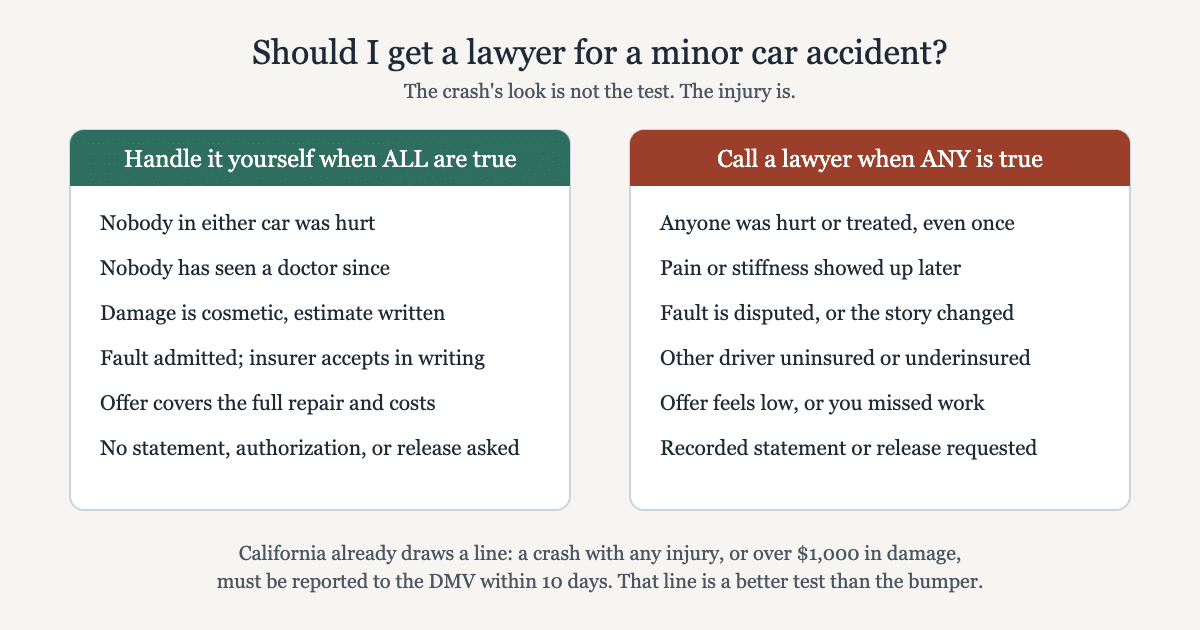
Here’s the simplest way to look at it. If anything in the left column applies, talk to a lawyer. If you’re entirely in the right column, you probably don’t need one.
| ✓ HIRE A LAWYER
When stakes are high or fault is contested |
✗ HANDLE IT YOURSELF
When the case is genuinely simple |
|
|
If you’re unsure, lean toward calling. Free consultations are standard, and at Gammill Law, our case evaluations are no-obligation. A 20-minute phone call costs you nothing and gives you a real opinion from someone who handles these cases for a living. You can also try our free injury settlement calculator for a quick sense of what your case might be worth.
This is the biggest factor. Injury claims involve medical bills, lost wages, future treatment, and pain and suffering damages, and insurers fight every one of those categories. The dollars at stake are usually large enough that an attorney’s fee is more than offset by what they recover above what you’d get on your own.
Even soft-tissue injuries like whiplash, which insurers love to dismiss, are worth representation if you’re in active treatment. Adjusters routinely undervalue these claims because they assume an unrepresented person won’t push back.
If the other driver is denying responsibility, or their insurer is hinting that you were partially at fault, you need someone who knows how to fight that. California’s pure comparative negligence rule means even being found a small percentage at fault directly reduces your recovery. If a jury awards $100,000 but finds you 30% responsible, you walk away with $70,000. That makes fault arguments worth real money, and worth fighting.
Crashes involving delivery trucks, rideshare vehicles, semis, and company cars are different animals. Multiple insurance policies are usually in play, the legal questions get more complex, and the stakes are higher. Truck accident cases in particular involve federal regulations, multiple defendants, and aggressive corporate insurers who lawyer up the moment a crash is reported. You shouldn’t be the only side without representation.
If the at-fault driver has no insurance or not enough coverage to handle your damages, you’ll likely be filing a claim against your own uninsured/underinsured motorist policy. That sounds straightforward until you realize that your own insurance company is now functionally on the other side of the table. They will defend that claim like any other. Having a lawyer matters.
Catastrophic injury cases — traumatic brain injuries, spinal cord damage, severe injuries with permanent disability — and wrongful death claims involve life-altering damages and require specialized experience. The dollar amounts in these cases (often well into seven or eight figures) make insurers fight harder, and the legal complexity demands an attorney who has handled them before.
If your claim has been sitting open for weeks with no movement, or you’re getting reasons why coverage doesn’t apply, the situation has shifted from “routine claim” to “adversarial process.” The clock starts mattering, the statute of limitations starts looming, and the insurer is now playing for time. Get representation.
Lawyers aren’t free, even on contingency. The fee comes out of your settlement, so it’s worth asking whether your case actually benefits from one. You can usually skip representation if all of these are true:
In simple property-damage-only cases, the insurer’s first or second offer is often close to fair, and an attorney’s fee would eat into a recovery that wouldn’t have grown much with representation anyway.
People sometimes picture lawyers as expensive paperwork machines. The reality is more involved than that. Here’s what a personal injury attorney handles on a typical car accident case:
| 1 | Investigates the accident
Pulls police reports, interviews witnesses, gathers traffic camera footage, and reconstructs the crash if needed. |
| 2 | Calculates the full value of your claim
Includes future medical costs, lost earning capacity, and pain and suffering, not just current bills. |
| 3 | Handles all communication with insurers
You stop getting adjuster calls. They stop trying to trip you up on recorded statements. |
| 4 | Negotiates the settlement
Knows what your case is worth, what insurers typically pay, and when to push back on lowball offers. |
| 5 | Files a lawsuit if necessary
Most cases settle, but the threat of litigation is what often produces a fair offer in the first place. |
| 6 | Manages medical liens and bills
Coordinates with your providers, negotiates down outstanding balances, and protects your settlement from being eaten by hospital bills. |
| 7 | Represents you in court if it goes to trial
Roughly 5% of personal injury cases go to trial. When yours does, you want someone who’s done it before. |
The investigation and valuation pieces are the parts most people underestimate. An adjuster’s first offer is based on a software-generated number that almost always leaves out future medical needs and undervalues pain and suffering. A lawyer rebuilds that number from scratch, with documentation. Properly documenting your personal injury is something most people don’t know how to do alone, and it’s where a lot of value gets created or lost.
Here’s how the two paths typically compare across the factors people care about most:
| Factor | Without an Attorney | With an Attorney |
|---|---|---|
| Average settlement | Lower; insurer sets the anchor | Higher; backed by case law and evidence |
| Time to resolve | Often faster, but at lower value | Longer, but more thorough |
| Out-of-pocket cost | None upfront | None upfront (contingency fee) |
| Negotiation leverage | Limited; insurer knows the playbook | Strong; threat of litigation matters |
| Stress level | High; you handle every call | Lower; attorney handles communication |
| Best for | Minor crashes, no injuries | Injuries, disputed fault, complex claims |
The “time to resolve” row is worth a closer look. Going it alone often feels faster because the insurer wants to close the file quickly. But faster is rarely the same as better. The whole point of the early offer is to get you to settle before the full picture of your injuries and losses is clear.
Almost all personal injury attorneys in California work on what’s called a contingency fee, which means they don’t charge anything upfront. They get paid only if they recover money for you, and their fee is a percentage of the settlement or verdict.
Most contingency fees fall in this range:
These numbers vary by firm. Always ask for the exact percentage in writing before you sign anything.
Beyond the fee, there are case costs: filing fees, expert witnesses, medical record retrieval, court reporters, and so on. Reputable firms front these costs and only get reimbursed if you win. Make sure your fee agreement is clear on this; you don’t want to discover at settlement that expenses come out of your share separately from the contingency fee, in a way you didn’t expect.
This is the question everyone wants answered. Here’s a realistic example.
Suppose you handle the claim yourself and the insurer offers you $15,000. A lawyer takes the same case and negotiates it up to $40,000. After a 33⅓% fee ($13,333) and let’s say $1,500 in case expenses, you walk away with about $25,167.
Net result: $25,167 with a lawyer vs. $15,000 without. You’re $10,000 ahead, and you didn’t have to spend three months on the phone with adjusters.
This isn’t every case. Sometimes the difference is smaller. Occasionally, particularly in very minor claims, the math actually does favor handling it yourself. But on injury cases of any meaningful size, the math usually breaks toward representation by a comfortable margin.
| Not Sure If You Need a Lawyer? Find Out for Free.
A 30-minute consultation costs you nothing and tells you whether your case is worth pursuing. Gammill Law’s personal injury attorneys don’t charge unless you win, and you’ll walk away with a clearer picture of what your claim is actually worth. |
Once you’ve decided to hire someone, the next question is who. Personal injury law is a crowded field, and not every lawyer is good at it. A few things to look for:
You want someone whose primary practice is personal injury law, not a general practice attorney who handles wills and divorces and dabbles in car accidents on the side. Insurers know who’s a serious threat and who isn’t. Specialization shows.
Most cases settle, but the lawyers who get the highest settlements are usually the ones insurers know will actually take a case to trial if the offer isn’t fair. Ask candidly: how many trials have you done in the past few years? If the answer is “none,” the insurer probably already knows that too.
Personal injury practice is heavily local. The judges, opposing attorneys, claims adjusters, and even local jury norms all matter. A lawyer with deep roots in your county usually has a meaningful advantage over a flashier firm from three states away. If you’re in the Los Angeles area, that means knowing the difference between a Stanley Mosk Courthouse jury and a Compton Courthouse jury, and how each tends to value certain types of claims.
You’re going to be working with this person for months, possibly longer. During the initial consultation, notice how they talk to you. Do they answer your questions clearly, or do they dodge into legalese? Do they explain the process, or do they just want you to sign? Trust your gut here.
A reputable firm will show you the fee agreement before you sign and walk you through it line by line. If anything feels rushed, vague, or pressured, that’s a red flag. The contingency fee, the handling of case expenses, and what happens if you fire the firm or they drop your case should all be spelled out.
Sooner is better. Evidence disappears, witnesses move, and surveillance footage gets overwritten, sometimes within days. A lawyer can also keep you from making the kinds of early mistakes that hurt your case — the ones we cover in our guide to common personal injury claim mistakes — like giving a recorded statement to the other insurer or signing a broad medical release. You don’t have to commit to representation at the first call. Just talk to one.
Yes, generally. You have the right to fire your attorney and hire a different one at almost any point. The wrinkle is fees: your original lawyer may be entitled to be paid for work already done, usually out of your eventual settlement. The new lawyer can help sort that out so you don’t end up paying two full contingency fees.
If you’ve already signed a settlement release, your case is generally over and you can’t reopen it, even if your injuries turn out to be worse than you thought. There are very narrow exceptions (fraud, for example), but they’re rare. This is exactly why people are warned not to sign anything quickly.
This is the most common misconception about hiring a personal injury attorney. You don’t pay anything upfront. Contingency fees mean the lawyer only gets paid if you win, and the fee comes out of the settlement, not out of your pocket. If they don’t recover anything for you, you don’t owe them a fee.
Clear fault is helpful, but it doesn’t make the insurer generous. Liability and value are two different conversations, and insurers fight on the value side even when fault isn’t in dispute. If you have injuries, you probably still benefit from representation, even on a clear-fault case.
Sometimes, yes. Lawyers don’t settle for the first offer, and full investigation and treatment take time. The trade-off is that the longer process usually produces a substantially better outcome. Just keep the California statute of limitations in mind — you have two years from the date of the crash to file a personal injury lawsuit, so don’t let things drift indefinitely.
Is it worth getting an attorney for a car accident? If you walked away unhurt and your fender just needs paint, probably not. If you have any kind of injury, any kind of dispute, or any kind of pressure from an insurer, almost certainly yes.
The free consultation is the fastest way to find out. Contact Gammill Law for a no-cost case review. Spend twenty minutes on the phone, explain what happened, and listen to what an experienced attorney says. A good lawyer will tell you straight up whether your case needs representation or whether you’re fine handling it yourself. The honest ones turn down cases that aren’t worth pursuing all the time.
That call costs you nothing and answers the question for your specific situation, which is more useful than any general guide can be.