Hi, my name is David Gammill — injury lawyer.

Most people only think about hiring a car accident lawyer once they’re already deep into a stressful situation, and that’s exactly the worst time to figure out what one actually does. The phrase “car accident lawyer” gets used as if it explains itself. It doesn’t.
What follows is the unvarnished version. Not the brochure language, not the courtroom theatrics from movies. The real list of things a car accident attorney spends their time on after a crash, why each piece matters, and how the process actually moves forward.
A car accident lawyer’s core job is to convert your accident, your injuries, and your losses into the maximum legal compensation you’re entitled to, while shielding you from the tactics insurance companies use to minimize that number.
That sentence covers a lot of ground. The rest of this article unpacks it.
Here’s the work, broken down. Most cases involve all of these phases, though the depth of each one varies depending on the severity of the accident.
| 1 | Free initial case evaluation
Reviews the facts, asks the right questions, and tells you honestly whether your case needs a lawyer at all. |
| 2 | Investigates the accident
Pulls police reports, interviews witnesses, secures dash cam and surveillance footage, and reconstructs the crash if needed. |
| 3 | Manages all insurance communication
Stops the adjuster calls, handles recorded statement requests, and prevents you from saying anything that hurts your case. |
| 4 | Documents your damages thoroughly
Tracks medical bills, lost wages, future treatment costs, and pain and suffering with the kind of evidence insurers can’t dismiss. |
| 5 | Calculates the full value of your claim
Builds a number that includes future medical needs and long-term effects, not just current bills. |
| 6 | Negotiates the settlement
Sends a demand letter, counters lowball offers, and pushes the insurer toward fair value. |
| 7 | Files a lawsuit if necessary
Most cases settle, but the credible threat of trial is what produces fair offers in the first place. |
| 8 | Represents you at trial if it goes that far
Roughly 5% of cases reach trial. When yours does, you want someone who’s done it before, not someone reading from a script. |
Almost every personal injury attorney offers a free consultation. This isn’t a sales pitch (or at least, it shouldn’t be). A good lawyer uses this call to figure out three things: whether you have a real legal claim, how strong it is, and whether you’d benefit from representation.
Honest lawyers turn down weak cases. If your damage is purely cosmetic and the insurer is paying a fair amount, a real attorney will tell you to handle it yourself rather than take a fee out of a small recovery. That’s not a gimmick. It’s how the contingency model works.
If they think you have a case, you’ll typically sign a contingency fee agreement, which means you pay nothing upfront and the lawyer’s fee comes out of any eventual recovery. Schedule a free case evaluation to see what your specific situation looks like.
This is the part most people don’t realize lawyers do. The police report is a starting point, not the final word. Officers arrive after the fact, take quick statements, and sometimes get details wrong. A good lawyer treats the police report as one piece of evidence among many.
Investigation can include:
In a clear rear-end collision, this investigation might take an hour. In a multi-vehicle highway crash with disputed fault, it can take weeks and tens of thousands of dollars in expert fees, which a reputable firm fronts.
This is where most clients feel the immediate value. Insurance adjusters call constantly after a crash. They want recorded statements, signed medical authorizations, and a quick settlement signed off before you’ve fully grasped what happened to your body.
Once you have an attorney, all that traffic redirects to them. You don’t take adjuster calls. You don’t get bombarded with paperwork. You don’t have to second-guess every word in a recorded statement.
More importantly, your lawyer knows what the insurer is allowed to ask, what they’re not, and which questions are designed to trip you up. The default phrase “I’ll have my attorney respond to that” is one of the most powerful sentences in injury law.
Insurance companies use sophisticated software (like Colossus) to value claims, and that software gives more weight to certain types of evidence. A lawyer knows how to gather and present the kind of documentation that produces a higher number. We’ve covered this in detail in our guide to documenting your personal injury for a lawsuit, but the short list includes:
Most people think a settlement equals their medical bills plus some extra. That’s not how it works.
Your case includes:
The math behind pain and suffering damages in California uses either a multiplier method or a per diem method, both of which produce wildly different numbers depending on how the case is framed. This is where experienced representation produces leverage that unrepresented claimants simply don’t have.
Once treatment is mostly complete and the lawyer has a clear picture of your damages, they’ll send the at-fault driver’s insurer a demand letter. This is a formal document laying out what happened, what your damages are, and what amount you’re seeking.
The insurer responds, usually with a counter that’s well below the demand. The lawyer pushes back with evidence. Several rounds of negotiation typically happen before a settlement number emerges.
Most cases settle here, before any lawsuit is filed. The settlement is presented to you, and you decide whether to accept. Your lawyer can advise you on whether the offer is fair, but the final call is yours.
If the insurer refuses to negotiate fairly, your lawyer files a personal injury lawsuit. This isn’t the same as going to trial. Filing a lawsuit triggers a process called discovery, where both sides exchange evidence and take depositions, often producing settlement leverage that pre-litigation negotiation didn’t.
The vast majority of filed lawsuits still settle before trial. The lawsuit itself is often what produces a fair number, even if the case never sees a courtroom.
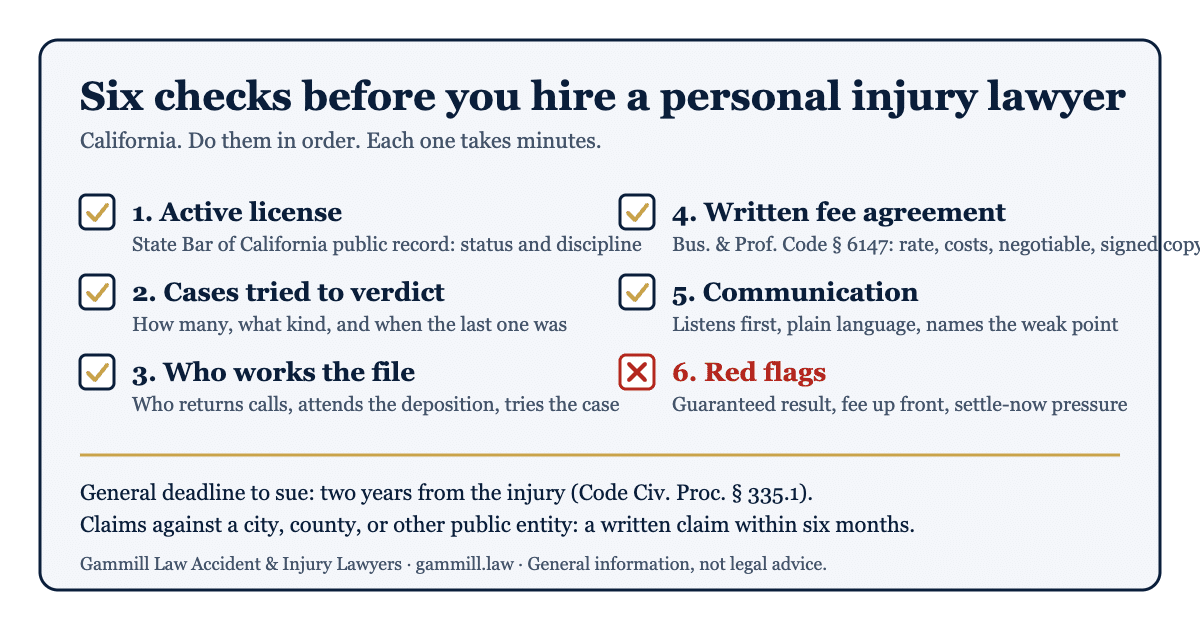
Time matters here. The California statute of limitations gives you two years from the date of the accident to file a personal injury lawsuit. Miss that deadline and your case is over, regardless of how strong it would have been.
If settlement still isn’t possible, the case goes to trial. Roughly 5% of personal injury cases reach this stage. Trial means jury selection, opening statements, witness testimony, expert testimony, cross-examination, closing arguments, and a jury verdict.
This is where trial experience matters. Lawyers who never actually try cases get worse settlement offers throughout the process because insurers know they’re unlikely to follow through. The firms that consistently produce the highest settlements are the ones insurers know will take a case all the way.
A few myths worth clearing up.
Your lawyer doesn’t pay for your treatment. They may help arrange medical care on a lien basis (where the doctor agrees to wait for payment until settlement), but the bills remain your responsibility until the case resolves.
Personal injury law and traffic law are different practices. If you got a citation for the accident, you’ll typically need a separate traffic attorney, though your injury lawyer can sometimes refer you to one.
A lawyer can recover money. They can’t undo your injury, replace lost time, or fix the emotional toll of a serious crash. The settlement is meant to compensate, not erase. That’s worth keeping in mind when expectations are forming.
| Ready to Talk to a Lawyer?
If you’ve been in a car accident and aren’t sure what to do next, a free consultation costs you nothing and tells you whether your case is worth pursuing. Contact Gammill Law’s personal injury attorneys for a free, no-obligation case review. |
Almost every personal injury attorney works on contingency, meaning they’re paid a percentage of the settlement only if they win. No win, no fee. Out-of-pocket costs are zero.
Typical contingency rates in California:
Beyond the percentage fee, there are case costs (filing fees, expert witnesses, deposition transcripts) which a reputable firm fronts and recovers from the settlement only if they win.
Nothing. Almost all personal injury attorneys work on contingency, so you pay nothing out of pocket. The fee comes out of any eventual settlement. If they don’t recover anything, you don’t owe them a fee.
Simple injury cases can resolve in a few months. Cases involving significant injuries usually take 6 to 18 months because you need to complete medical treatment before the value can be calculated. Litigated cases can take longer.
Probably not. Roughly 95% of personal injury cases settle without ever going to trial. Even cases where a lawsuit is filed usually settle during discovery.
California uses pure comparative negligence, meaning you can still recover damages even if you’re partially at fault. Your award is just reduced by your percentage of fault. Even at 90% fault, you can still recover 10%.
It depends on what “minor” means. If you walked away with no medical treatment and only cosmetic damage to your car, you probably don’t need representation. If you’ve had even a few medical visits, lost a day or two of work, or are dealing with ongoing pain, talking to a lawyer is usually worthwhile. Most personal injury attorneys offer free consultations specifically so people can find out without committing.
If you carry uninsured/underinsured motorist coverage, your own policy steps in. Otherwise, you may need to sue the at-fault driver personally, which often produces limited practical recovery if they don’t have assets. A lawyer can help you understand your options.
A car accident lawyer doesn’t just “handle paperwork.” They investigate, document, calculate, negotiate, and litigate, all while shielding you from insurer tactics that would otherwise reduce or deny your claim.
On a serious injury case, that work typically produces a meaningfully higher recovery than going it alone, even after the contingency fee. On a minor case, the math sometimes favors handling it yourself, and an honest lawyer will tell you so.
Either way, the free consultation is the fastest way to know which side of that line your case falls on.